Translate English to English: The Complete Old English Translator Guide
When you translate english to english across time — from Old English to Shakespearean to Modern — you are not studying a foreign language. You are tracing the evolution of every word you speak today. This guide covers the full journey: history, pronunciation, Shakespearean phrases, Anglo-Saxon speech, translation tables, and a direct link to our free online translation tool at partnerhoursguide.com/translator-old-english-tool/
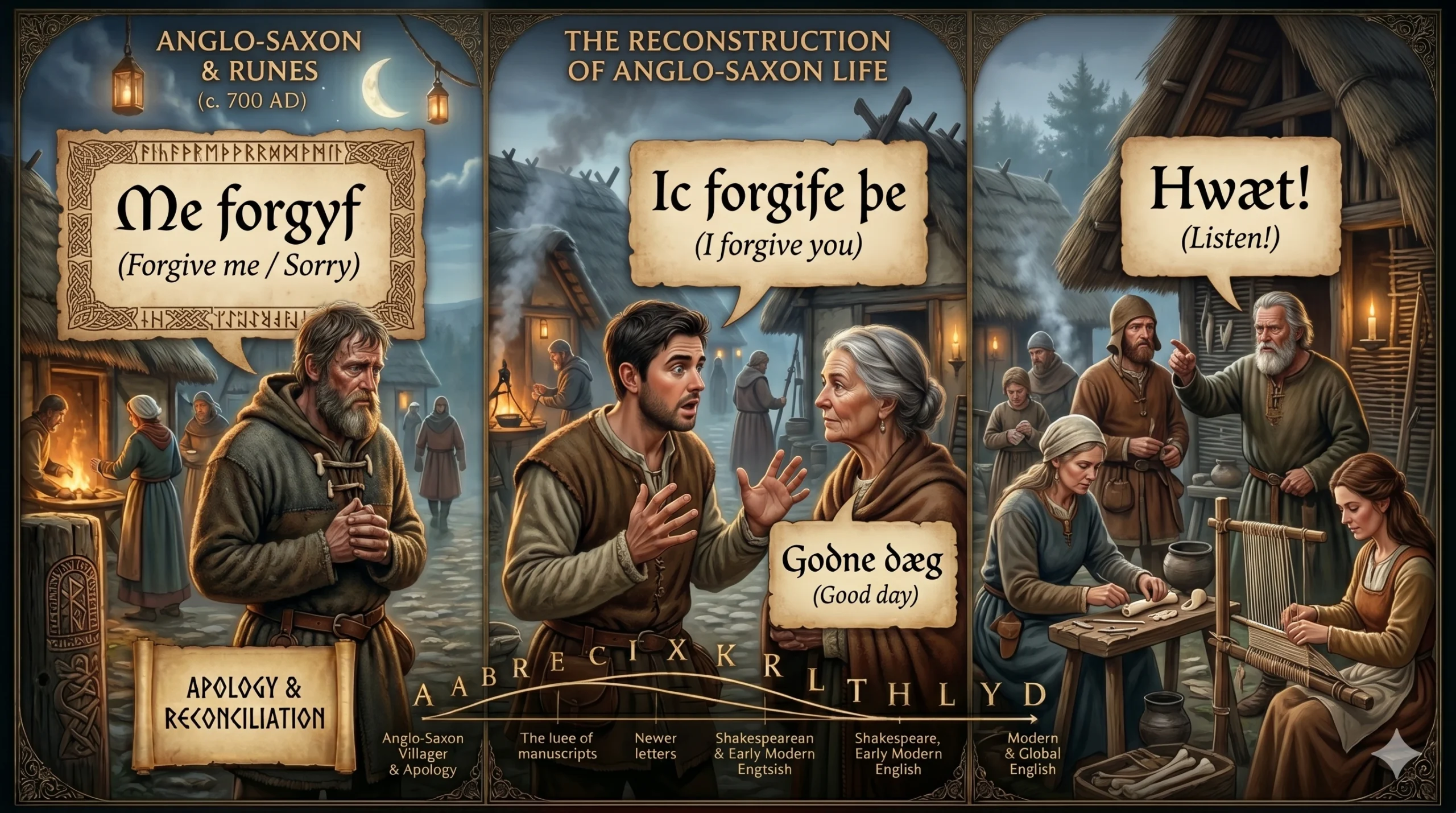
Imagine picking up a book written in English — but understanding nothing. Not one word. That is exactly what happens when you read Beowulf in its original form. Written around 700–1000 AD, this epic poem opens with:
“Hwæt! We Gardena in geardagum, þeodcyninga, þrym gefrunon.”
— Beowulf, ~700 AD (Old English)
The translation? “Listen! We have heard of the glory of the Spear-Danes’ kings in days of yore.”
This is the language our ancestors spoke — and it is nothing like what you are reading right now. It is Old English: raw, powerful, and utterly foreign to modern eyes.
Today, millions of people search for ways to translate english to english across centuries — for tattoos, creative projects, history essays, or pure curiosity. This guide walks you through what Old English actually was, how it differs from Shakespearean English, what the Anglo-Saxons sounded like, and how you can translate any text into Old English instantly.
Translate English to English: Old English vs Shakespearean English
Here is where most people get confused — and understandably so. When someone says ‘Old English,’ they often picture Shakespeare’s language: thee, thou, doth, forsooth. But Shakespearean English is not Old English at all. They are separated by roughly 500 years and a Norman invasion.
Shakespeare wrote in Early Modern English, spoken from about 1450 to 1700 AD. Old English — sometimes called Anglo-Saxon — was spoken from 450 to 1150 AD. The two are as different from each other as English is from Dutch today.
The Evolution of English: A Brief Timeline
| Era | Period | What Happened |
|---|---|---|
| Old English Arrives | 450 AD | Germanic tribes — Angles, Saxons, Jutes — bring their language to Britain. Sounds closer to German than modern English. (You can view some of the oldest surviving records at the British Library Anglo-Saxon Manuscripts collection). |
| Norman Conquest | 1066 AD | William the Conqueror invades. Over 10,000 French words flood into English — government, justice, beauty. |
| Middle English | 1150 AD | Chaucer writes The Canterbury Tales (~1400 AD). Still difficult, but recognizable fragments appear. |
| Shakespearean English | 1590 AD | Early Modern English — what most people call ‘Old English’ by mistake. Thee, thou, hath, dost are hallmarks. |
| Modern English | 1755 AD | Samuel Johnson’s Dictionary standardizes the language into the form we recognize today. |
Try the Free Translator Tool
Experience the true sound of Anglo-Saxon instantly. Convert modern English into authentic Old English.
Try the Free Translator ToolSide-by-Side Comparison
| Modern English | Old English (Anglo-Saxon) | Shakespearean (Early Modern) |
|---|---|---|
| Hello, how are you? | Hāl, hū eart þū? | Good morrow! How dost thou fare? |
| I love you | Ic lufie þē | I do love thee |
| I am sorry | Ic eom sārig | I prithee, forgive me |
| I forgive you | Ic forgife þē | I do thee pardon |
| Good evening | Gōd ǣfen | Good e’en to thee |
| My friend | Mīn frēond | Mine own good friend |
| God bless you | God þē bletsige | God be with thee |
| Water | Wæter | Water (unchanged) |
Old English vs Modern English: How Different Are They?
The short answer: radically different. Old English had grammatical gender, complex noun cases, and a verbal structure more like Latin than anything spoken today. When the Norman French invaded in 1066, over half of Old English vocabulary was replaced or reshaped. If you use an old english translate search to verify your text, you will quickly notice how many words shifted from their original forms.
Yet roughly 60% of our most commonly used words come directly from Old English — including the, be, to, of, and, a, in, that, have, and it. The Norman invasion changed the vocabulary of learning and nobility; the Anglo-Saxon heart of the language survived. You can use our free old english translator tool to see the roots of any phrase.
Translate Words into Old English: Quick Reference
| Modern Word | Old English | Pronunciation | Root Language |
|---|---|---|---|
| House | Hūs | Hooze | Proto-Germanic |
| Earth / World | Eorðe / Middangeard | Ay-or-tha / Mid-dan-gay-ard | Germanic |
| King | Cyning | Koo-ning | Proto-Germanic |
| Man / Woman | Mann / Wīfmann | Mann / Weef-mann | Germanic |
| Night | Niht | Neecht (guttural h) | Germanic |
| Fire | Fȳr | Fear (long vowel) | Proto-Germanic |
| Victory / Glory | Sige / Wuldor | See-yeh / Wul-dor | Germanic |
| Battle / War | Beadu / Wīg | Bay-ah-doo / Weeg | Germanic |
| Son / Daughter | Sunu / Dohtor | Soo-noo / Dok-tor | Proto-Germanic |
| God / Gods | God / Godu | God / Go-doo | Proto-Germanic |
How Did Anglo-Saxons Speak? Audible Short Sentences
If you could step back into a 7th-century Anglo-Saxon village, you would hear a language that sounds unmistakably Germanic — closer to modern Dutch or Frisian than to anything spoken in Britain today. The rhythm is percussive, the consonants hard, the vowels long and open.
| Old English Phrase | Pronunciation | Meaning & Notes |
|---|---|---|
| “Hwæt!” | Hwat! (like “what” with aspiration) | Means “Listen!” or “Attention!” — the famous Beowulf opener. The Anglo-Saxon equivalent of clearing your throat before a story. |
| “Ic eom hāl.” | Itch ay-om haal | “I am well / I am whole.” The root of our word “hale” — as in “hale and hearty.” |
| “Gōdne morgen.” | Goad-nuh mor-gen | “Good morning.” Nearly identical to modern German — guten Morgen. The connection is direct. |
| “Micel þancas!” | Mitch-el than-kas | “Many thanks!” Micel means “much/great” — ancestor of Scottish “Mickle.” Þancas is the root of “thanks.” |
| “Hwā eart þū?” | Hwaa ay-art thoo | “Who are you?” The interrogative hwā becomes “who” in modern English — you can hear the link. |
| “Þis land is gōd.” | This land iss goad | “This land is good.” The letter Thorn (þ) makes a “th” sound — ancestor of every “th” in modern English. |
Notice the pattern? Old English is not gibberish — it is familiar in structure. Once you see that many basic words are simply older versions of today’s English, translating English to English across time becomes genuinely thrilling.
How Do You Say “Sorry” in Ancient English?
In Old English, “sorry” was “ic eom sārig” — literally meaning “I am sorrowful” or “I am full of sorrow.” The word sārig is the direct ancestor of our modern word sorry. But in Old English it carried far more weight. It did not mean a casual “oops” — it meant a genuine heaviness of heart.
| Era | How to Say Sorry | Literal Meaning |
|---|---|---|
| Old English (450–1150) | Ic eom sārig | I am sorrowful / full of grief |
| Middle English (1150–1450) | I am sory | Transitional form |
| Shakespearean (1450–1700) | I prithee, forgive me | I beg you, forgive me |
| Modern English | I’m sorry | — |
How Do You Say “I Forgive You” in Shakespearean Language?
Shakespeare himself answered this one. In The Tempest (Act 5, Scene 1), Prospero says: “I do forgive thee.” That is the cleanest form. But the Bard had other, richer options:
| Shakespearean Phrase | Modern Translation | Context |
|---|---|---|
| I do thee pardon | I forgive you | General Shakespearean usage |
| I do forgive thee | I forgive you | The Tempest, Act 5 Scene 1 |
| I grant thee pardon | I grant you forgiveness | Formal / royal context |
| Thou art forgiven | You are forgiven | Passive, declarative form |
| I hold no grudge | I bear you no ill will | Informal Elizabethan usage |
| Ic forgife þē | I forgive you | Old English — Anglo-Saxon, pre-Norman |
“The quality of mercy is not strained. It droppeth as the gentle rain from heaven upon the place beneath.”
— William Shakespeare, The Merchant of Venice (1596)
Which English Accent Is Hardest to Understand?
Old English is, without question, the hardest form of English for any modern speaker to understand. Among living accents, surveys of native English speakers and language researchers most frequently cite:
| Rank | Accent | Why It’s Difficult |
|---|---|---|
| 1 | Geordie (Newcastle, England) | Retains more Old Norse vocabulary than any other dialect |
| 2 | Scots English (Glaswegian) | Heavy influence from Scots Gaelic and Norse |
| 3 | Deep Rural West Country (Somerset/Devon) | Preserves features of Middle English |
| 4 | Broad Yorkshire | Strong vowel shift, Old Norse substrate words |
| 5 | Jamaican Patois / Creole | Creole structure with English vocabulary |
Geordie English is the dialect most linguistically connected to Old English. It preserves Old Norse vocabulary — bairn (child), gan (go), canny (clever/good) — lost in southern dialects after 1066. When a Geordie speaks, they are in a very real sense echoing the Anglo-Saxon world.
What Is the #1 Easiest Language to Learn?
The US Foreign Service Institute (FSI) — which trains diplomats — has studied this rigorously. For native English speakers, Norwegian requires only 575–600 classroom hours. Spanish, French, Portuguese, and Italian follow at 600–750 hours.
By contrast, the FSI classifies Old English as a Category III difficulty language for modern English speakers — comparable to Russian or Turkish — despite being the direct ancestor of today’s English. The Norman invasion scrambled the grammar so completely that you cannot simply learn a few rules and read Beowulf.
This is exactly why an online text translator tool is so valuable. Rather than spending months studying an extinct language form, you can use our free online translator at partnerhoursguide.com/translator-old-english-tool/ to render modern English into Old English instantly.
Why Translate English to English Still Matters Today
Here is a truth worth sitting with: when you say good morning, you are speaking words that have been in use for over 1,500 years. Gōdne morgen — the Anglo-Saxon phrase — predates the Norman Conquest, the Black Death, the printing press, and every political revolution in British history. Your daily greeting is older than England itself.
That is what makes this more than a linguistic exercise. The Anglo-Saxons were farmers, warriors, poets, and parents. They fell in love and said Ic lufie þē — I love you — to people who mattered to them. Their language did not die. It evolved. It survived a Norman invasion, a great vowel shift, and the spread of the British Empire. Today, it lives in every sentence you speak. You just need a translator to see it.
“Old English is not a dead language — it is the skeleton of a living one. Every time you say ‘the’ or ‘and’ or ‘is,’ you are speaking the same words an Anglo-Saxon farmer spoke over fields in 700 AD.”
Try the Free Old English Translator
Start translating your own words back into the age of kings, runes, and warriors.
Try the Free Old English Translator