Convert standard text into Morse code signals and translate dots/dashes back into readable prose. Experience authentic sounder playback, flash visual signals, and copy output instantly.
Before the digital era, telecommunication relied on simple pulses of electrical current sent across copper wires. Invented by Samuel Morse and Alfred Vail in the 1830s, the electromagnetic telegraph revolutionized human connectivity. Operators clicked mechanical keys that sent brief and sustained signals to sounders miles away.

Switch instantly between translating English text to dots and dashes, or converting code sequences back into clean prose with our reverse engine.
Hear your message played with high-accuracy timing using your browser's Web Audio API. Adjust the speed in Words Per Minute (WPM) and tone frequency.
A live glowing telegraph lamp blinks the exact rhythms of dots and dashes, perfect for maritime signaling practice and visual training.
Watch characters map as you type. No reload required, no remote servers hit. The entire application runs natively in your browser.
Engineered with styling and typography details that honor the golden age of telegraph keys, railways, and marine radio rooms.
Optimized for fast rendering, easy navigation, and accessibility standards for modern devices.
Morse code is not just a sequence of random symbols; it is a highly structured rhythmic language built upon a basic timing unit (usually defined by the duration of a single dot):
During the late 19th and early 20th centuries, naval vessels relied heavily on visual Morse signaling via carbon-arc lamps and shutters. This allowed ships to maintain radio silence while communicating across short distances at sea. Known as "flashing light" signaling, it remains an essential backup method for modern navies worldwide.
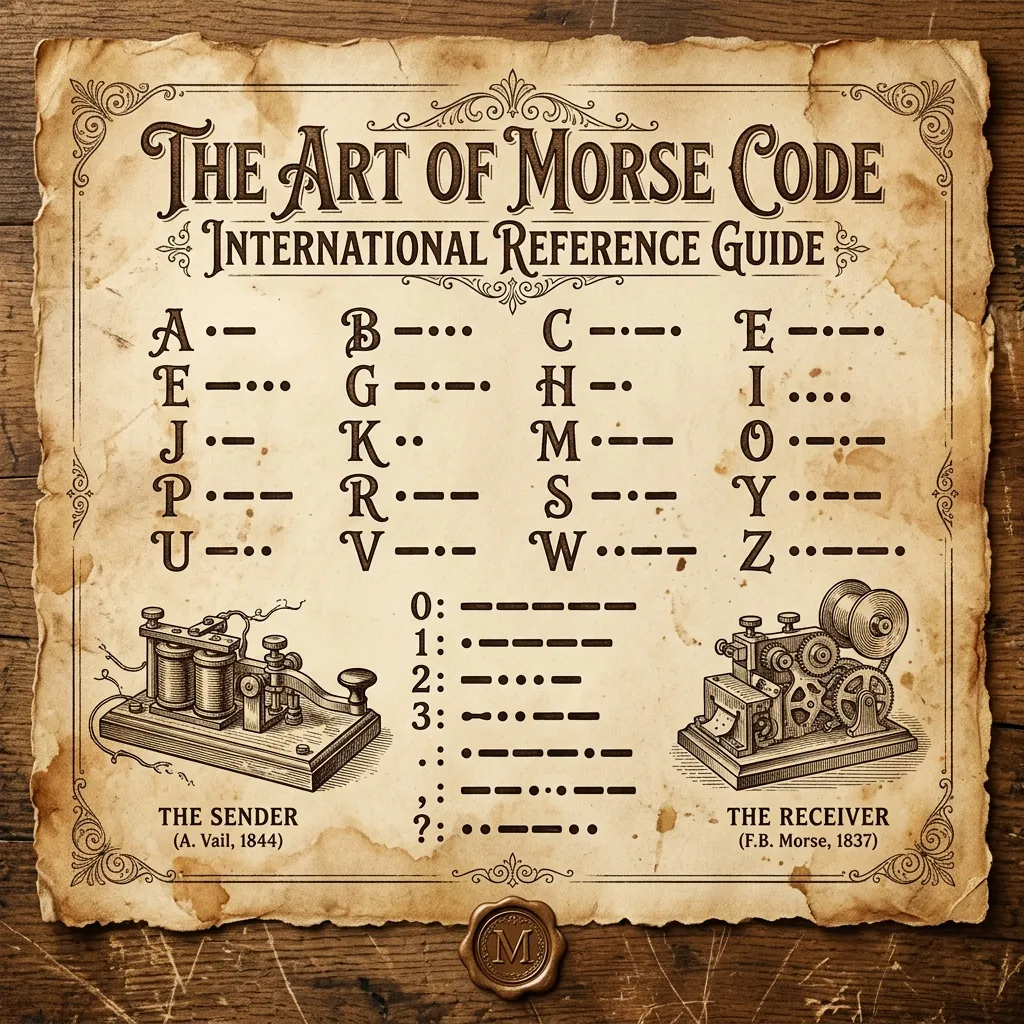
Use the lookup chart below to study individual letter and number assignments for International Morse Code.
A Morse code translator is a tool that converts plain text into Morse code, and converts Morse code back into text, usually instantly and in real time as you type or paste a message.
Type your text into the input box on this page. It converts every letter, number, and punctuation mark into Morse code instantly, with no sign-up, download, or payment required.
Yes. It uses your browser's audio engine to turn dots and dashes into real tones — short beeps for dots, longer beeps for dashes — at a speed and pitch you control.
A dot is a short signal; a dash is a signal three times as long as a dot. Different combinations of dots and dashes represent different letters, numbers, and symbols. For example, S is three dots and O is three dashes, which is why SOS is instantly recognizable.
Yes. SOS is always three dots, three dashes, three dots sent as one unbroken string with no gaps between the letters. It's the internationally recognized distress signal because it's simple to send and impossible to mistake for anything else.
Yes. Morse code has defined signals for all ten digits (0–9) and common punctuation like periods, commas, and question marks, in addition to the full alphabet.