Spanish Words in English: Translator, Meanings, History & Common Examples
Exploring the integration of spanish words in english reveals a rich linguistic tapestry shaped by geography, history, and cultural integration. Why do Americans learn Spanish in such record numbers? As the second most widely spoken language in the United States, Spanish has migrated past classrooms and border states, cementing itself directly inside modern English dictionaries. From the southwest ranches of the 19th century to today’s food, media, and business landscape, bilingual communication is no longer a localized convenience—it is a vital cultural bridge that shapes American vocabulary every single day.
Free Spanish to English Translator
Direct Answer
Our free Spanish to English translator provides instant translation, pronunciation metrics, and exact vocabulary meanings for common Spanish words and phrases, running entirely inside your browser without any delay.
Our interactive translator allows you to convert text back and forth between Spanish and English instantly. Designed with high-performance client-side logic, it offers real-time conversions, voice pronunciation, copy-to-clipboard options, and text download capabilities.
This translation engine uses a comprehensive database to parse terms instantly. It is ideal for students wishing to expand their daily vocabulary, travelers drafting emails, and language analysts mapping the migration of loanwords. Because it loads entirely in the browser, your data stays private and compiles instantly.
English to Spanish Translator
Direct Answer
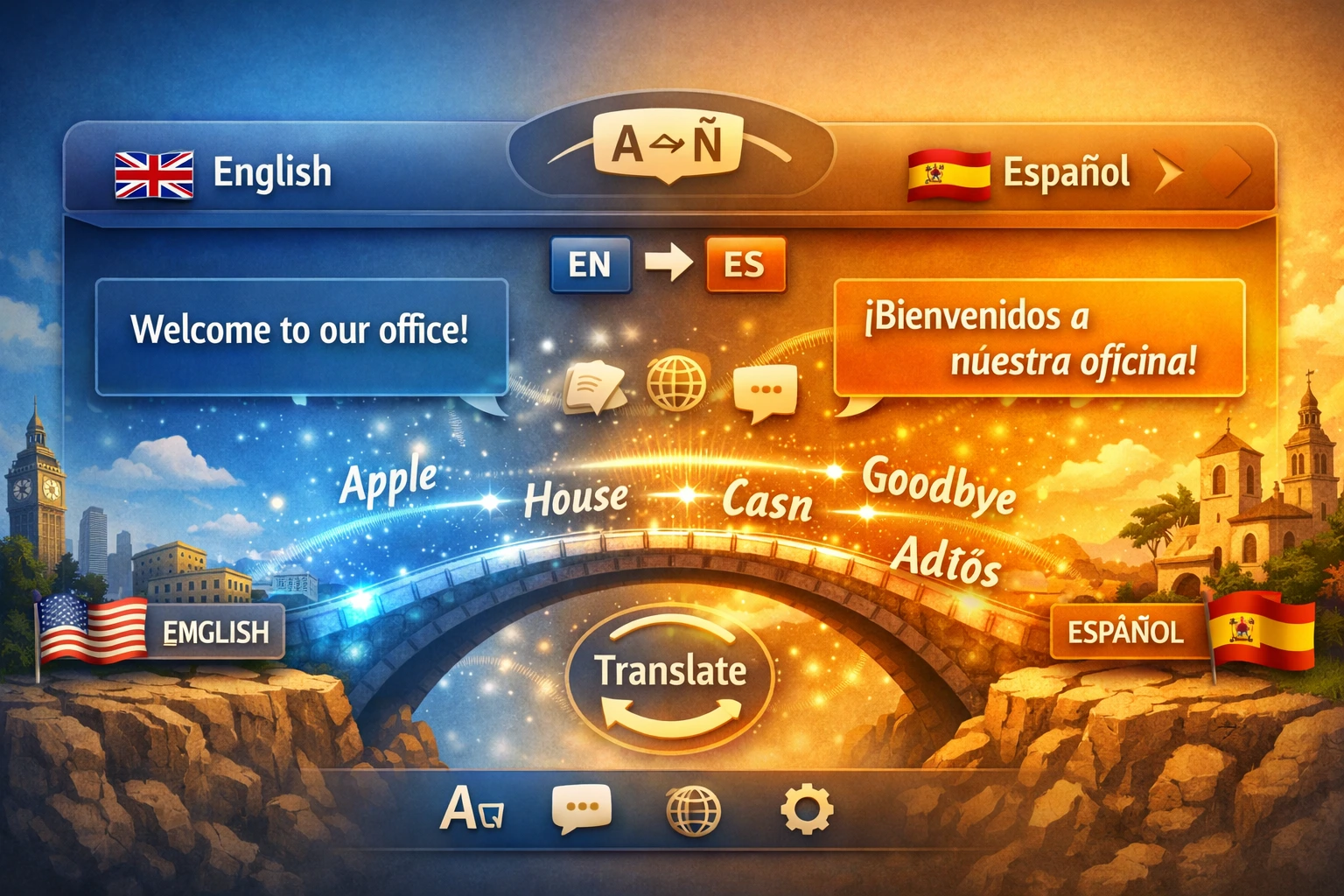
Converting English into Spanish helps bridge linguistic gaps in commerce, travel, and public service. By switching the translation mode, users can quickly find verb alignments, gender configurations, and proper nouns in Spanish.
Translating from English into Spanish requires special attention to verb tables, adjective gender matches, and structural rules. In modern fields like travel, business, education, and daily communication, maintaining direct alignments prevents misunderstandings. For example, business agreements rely on clear, professional registers, whereas daily conversations utilize colloquial patterns.
Our two-way tab above allows you to quickly swap modes and translate complex sentences directly into clear Spanish. Simply select the tab “English → Spanish,” type your phrase, and review the instant conjugations.
History of the Spanish Language
Direct Answer
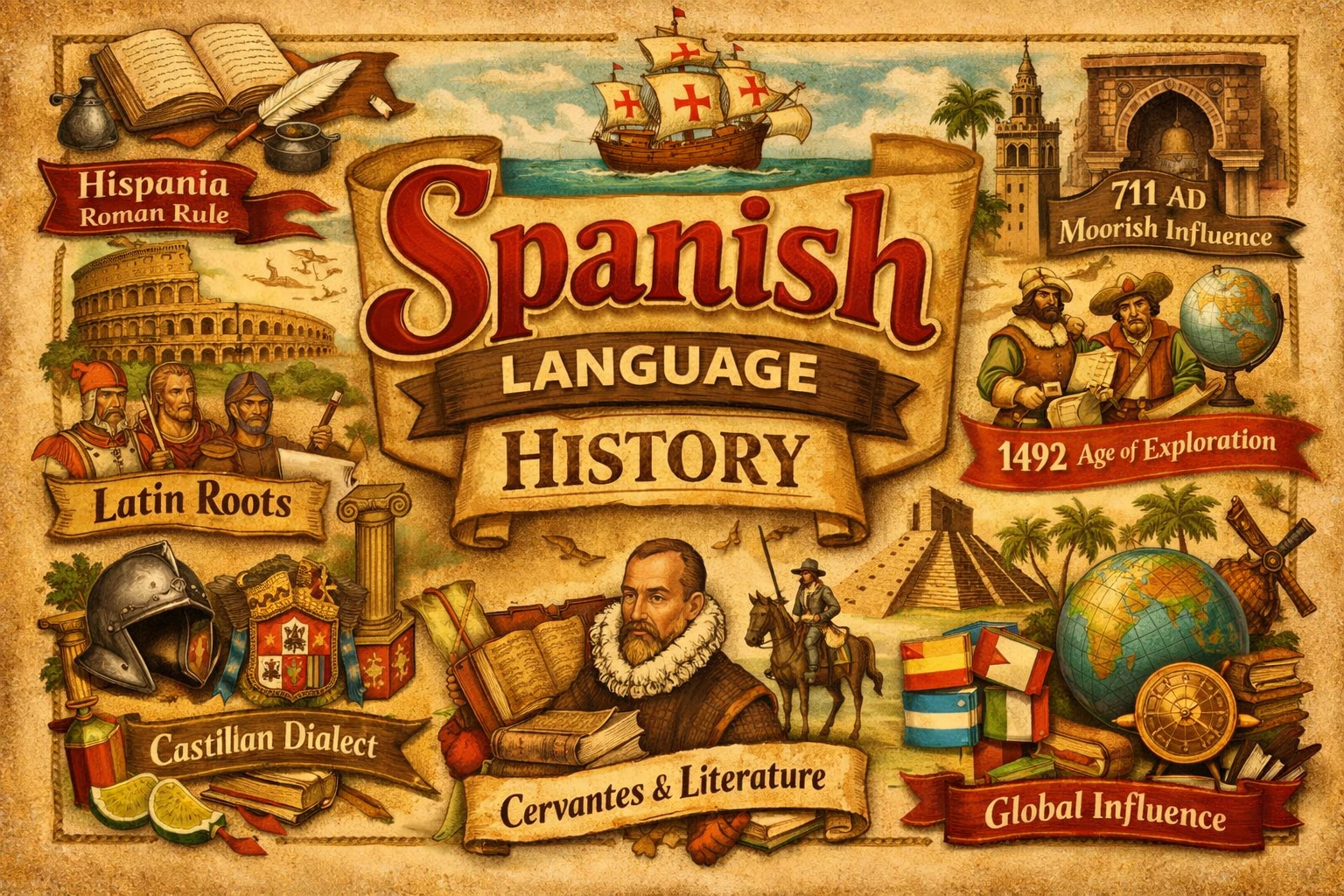
Spanish evolved from Vulgar Latin spoken in the Iberian Peninsula during the Roman Empire, later incorporating substantial Arabic, Basque, and Indigenous American elements to become a global tongue spoken across 20+ countries.
The history of Spanish is a journey of empire, migration, and linguistic convergence. Originally arriving on the Iberian Peninsula as Vulgar Latin carried by Roman soldiers, the language underwent massive transformations. Following the fall of Rome, Germanic tribes and later Arabic-speaking Moors left lasting imprints on Castilian Spanish. In fact, over 4,000 modern Spanish words are directly derived from Arabic roots.
During the Age of Discovery in the 15th and 16th centuries, Spanish spread rapidly across the Americas, converging with indigenous languages like Nahuatl and Quechua. Today, Spanish is the official language of 20 countries, including Mexico, Colombia, Spain, Argentina, Peru, Venezuela, Chile, Ecuador, and Cuba, creating a diverse global community of speakers.
Is English Derived From Spanish?
Direct Answer
No, English is not derived from Spanish. English is a West Germanic language, while Spanish is a Romance language derived from Latin. However, both share thousands of cognates due to Latin’s heavy historical influence on both language branches.
It is a common misconception that English and Spanish are direct sister languages. They belong to different branches of the Indo-European language family. English originated from Germanic dialects spoken by Angles, Saxons, and Jutes, while Spanish emerged directly from Latin. Despite this separation, English has imported thousands of Spanish loanwords throughout history, alongside historical Latin terms introduced through Norman French after the Conquest of 1066.
Why Are Spanish Words Used In English?
Direct Answer
Spanish words are used in English due to centuries of geographical proximity, territorial integration (especially in the American Southwest), cultural exchange, culinary trends, and the continuous growth of the Hispanic population in North America.
Geographic proximity and shared borders between the United States and Mexico have facilitated deep cultural exchanges. Over centuries, words describing culinary items (taco, salsa, cafeteria), geographical features (canyon, mesa, sierra), and weather events (tornado, hurricane) moved naturally into everyday English. Today, global media, music, movies, and international commerce continue to fuel this linguistic blending.
Top 100 Most Used Spanish Words
Here are the most searched and frequently used Spanish words, presenting their direct translations for quick study:
| Spanish Word | English Translation | Spanish Word | English Translation |
|---|---|---|---|
| Hola | Hello | Amigo | Friend |
| Gracias | Thank you | Por favor | Please |
| Adiós | Goodbye | Sí | Yes |
| No | No | Buenos días | Good morning |
| Buenas noches | Good night | ¿Cómo estás? | How are you? |
| Bien | Well / Good | Amor | Love |
| Familia | Family | Casa | House |
| Perro | Dog | Gato | Cat |
| Comida | Food | Agua | Water |
| Dinero | Money | Tiempo | Time / Weather |
| Trabajo | Work / Job | Escuela | School |
| Libro | Book | Calle | Street |
| Ciudad | City | País | Country |
| Vida | Life | Muerte | Death |
| Feliz | Happy | Triste | Sad |
| Grande | Big | Pequeño | Small |
| Caliente | Hot | Frío | Cold |
| Hermoso | Beautiful | Fácil | Easy |
| Difícil | Difficult | Nuevo | New |
| Viejo | Old | Joven | Young |
| Hijo | Son | Hija | Daughter |
| Madre | Mother | Padre | Father |
| Hermano | Brother | Hermana | Sister |
| Mañana | Tomorrow / Morning | Hoy | Today |
| Ayer | Yesterday | Hora | Hour |
| Semana | Week | Año | Year |
| Verano | Summer | Invierno | Winter |
| Música | Music | Película | Movie |
| Coche | Car | Bicicleta | Bicycle |
| Mesa | Table | Silla | Chair |
| Puerta | Door | Ventana | Window |
| Cuerpo | Body | Mano | Hand |
| Cabeza | Head | Pie | Foot |
| Sol | Sun | Luna | Moon |
| Estrella | Star | Flor | Flower |
| Árbol | Tree | Mar | Sea |
| Río | River | Tierra | Earth / Land |
| Fuego | Fire | Viento | Wind |
| Cielo | Sky / Heaven | Nube | Cloud |
| Luz | Light | Noche | Night |
| Tarde | Afternoon / Late | Verdad | Truth |
| Mentira | Lie | Paz | Peace |
| Guerra | War | Fuerza | Strength |
| Suave | Soft | Duro | Hard |
| Rápido | Fast | Lento | Slow |
| Alto | Tall / High | Bajo | Short / Low |
| Rico | Rich / Tasty | Pobre | Poor |
| Siempre | Always | Nunca | Never |
| Todo | All / Everything | Nada | Nothing |
| Con | With | Sin | Without |
Hard Spanish Words In English
Some Spanish words are notorious tongue-twisters or grammatical challenges for English speakers. Here are key examples:
- Desarrollador (de-sah-rro-yah-dor): Means *Developer*. Example: “El desarrollador escribe código limpio.”
- Ferrocarril (fe-rro-cah-rreel): Means *Railway*. Requires rolling the ‘rr’ sound. Example: “El ferrocarril cruza las montañas.”
- Paralelepípedo (pah-rah-leh-leh-pee-peh-doh): Means *Parallelepiped* (a 3D geometrical shape). Example: “La caja tiene forma de paralelepípedo.”
- Otorrinolaringólogo (oh-toh-rree-noh-lah-reen-goh-loh-goh): Means *Otorhinolaryngologist* (ENT Doctor). Example: “Tengo una cita con el otorrinolaringólogo.”
Spanish Words Americans Use Every Day
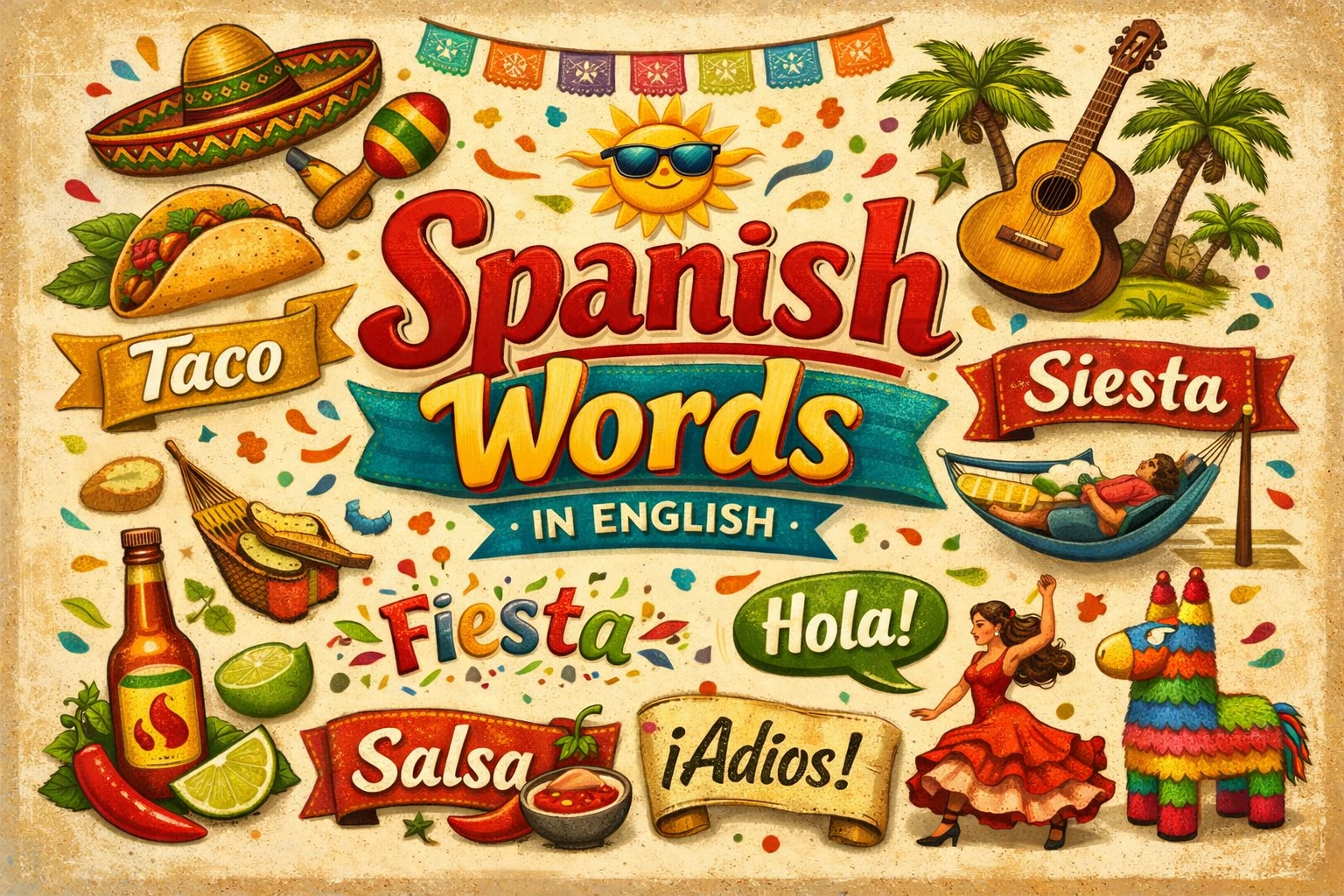
Many Spanish words have integrated so completely into American English that their foreign origins are rarely noticed. Examples include:
- Hola, Adios, Gracias: Standard greetings and expressions of gratitude.
- Fiesta: Used in English to mean a grand party or festival.
- Patio: Originally a Spanish term for an inner courtyard, now referring to any outdoor paved area.
- Plaza: A public square or shopping center.
- Ranch (Rancho): A large farm for raising livestock.
- Mosquito: Literally meaning “little fly” in Spanish.
- Tornado: Derived from the Spanish word *tronada* (thunderstorm) and *tornar* (to turn).
Famous Americans Who Speak Spanish
Numerous high-profile American celebrities have mastered Spanish, frequently showcasing their bilingualism during media events:
- Jennifer Lopez & Eva Longoria: Both grew up in bilingual households, utilizing Spanish to connect with their heritage and expand their career opportunities.
- Ben Affleck: Learned Spanish fluently while living in Mexico during his teenage years.
- Will Smith: Dedicated years to studying Spanish to communicate directly with global fans.
- Gwyneth Paltrow: Spent a high school exchange semester in Spain, becoming highly conversational in the language.
Spanish vs English Vocabulary Comparison
Comparing these two systems reveals several core architectural and pronunciation contrasts:
| Feature | Spanish Language | English Language |
|---|---|---|
| Sentence Structure | Subject-Verb-Object (more flexible, allows adjective after noun) | Subject-Verb-Object (strict, adjective before noun) |
| Pronunciation | Phonetically consistent (words are spoken exactly as written) | Irregular pronunciation rules and silent letters |
| Nouns & Genders | Masculine or feminine classification for all nouns | Neutral nouns without grammatical genders |
| Learning Difficulty | Easy phonetic foundation, complex verb conjugations | Easy verb structures, highly complex pronunciation rules |
Benefits Of Learning Spanish
Becoming bilingual offers substantial life, professional, and cognitive dividends:
- Career Opportunities: Bilingual candidates are in high demand in fields like medicine, customer service, law, international trade, and education.
- Global Travel: Enables immersive experiences across Spain, Central America, and South America.
- Cognitive Strength: Studies indicate that bilingualism enhances multitasking ability, delay of cognitive decline, and improved problem-solving skills.
1000 Common Spanish Words Database
Explore our paginated list of 1000 common Spanish words, their English meanings, and contextual example sentences. Use the search box below to filter immediately.
| Spanish Word | English Meaning | Example Sentence |
|---|
Frequently Asked Questions
Conclusion
In summary, integrating Spanish vocabulary within English highlights a historical process of cultural, political, and social alignment. Whether you are using this language for professional opportunities, travel adventures, or academic studies, a solid bilingual vocabulary unlocks doors across the globe. Use the free Spanish Words in English Translator to translate, learn, and expand your vocabulary today.