Anglo-Saxon · Linguistics · History
The Complete Old English Alphabet: History, Letters, Pronunciation & Manuscripts
Introduction: What Is the Old English Alphabet?
The old English alphabet is both familiar and alien. It shares most of its characters with the Latin script you are reading now, yet it contains letters that have vanished from modern keyboards and sounds that have no direct equivalent in contemporary English. Understanding this writing system means stepping into Anglo-Saxon England — a world of monasteries, warrior poetry, royal lawcodes, and the slow transformation of a Germanic dialect into the world language English would one day become.
Old English, also called Anglo-Saxon, was the language spoken and written in Britain from roughly the mid-5th century CE to the mid-11th century. It is not “Shakespearean English” — Shakespeare wrote in Early Modern English, which is far closer to what you are reading now. Old English is a genuinely different historical stage of the language, as distinct from Modern English as Latin is from Italian.
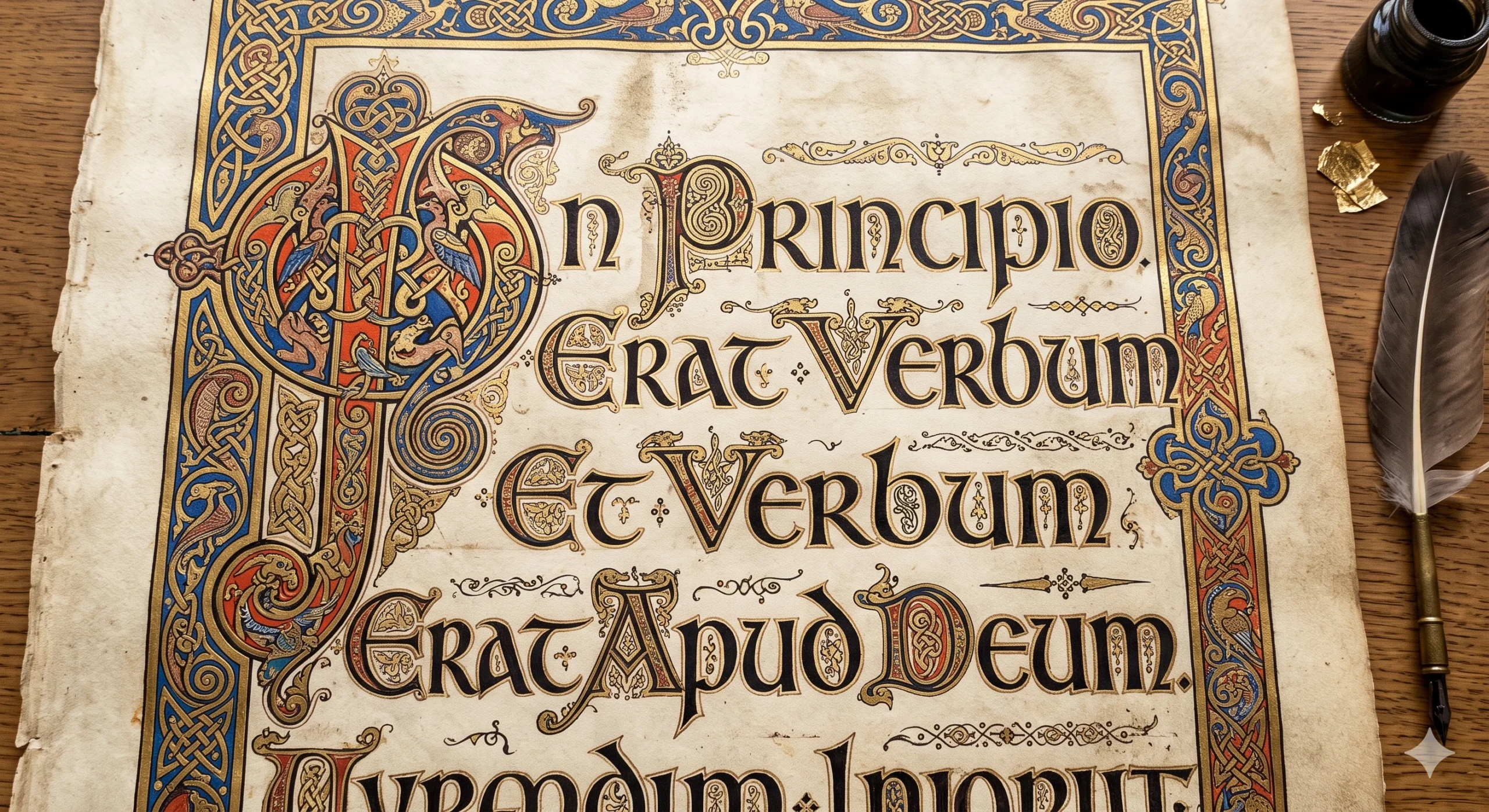
The language looks unusual because Anglo-Saxon scribes used a Latin-based alphabet augmented by special characters — some borrowed from the runic writing tradition, some adapted from insular manuscript practice — to represent sounds the standard Latin letters could not capture cleanly. Christian literacy, Irish and Roman missionary activity, and a thriving manuscript culture transformed English writing over time. After the Norman Conquest of 1066, continental scribal habits pushed spellings toward forms that look more familiar to modern readers, gradually retiring the special Old English characters.
The British Library holds the largest collection of Anglo-Saxon manuscripts in the world. Its Beowulf manuscript — the sole surviving copy of the most famous Old English poem — is one of the most studied documents in the history of the English language.
Historical Timeline of the Old English Alphabet
The writing system did not appear fully formed. It evolved over six centuries, shaped by religion, conquest, scholarship, and the practicalities of scribal work.
The Complete Old English Alphabet
The Old English alphabet is generally presented as a 24-letter system in modern scholarly editions, though the exact inventory varies by manuscript, scribe, and editorial convention. The core Latin letters are augmented by four special characters. Some letters — particularly k and z — appear only rarely or mainly in borrowed words.
| Letter | Name | IPA Value | Modern Equivalent | Notes |
|---|---|---|---|---|
| A a | a | /a/ or /ɑ/ | a | Core native vowel; length distinction matters |
| Æ æ | æsc (ash) | /æ/ | a in cat | Distinctive Old English vowel letter; preserved in all scholarly editions |
| B b | beorc | /b/ | b | Stable; close to modern value |
| C c | cen | /k/ or /tʃ/ | k / ch | Context-sensitive; front vowels may trigger affricate value |
| D d | dæg | /d/ | d | Generally stable across the period |
| Ð ð | eth | /ð/ or /θ/ | th | Used interchangeably with thorn by most scribes |
| E e | eh | /e/ or /ɛ/ | e | Short/long distinction changes word meaning |
| F f | feoh | /f/ or /v/ | f / v | Voiced between vowels; same letter, two phonetic values |
| G g | gyfu | /g/, /ɣ/, or /j/ | g / y | One of the most variable letters; context is everything |
| H h | hægl | /h/ or /x/ | h | Could have fricative value in clusters |
| I i | is | /i/ or /ɪ/ | i | High front vowel; long/short contrast matters |
| K k | calc | /k/ | k | Rare until late Old English; mostly replaces C before e/i in later texts |
| L l | lagu | /l/ | l | Stable; shows continuity across the centuries |
| M m | mann | /m/ | m | Stable; common in inflectional endings |
| N n | nyd | /n/ | n | Stable; very frequent in grammatical endings |
| O o | ōs | /o/ or /ɔ/ | o | Length distinction changes meaning |
| P p | peorð | /p/ | p | Stable; part of the Latin-inherited layer |
| R r | rād | /r/ | r | Likely trilled or tapped; do not read with modern accent values |
| S s | sigel | /s/ or /z/ | s | Context-sensitive voicing between vowels |
| T t | tīr | /t/ | t | Stable; useful anchor for readers |
| Þ þ | þorn (thorn) | /θ/ or /ð/ | th | Runic-derived; the most iconic Old English letter |
| U u | ūr | /u/ or /ʊ/ | u | Participates in sound shifts to Middle English spelling |
| Ƿ ƿ | ƿynn (wynn) | /w/ | w | Runic-derived; replaced by w in print tradition |
| X x | — | /ks/ | x | Mostly in borrowed/learned words; not a core native letter |
| Y y | yr | /y/ | (none exact) | Front rounded vowel; not the modern ‘y’ sound |
| Z z | — | /ts/ | z | Rare; mainly in biblical names and foreign borrowings |
The letter K was little used in Old English until late in the Anglo-Saxon period. For most of the Old English era, the letter C did the work of modern K, which is why you often see spellings like cyning (king) rather than kyning in older manuscripts.
The Four Special Letters of the Old English Alphabet
The four additions to the Latin alphabet are the heart of what makes the old English alphabet distinctive. Each one was invented or adapted to solve a specific phonological problem — to represent a sound that Latin letters simply could not capture accurately.
“Ye Olde Shoppe” is not Old English. The “Y” in “Ye” is not a letter choice — it is a printing error. When thorn (þ) was used as an abbreviation for “the,” later printers who lacked the thorn character in their type sets substituted the visually similar letter “y.” The word was always pronounced “the,” never “ye.” This mistake has been repeated for centuries and still appears in novelty shop signs today.
Old English Alphabet Pronunciation Guide
Old English pronunciation must be approached through IPA rather than through modern English spelling intuition. The same letter can represent different sounds in different environments, and vowel length — marked with a macron (ā, ē, ī, ō, ū) in modern editions but not always in original manuscripts — can change a word’s meaning entirely.
Vowel Pronunciation
| Letter | Short Value | Long Value | Modern Comparison |
|---|---|---|---|
| A a | /a/ | /aː/ | Short: “a” in father (short); Long: “a” in father (extended) |
| Æ æ | /æ/ | /æː/ | Short: “a” in cat; Long: extended same sound |
| E e | /e/ | /eː/ | Short: “e” in bed; Long: “ay” in day |
| I i | /ɪ/ | /iː/ | Short: “i” in bit; Long: “ee” in see |
| O o | /o/ | /oː/ | Short: “o” in pot; Long: “o” in bone |
| U u | /ʊ/ | /uː/ | Short: “u” in put; Long: “oo” in food |
| Y y | /y/ | /yː/ | Front rounded vowel — no direct modern English equivalent. Similar to French u or German ü. |
Consonant Pronunciation Rules
| Letter | Environment | Sound | Example |
|---|---|---|---|
| C c | Before a, o, u, consonants | /k/ | cuman (come) = /ˈkuman/ |
| C c | Before e, i, æ | /tʃ/ | cild (child) = /tʃild/ |
| F f | Between voiced sounds | /v/ | ofer (over) = /ˈover/ |
| F f | Word-initial or final | /f/ | fæder (father) = /ˈfæder/ |
| G g | Word-initial before back vowels | /g/ | gōd (good) = /goːd/ |
| G g | Between vowels or after front vowels | /ɣ/ or /j/ | dæg (day) = /dæj/ |
| H h | Word-initial | /h/ | hūs (house) = /huːs/ |
| H h | After vowels in clusters | /x/ | niht (night) = /nixt/ |
| S s | Between voiced sounds | /z/ | rīsan (rise) = /ˈriːzan/ |
| Þ/Ð | All positions | /θ/ or /ð/ | þe (the), oðer (other) |
Old English stress typically falls on the first syllable of the root of native words — so lǣran (to teach) is stressed on lǣr-. Prefixes and inflectional endings are unstressed. This pattern is one reason Old English poetry could use alliteration so effectively: the stressed syllables were predictable.
Diphthongs in Old English
Old English had several diphthongs — combinations of two vowel sounds within a single syllable — that do not survive in Modern English. These include ea, eo, ie, and their long equivalents. Diphthongs are often the trickiest part of Old English pronunciation for modern readers because they look like two separate vowels but function as one unit.
| Diphthong | Approx. Value | Example | Modern Descendant |
|---|---|---|---|
| EA ea | /æɑ/ | eald (old) | old |
| EO eo | /eo/ | eorl (nobleman) | earl |
| IE ie | /ie/ | field (field) | field |
Old English Manuscripts: The Evidence Base
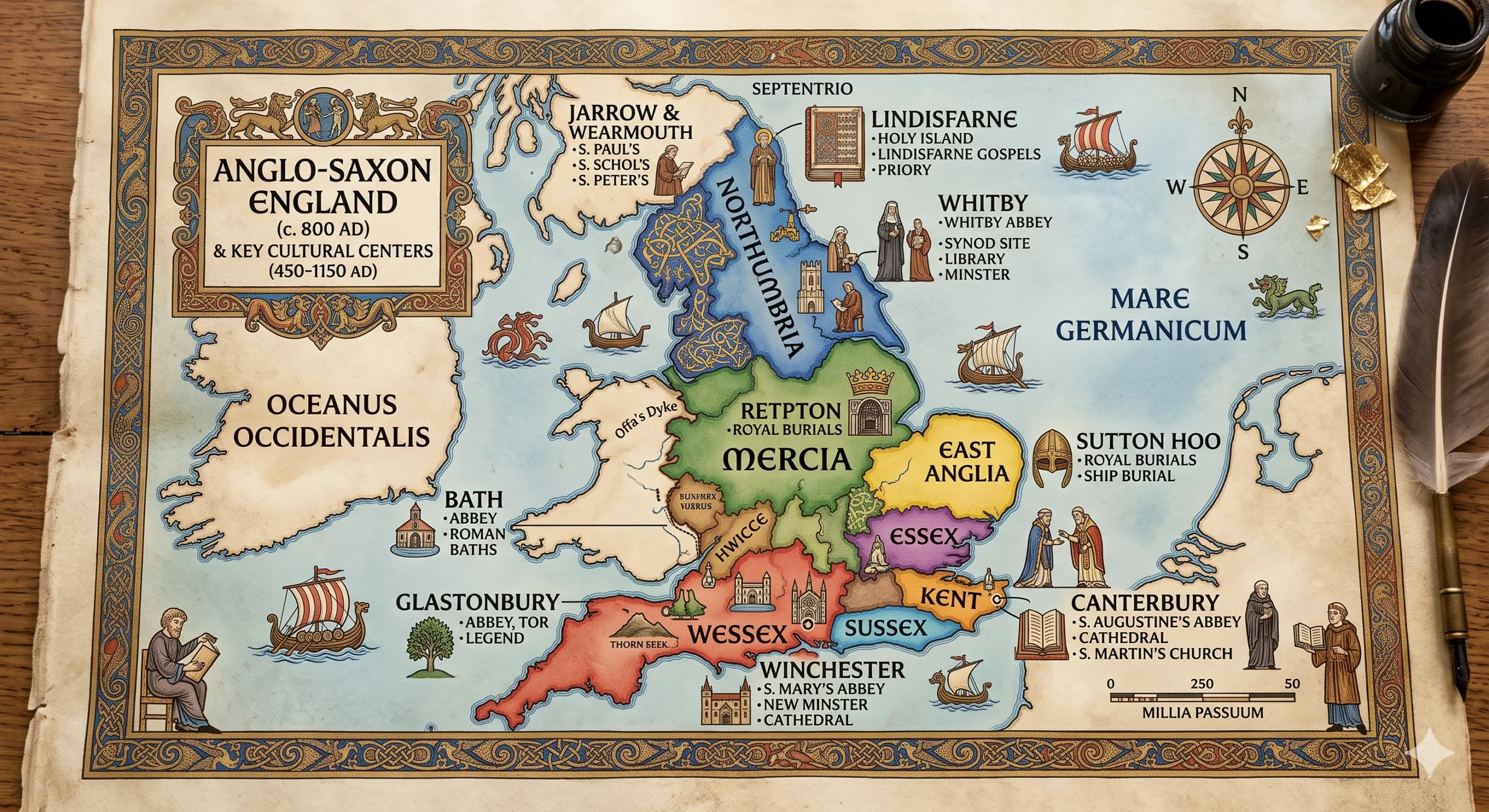
Everything we know about the old English alphabet comes from physical manuscripts. The letters, their shapes, their relative frequency, and their phonetic values are all reconstructed from texts written by scribes working in monasteries, royal courts, and cathedral schools across Anglo-Saxon England.
The Five Major Old English Manuscripts
The British Library notes an important distinction: the oldest English writing (short runic inscriptions, early marginal notes) is different from the oldest substantial English literary texts. The Ruthwell Cross inscription predates the great poetic codices by centuries; the Exeter Book preserves the greatest volume of poetry.
| Manuscript | Date | Location | Significance |
|---|---|---|---|
| Beowulf manuscript (Cotton Vitellius A. xv) | c. 1000 CE | British Library, London | Sole copy of Beowulf (3,182 lines); most studied Old English poem; defines the heroic tradition |
| Exeter Book (Codex Exoniensis) | c. 970 CE | Exeter Cathedral Library | Largest surviving collection of Old English poetry; includes elegies, riddles, and the Wanderer |
| Junius Manuscript (Oxford, Bodleian MS Junius 11) | c. 1000 CE | Bodleian Library, Oxford | Major collection of biblical Old English poetry including Genesis A & B |
| Vercelli Book (Codex Vercellensis) | c. 950–1000 CE | Cathedral Library, Vercelli, Italy | Contains the Dream of the Rood (the oldest known Old English poem with named subject) and prose homilies |
| Anglo-Saxon Chronicle | c. 890–1154 CE | Multiple copies; British Library & others | Continuous historical record from the 9th century; essential for dating events and language change |
Scribal Practice and Variation
Old English spelling was not standardized the way Modern English spelling is. Individual scribes made choices based on their dialect, their training, the conventions of their scriptorium, and their own personal habits. The same word could be spelled differently by scribes working a generation apart or even within the same scriptorium.
Cambridge University Press emphasizes that thorn and eth were used without distinction by most scribes — individual preference mattered far more than any strict phonemic rule. This scribal flexibility means that reading Old English requires recognizing variants and not assuming a single correct form.
The closest thing to a standard written dialect was Late West Saxon, the form of Old English used in manuscripts produced in and around Wessex after the reign of King Alfred. Most of the major literary manuscripts — including the Exeter Book and the Beowulf manuscript — are written in Late West Saxon or a variety close to it.
Every Letter of the Old English Alphabet Explained
The following guide covers each letter in the old English alphabet with its historical background, sound values, and relevance to modern readers. Letters are presented in traditional alphabetical order.
A — The Foundation Vowel
A is inherited from Latin and was one of the most common letters in Old English. It could represent a short open vowel /a/ or a long one /aː/, and the distinction mattered: man (man) and mān (crime) are related forms where length changes meaning. For modern readers, A is a comfortable entry point because it behaves more predictably than letters like C or G.
Æ — The Ash Vowel
Ash is the first of the four special characters and one of the most important vowels in Old English. It represents a fronted open vowel — /æ/ — that sounds like the “a” in modern English “cat.” This sound appears constantly in core Old English vocabulary: æt (at), æfter (after), fæder (father), cræft (skill, craft). Cambridge identifies it as the Anglo-Saxon letter called æsc. In modern scholarly writing, ash is always preserved because its presence is a signal to readers about Old English phonology.
B — Stable Across the Centuries
B is close to its modern value /b/ and is one of the least controversial letters in the system. It appears in common Old English nouns and verbs: beorn (warrior), blōd (blood), bēag (ring/bracelet). B is useful pedagogically because it gives learners a stable reference point amid more variable letters.
C — The Context-Sensitive Consonant
C is one of the trickiest letters for modern readers. Before back vowels (a, o, u) and consonants, it generally represents /k/: cuman (come), corn (grain), clæne (clean). Before front vowels (e, i, æ), it may represent an affricate closer to modern “ch”: cild (child), ceap (bargain — giving us “cheap” and “Cheapside”). This contextual shift is one reason that Old English pronunciation cannot be inferred from spelling alone. A pronunciation table is essential for any serious guide.
D — A Reliable Consonant
D represents /d/ and is generally stable. It appears in key Old English words: dæg (day), dragan (to draw/drag), dōm (judgment, fate — giving us “doom”). In manuscripts, D sometimes appears in combinations and spelling variants reflecting scribal habits, but its basic phonetic value is consistent.
Ð — Eth, the Cross-Stroke TH
Eth was formed by adding a diagonal stroke through the ascender of the letter D as written in the Irish manuscript tradition. It represents /ð/ or /θ/ — both “th” sounds — and was used by scribes interchangeably with thorn. The popular teaching shortcut that assigns “voiced th” to eth and “voiceless th” to thorn is a modern simplification not consistently supported by manuscript evidence. Eth survives today in Icelandic, where it still marks the voiced “th” sound in words like þetta (this).
E — Front Mid Vowel
E covers a range of front mid vowel values /e/ or /ɛ/, with short and long variants. Common words: etan (to eat), eorl (nobleman), ellen (courage). Modern readers should avoid assuming “e” sounds like modern English “e” — the continental vowel value is often closer to the correct pronunciation.
F — The Voicing Variable
F represents two phonetically distinct sounds written with the same letter: voiceless /f/ word-initially and word-finally, and voiced /v/ between voiced sounds. This is why fæder (father) uses the voiceless value and ofer (over) uses the voiced value. The same pattern of f/v alternation survives in Modern English in words like “knife/knives” and “leaf/leaves.”
G — The Most Variable Letter
G is the most phonetically complicated letter in the old English alphabet. Depending on its environment, it can represent /g/ (before back vowels: gōd, good), a voiced velar fricative /ɣ/ (between back vowels), or a palatal approximant /j/ (before or after front vowels: gēar, year; dæg, day). Cambridge notes that these different sound realizations from one letter are a crucial reason why Old English needs proper pronunciation training rather than spelling intuition.
H — More Than an Aspirate
H is familiar in form but can represent more than the simple aspirate of modern English. Word-initially, it is /h/ as expected. In consonant clusters — especially ht and hs — it likely represented a velar or palatal fricative /x/ similar to the “ch” in Scottish “loch”: niht (night), hlāf (loaf), hwæt (what — the famous opening word of Beowulf).
I — High Front Vowel
I represents the high front vowel in both short /ɪ/ and long /iː/ forms. Common words: is (is), inn (inn), īs (ice). The short/long distinction changes word meaning, which is why macron-marked editions are valuable: wit (we two) vs wīt (punishment).
K — The Late Arrival
K existed in the Old English alphabet but was rarely used until late in the Anglo-Saxon period. Cambridge explicitly states that it was “little used” until near the end of the period. When it does appear, it generally represents the same /k/ value as C. By the later Old English and early Middle English periods, K starts appearing more frequently, especially before the front vowels e and i where C’s pronunciation had become ambiguous.
L, M, N — The Liquid and Nasal Consonants
L, M, and N are among the most stable letters in the system. They retain their familiar values across the Old English period and into modern English. N is especially common in grammatical endings: the dative and genitive inflections of Old English add nasal sounds frequently, making N one of the highest-frequency letters in the corpus. M appears in core vocabulary: mann (man), mōdor (mother), mearh (horse).
O — The Round Vowel
O represents a rounded back vowel in both short /o/ and long /oː/ forms. Long ō in Old English often developed into the “oa” or “oo” spellings of Modern English: gōd (good), dōm (doom), fōt (foot). This vowel is one of the clearest examples of how Middle English sound changes can be traced back to Old English originals.
P — The Latin Inheritance
P is close to its modern value /p/ and is part of the inherited Latin layer of the alphabet. It appears in words like prēost (priest, from Latin presbyter), showing how Latin influence entered Old English vocabulary through the Church.
R — The Trilled Consonant
R is generally written in familiar form, but its Old English pronunciation was likely trilled or tapped — closer to a Spanish or Italian R than to modern British or American R. This matters for reconstructed readings of Old English poetry, where alliteration depends on the initial sound of words. The instruction to avoid reading R with a modern accent is important for any serious student.
S — The Voiced/Voiceless Shifter
Like F, S can represent two phonetically distinct sounds: voiceless /s/ in most positions and voiced /z/ between voiced sounds. Old English did not have a separate Z letter for native words — the same S letter covered both values. Common words: sunne (sun), sē (the/he), stān (stone).
T — The Stable Stop
T is one of the most reliably stable letters in Old English. It represents /t/ across the period and appears in core vocabulary: tīd (time), trēow (tree/faith), tungol (star). It is also very common in grammatical endings, making it high-frequency in any corpus analysis.
Þ — Thorn, the Iconic Letter
Thorn is the single most famous letter of the old English alphabet, and for good reason. It was borrowed from the runic futhorc — its runic name was þorn — and adapted into the Latin-script manuscript tradition to represent the “th” sounds that Latin had no dedicated letter for. Cambridge identifies thorn as representing both the voiceless /θ/ (as in “thin”) and the voiced /ð/ (as in “this”) depending on context. It remained in use through the early printing period before being misread as “y” — the origin of “Ye Olde.”
U — The Back Rounded Vowel
U represents the high back rounded vowel in both short /ʊ/ and long /uː/ forms. Common Old English words: under (under), ūt (out), hūs (house). Long ū often developed into the “ou” or “ow” spellings of Modern English — hūs becomes “house,” mūs becomes “mouse” — making U one of the best-preserved vowels for tracing the history of English sound change.
Ƿ — Wynn, the Runic W
Wynn is the second runic-derived letter in the Old English alphabet. It represented the /w/ sound — a phoneme absent from the standard Latin alphabet — and was taken directly from the runic futhorc. After the Norman Conquest, it was first replaced by the digraph “uu” and then by the single letter “w” we use today. Cambridge notes that modern printing consistently replaces wynn with w, which is why it is rarely encountered outside specialist manuscript studies.
X — The Learned Letter
X was inherited from the Latin alphabet and typically represented a /ks/ cluster. It appears mainly in words borrowed from Latin or Greek: Xristus (Christ), names, and learned vocabulary. It is not a core native Old English letter and its low frequency in texts reflects its foreign character.
Y — The Front Rounded Vowel
Y in Old English does not sound like modern English “y” at all. It represents a front rounded vowel /y/ — a sound that does not exist in standard Modern English but is found in French (as in tu) and German (as in über). This makes Y one of the most misunderstood letters for modern learners. Common words: yfele (evil), gyldan (to pay/gild). The front rounded vowel later merged with /i/ in most dialects, giving rise to Middle English spellings with I.
Z — The Foreign Letter
Z was rare in Old English and appeared almost exclusively in borrowings and foreign names, particularly biblical: Zaccheus, Zacharias. Where it did appear, it likely represented a /ts/-like affricate value. Z is important in the full alphabet picture because its scarcity shows how the Old English alphabet prioritized native sounds over completeness of the Latin inventory.
Old English vs Modern English: Alphabet Comparison
The differences between the old English alphabet and the modern English alphabet reflect six centuries of language change driven by the Norman Conquest, continental printing conventions, and gradual sound shifts.
| Feature | Old English (c. 450–1150) | Modern English |
|---|---|---|
| Alphabet base | Latin + 4 special characters | Latin (26 letters) |
| Special letters | Þ, Ð, Æ, Ƿ | None |
| TH sounds | Written þ or ð | Written th (digraph) |
| W sound | Written ƿ (wynn) | Written w |
| Front-a vowel | Written æ | Written a or no distinct letter |
| Vowel length | Phonemically significant; marked with macron in editions | Not phonemically marked in spelling |
| Letter K | Rarely used; C did the job | Common |
| Letter Z | Extremely rare; mainly foreign names | Present but uncommon in native words |
| Spelling standardization | Scribal convention; regional variation | Highly standardized since 18th century |
| Grammar complexity | Four cases, three genders, complex inflections | Minimal inflection; word order carries meaning |
Old English should never be described as “old-fashioned English.” It is a different historical stage of the language — as distinct from Modern English as Latin is from Italian. A Modern English speaker encountering Old English for the first time without training will not be able to read it.
Old English Alphabet vs Runic Writing (The Futhorc)
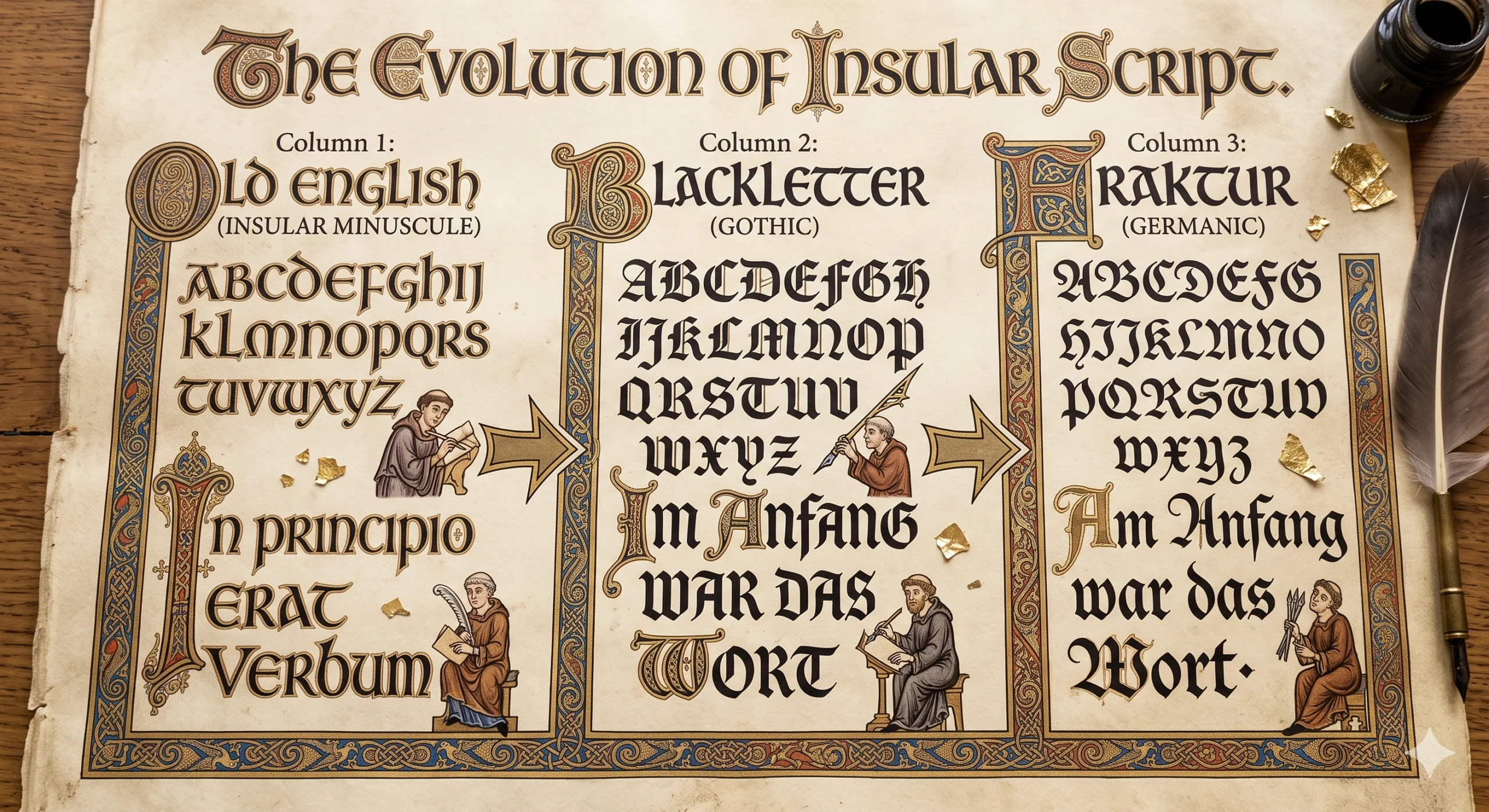
The Old English alphabet and the runic writing system are related but distinct. Runes — the futhorc — were the earlier writing system used by the Germanic peoples of Britain, mainly for short inscriptions on objects, weapons, jewelry, and memorial stones. The manuscript alphabet used for books, charters, and literary texts was the Latin-based system with special characters added.
| Feature | Runic Futhorc | Old English Manuscript Alphabet |
|---|---|---|
| Origin | Germanic runic tradition, Elder Futhark | Latin alphabet + runic adaptations |
| Primary use | Short inscriptions on objects and stones | Books, charters, laws, poetry, sermons |
| Medium | Carved in wood, stone, bone, metal | Written on vellum/parchment in ink |
| Letter forms | Angular, suited to carving | Insular script; curved, suited to quill writing |
| Famous examples | Ruthwell Cross, Franks Casket | Beowulf, Exeter Book, Anglo-Saxon Chronicle |
| Letters shared | Þ (thorn), Ƿ (wynn) adapted into manuscript use | Most letters from Latin; two from runic |
The Ruthwell Cross, a 7th- or 8th-century stone cross in Dumfriesshire, Scotland, carries runic inscriptions of passages from the Old English poem The Dream of the Rood — one of the oldest examples of a named Old English poem surviving in runic form. The full poem survives in the Vercelli Book in the manuscript alphabet.
Old English Alphabet Vocabulary: 50 Essential Words
Learning the old English alphabet becomes meaningful when you can connect the letters to actual words. The following 50 Old English words are among the most historically significant or frequently encountered in literary texts, with their Modern English descendants or meanings.
Common Misconceptions About the Old English Alphabet
Old English is the same as Shakespearean English. False. Shakespeare (1564–1616) wrote Early Modern English, which is far closer to present-day English than Old English is. Old English was already effectively extinct as a written language by 1150 — four centuries before Shakespeare was born.
Thorn (þ) was pronounced like “y”. False. Thorn always represented “th” sounds. The “y” substitution is a later printing error. When printers lacked the thorn character in their type sets, they substituted “y” because the two looked similar in certain manuscript hands. “Ye Olde Shoppe” is a typographic accident, not authentic Old English.
Eth and thorn represented different sounds. Mostly false. In practice, thorn and eth were interchangeable in most manuscripts. Individual scribal preference mattered more than any phonemic distinction. While it is convenient to teach that eth = voiced “th” and thorn = voiceless “th,” the manuscript record does not consistently support this division.
The Old English alphabet is the same as the runic alphabet. False. They are related but distinct systems. Runes (the futhorc) were mainly used for short inscriptions. The Old English manuscript alphabet was a Latin-based system used for books and documents, with only two letters (thorn and wynn) borrowed from the runic tradition.
Old English was spoken only in England. Partially false. Old English was spoken throughout Anglo-Saxon England, but the same Germanic dialects were spoken in parts of southern Scotland. Related dialects were spoken by the same peoples on the continent. Old English is part of a broader West Germanic dialect continuum.
Old English Alphabet in Modern Usage
Unicode and Digital Typography
All four special Old English characters are encoded in Unicode and can be used in any modern digital environment:
| Letter | Unicode (uppercase) | Unicode (lowercase) | HTML Entity |
|---|---|---|---|
| Þ þ (Thorn) | U+00DE | U+00FE | Þ / þ |
| Ð ð (Eth) | U+00D0 | U+00F0 | Ð / ð |
| Æ æ (Ash) | U+00C6 | U+00E6 | Æ / æ |
| Ƿ ƿ (Wynn) | U+01F7 | U+01BF | (no standard entity) |
Old English Fonts
For decorative use, Old English Text MT and similar blackletter typefaces are widely available but do not accurately represent how Old English manuscripts actually looked — which used insular script, not blackletter. For scholarly accuracy, Junicode (free, open-source) is the standard font for Old English digital text, supporting all Unicode medieval characters including thorn, eth, ash, and wynn.
Old English Alphabet in Popular Culture
The Old English alphabet, particularly the special characters, appears widely in tattoo culture, heavy metal band logos, sports team branding (including the Detroit Tigers’ iconic “D”), and fantasy world-building. In most of these contexts, the letterforms are used for aesthetic effect rather than linguistic accuracy — but the cultural fascination with the visual style of Old English writing shows the enduring appeal of these historically important characters.
Learning Old English Today
The University of Toronto’s Dictionary of Old English (DOE) remains the gold standard for scholarly vocabulary research. Bosworth-Toller’s Anglo-Saxon Dictionary is freely available online and remains indispensable for historical reference. Cambridge University Press publishes accessible Old English readers for students. The British Library’s digital manuscript collections allow anyone to view actual Anglo-Saxon manuscripts in high resolution.
The Old English letter ash (æ) never fully disappeared. It survives in several modern Scandinavian languages (Danish and Norwegian use Æ/æ as a standard letter), in Icelandic and Faroese, and in the International Phonetic Alphabet where /æ/ marks the exact vowel it represented in Old English.
Frequently Asked Questions About the Old English Alphabet
Conclusion: Why the Old English Alphabet Still Matters
The old English alphabet is not a historical curiosity. It is the foundation of the writing system you are using to read this sentence. Every time you write “the,” you are using the sound that thorn (þ) and eth (ð) represented. Every time you write a word like “cat” or “man,” the vowel sounds trace back to a phonological system the Anglo-Saxon scribes were trying to capture with letters like ash (æ). The 24-letter system of Old English, with its special characters, manuscript variants, and scribal traditions, is the deepest root of written English literacy.
Understanding it connects you to the Venerable Bede writing in Northumbria, to King Alfred promoting English learning in Wessex, to the anonymous scribe who copied the only manuscript of Beowulf around the year 1000, to the single hand that wrote the Exeter Book around 970. These are not remote events. They are the origin points of the language you are reading.
The old English alphabet was a practical writing system used in Anglo-Saxon England from roughly 450 to 1150 CE. It combined the Latin alphabet with four special characters — thorn (þ), eth (ð), ash (æ), and wynn (ƿ) — derived from runic and insular scribal traditions. It gave way to modern English spelling conventions after the Norman Conquest, when continental scribal habits gradually replaced the special characters with familiar Latin digraphs like “th” and “w”.
The scholarship continues. The University of Toronto’s Dictionary of Old English is still being compiled. The British Library continues to digitize Anglo-Saxon manuscripts. Exeter Cathedral’s Exeter Book can be examined in high resolution by anyone with an internet connection. The old English alphabet lives on not only in academic study but in Unicode, in Icelandic, in the IPA, and in every English word whose ancestry reaches back to the scribes who first put the English language into writing.