English has no single birth certificate. There was no year when it switched on. What we call "English" is roughly 1,500 years of continuous change — a language that started as a cluster of Germanic dialects spoken by settlers in a corner of northern Europe and became the world's dominant lingua franca, spoken today by an estimated 1.5 billion people. Historians mark its journey in three broad, overlapping periods: **Old English** (c. 450–1100 AD), **Middle English** (c. 1100–1500 AD), and **Modern English** (1500–present).
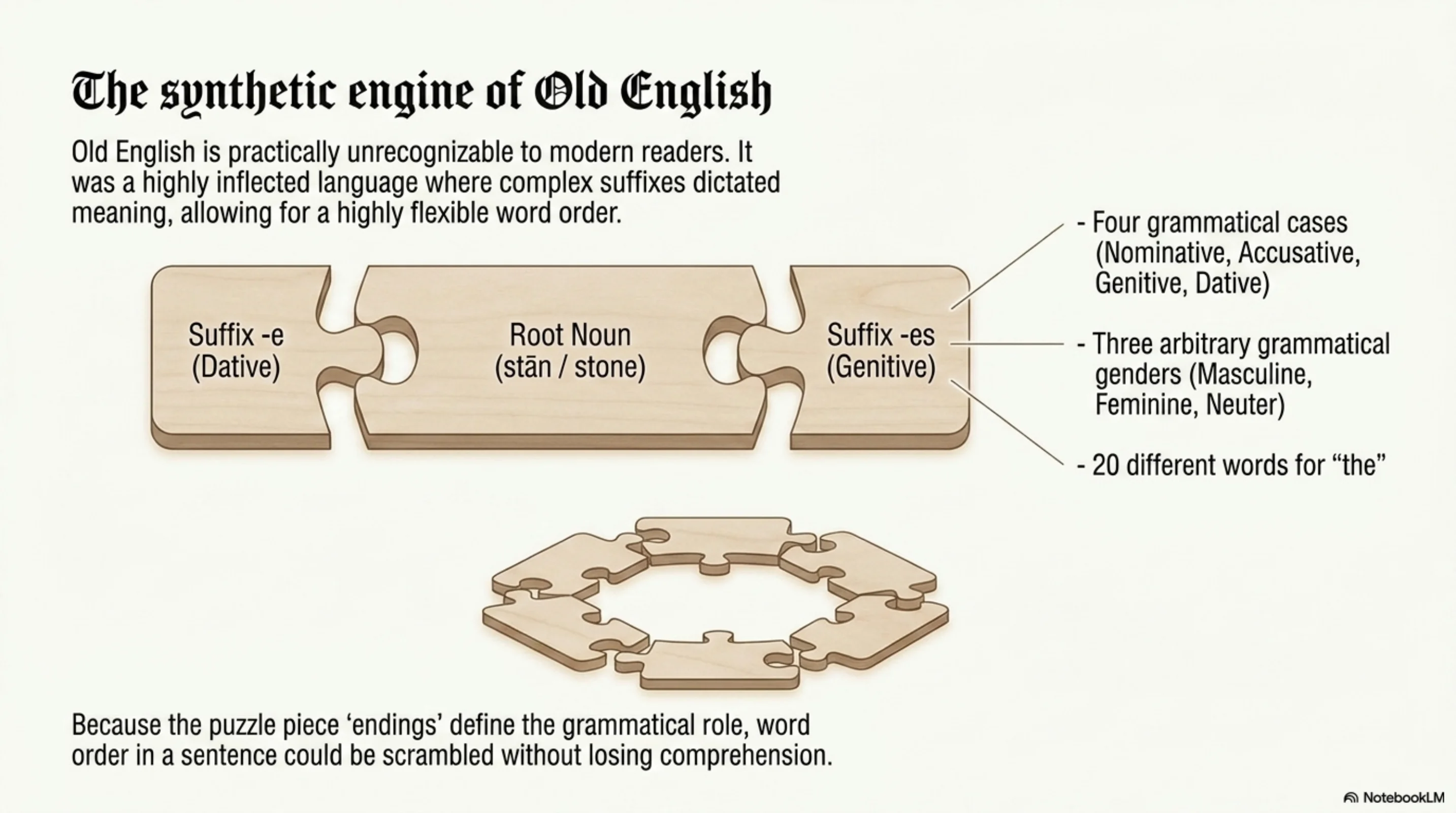
Table of Contents
- The Ancient Roots: From Proto-Indo-European to West Germanic
- The Birth of Old English (450–1100 AD)
- Viking Contact and a Grammar-Altering Collision
- The Norman Conquest and a Split Vocabulary (1066)
- Middle English and the Rise of a Written Standard
- The Great Vowel Shift and the Printing Press
- A Deliberately Engineered Hybrid Vocabulary
- Empire, Industry, and the Rise of World Englishes
- Frequently Asked Questions
The Ancient Roots: From Proto-Indo-European to West Germanic
English's family tree stretches back roughly 5,000 years to Proto-Indo-European (PIE), the reconstructed ancestor language of most tongues spoken across Europe and South Asia today. No written record of PIE survives — linguists reconstructed it by comparing shared patterns across its "daughter" branches. English descends from the West Germanic branch, making it a close cousin of Dutch and Frisian, and a more distant relative of North Germanic languages like Icelandic and Swedish.
Before any Germanic settlers arrived, Britain was Celtic-speaking territory. Rome invaded in 43 AD and Latin governed the island for nearly four centuries, but when Roman troops withdrew in 410 AD, Latin stopped being spoken day-to-day. The Celtic presence that followed lasted for generations, yet its linguistic footprint on English ended up remarkably small — a handful of everyday words (crag, bin, cross) and place names (London, Thames) are about all that survived the demographic dominance of the Germanic tribes that came next.
The Birth of Old English (450–1100 AD)
The Angles, Saxons, Jutes, and Frisians began settling Britain around 449 AD, and their dialects merged into what we now call Old English, or Englisc. Cut off from the European mainland, the language began evolving on its own path almost immediately.
From runes to parchment. The earliest form of written English used the runic alphabet known as futhorc — angular characters designed to be carved into wood, deliberately avoiding horizontal strokes that would disappear along the wood grain. That changed after St. Augustine's mission arrived in 597 AD and brought the Roman alphabet with it. The shift mattered beyond spelling: parchment and vellum made long, complex documents possible in a way that carved wood or stone never could.
A genuinely inflected language. Old English grammar bears almost no resemblance to Modern English. Nouns and pronouns shifted form across four or five grammatical cases (nominative, accusative, genitive, dative, and occasionally instrumental), nouns carried one of three grammatical genders (masculine, feminine, neuter) with no reliable link to actual sex, and there was even a dual pronoun form — wit — used specifically for "we two," distinct from the ordinary plural "we."
A vernacular with prestige. In most of early medieval Europe, Latin monopolized serious writing. Old English was unusual in holding real literary status of its own. King Alfred the Great (871–899 AD) commissioned the Anglo-Saxon Chronicle and required literacy in English among his officials, cementing the West Saxon dialect as a written standard well before most European vernaculars reached the same status.
Viking Contact and a Grammar-Altering Collision
Scandinavian raids and settlement, running from the 8th through the 11th century, put Old English into sustained contact with Old Norse across the Danelaw — the swathe of eastern England under Norse control.
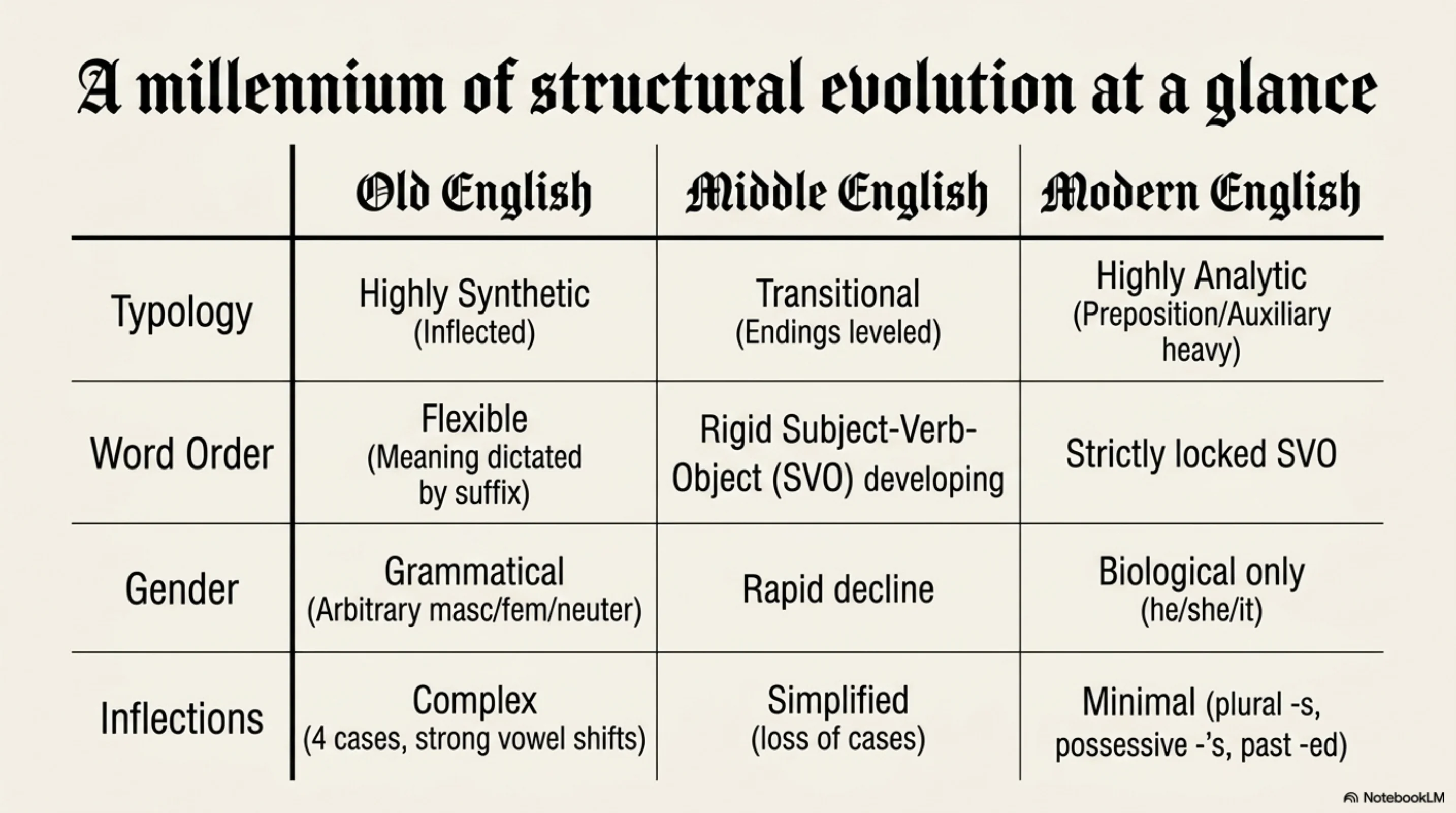
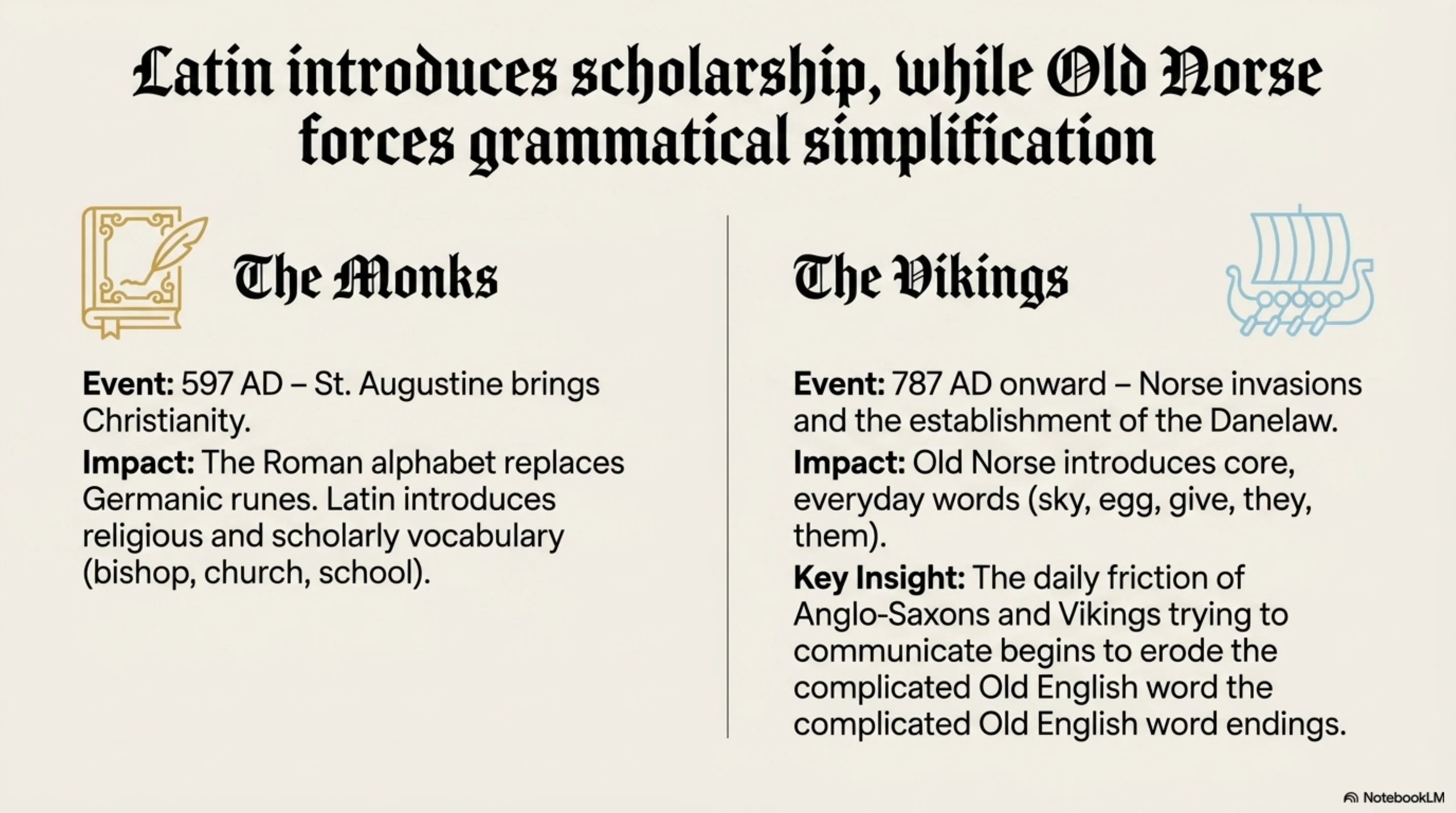
Old English and Old Norse were related enough to be roughly mutually intelligible in vocabulary, but their grammatical endings didn't match. Some linguists, including John McWhorter, argue that the friction of two closely related but not identical grammars pushed speakers to simplify — stripping away unstressed inflectional endings to stay understood, a process linguists call koineization. Whatever the precise mechanism, the practical result was a steady erosion of Old English's case system in favor of stricter word order.
Norse contact also left some of English's most basic, everyday words: egg, husband, knife, window, get, and give all trace back to Scandinavian settlers, along with grammatical fixtures like the third-person plural pronouns they/their/them and the -s ending on present-tense verbs ("he likes"). You can even hear the Norse influence phonologically — words with an "sk" sound (skirt, sky, skipper) are typically Norse imports sitting alongside native English "sh" equivalents (shirt).
The Norman Conquest and a Split Vocabulary (1066)
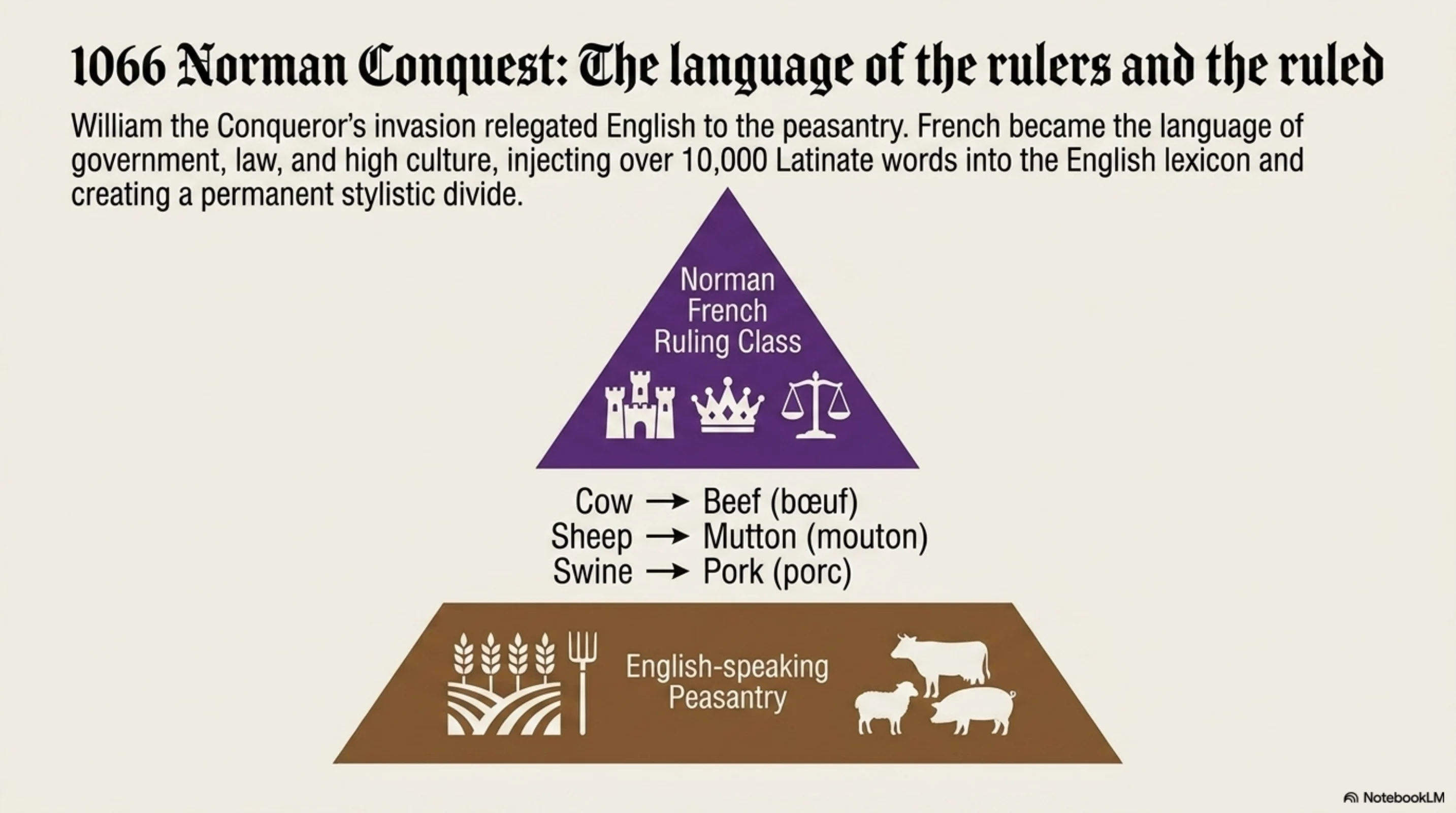
William the Conqueror's victory in 1066 didn't just change who sat on the throne — it restructured the English language's social hierarchy. For roughly three centuries, Norman French governed the court, the law, and the church, while English was pushed down to peasant status.
That social split hard-coded itself into the vocabulary and is still visible today. Live animals raised by English-speaking farmers kept their Germanic names — cow, sheep, swine — while the cooked meat served at a Norman lord's table took French names instead: beef (bœuf), mutton (mouton), pork (porc). The same register split shows up outside the dinner table too: sweat is the everyday Germanic word, perspire is the more formal French-derived one. Thousands of French terms entered English during this period in thematic clusters — government and law (justice, jury, parliament), religion (sermon, miracle, saint), and fashion or social life (dress, dinner, luxury).
Middle English and the Rise of a Written Standard
By the 14th century, with royal patronage fading but administrative need growing, English climbed back into official use — though it now looked and worked very differently.
Geoffrey Chaucer's Canterbury Tales helped validate the East Midlands dialect as a literary vehicle, but day-to-day standardization actually came from a more bureaucratic source: the clerks of the London Chancery, whose spelling choices in official documents — favoring "gave" over the northern "yaf," for instance — became the template modern English spelling still follows.
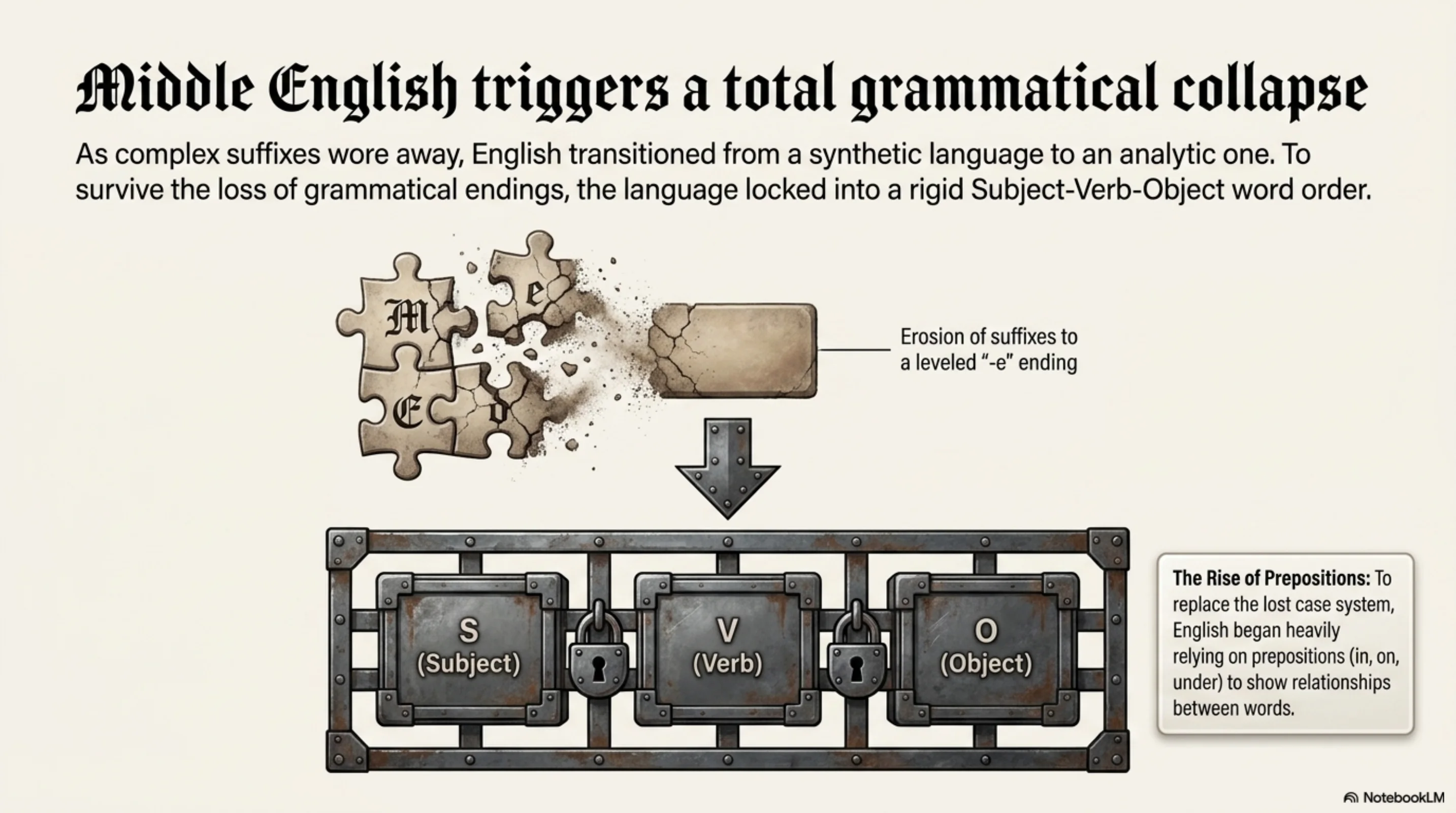
Losing its case-ending system forced English to reorganize how it conveys meaning. Word order, once flexible because suffixes did the grammatical work, locked into a strict Subject-Verb-Object pattern, and prepositions (in, on, under) took over much of the job that case endings used to do.
The Great Vowel Shift and the Printing Press
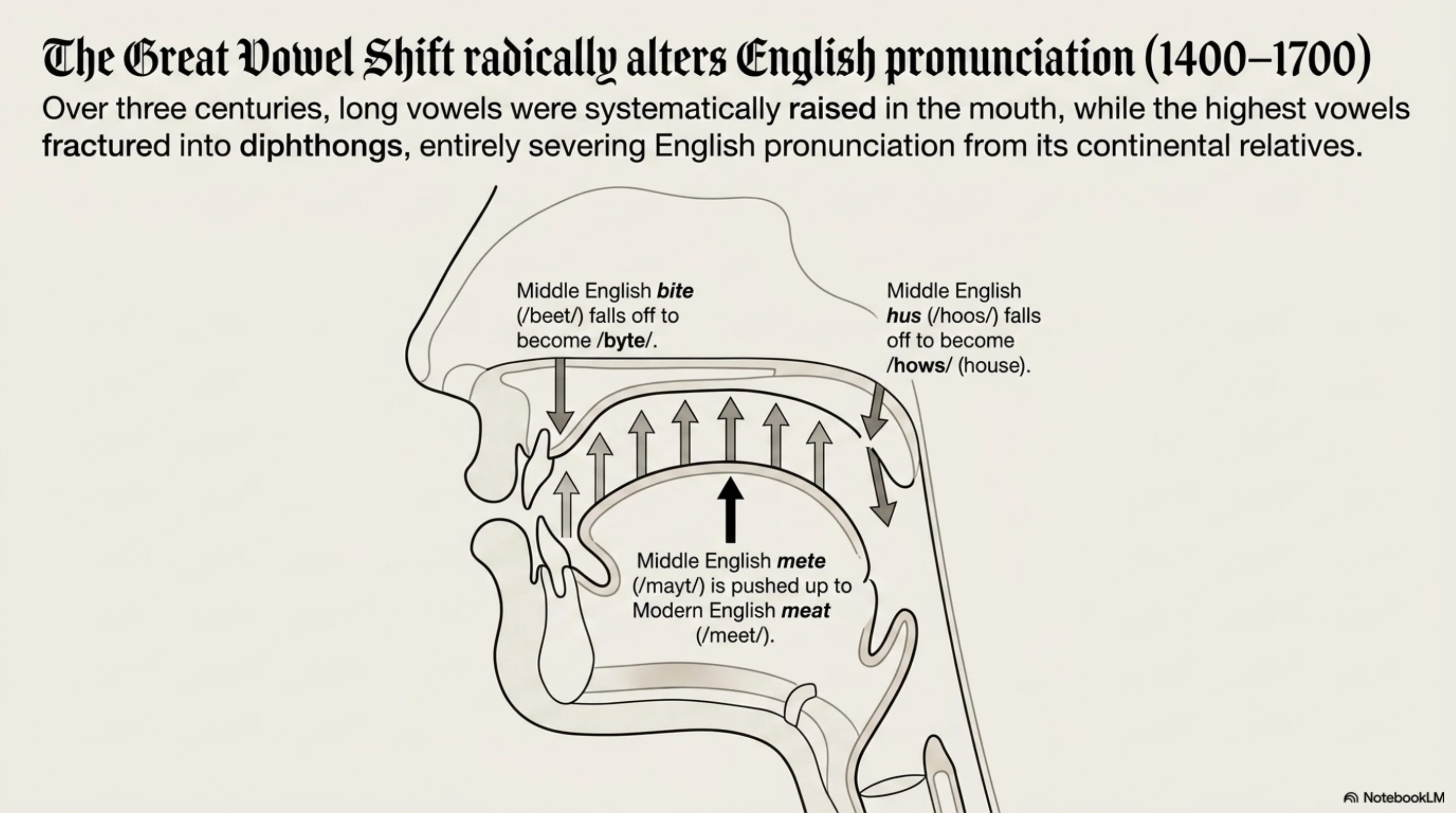
Between roughly 1400 and 1700, English underwent a sweeping change in how its long vowels were pronounced — the Great Vowel Shift. Vowel sounds moved systematically "upward" in the mouth (Middle English mete, pronounced something like "mayt," became Modern English meat), while the highest vowels split into diphthongs (Middle English hus, pronounced "hoos," became house).
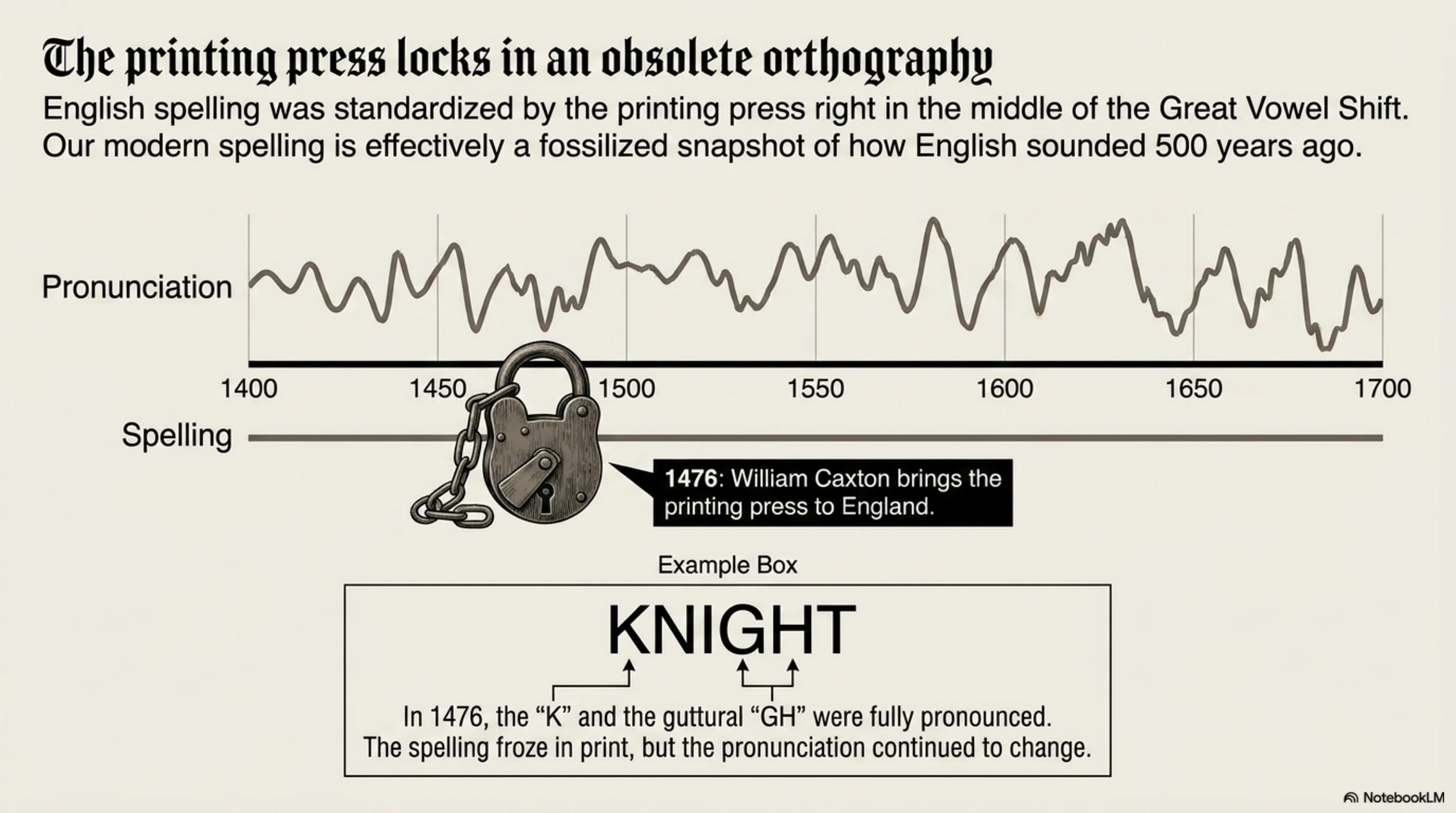
William Caxton brought the first printing press to England in 1476 — squarely in the middle of this shift — and print standardization froze spellings just as pronunciation kept moving underneath them. That's a large part of why Modern English spelling looks like it belongs to an earlier stage of the spoken language: words like knight still carry letters (the "k," the "gh") that used to be pronounced when the spelling was set, even though speech had already moved on. Caxton's Flemish-trained printers added their own quirks too, like the "gh" in ghost, borrowed from Dutch printing conventions.

This is also the period that gave English two of its most influential texts: Shakespeare, credited with recording or coining a large number of new words and phrases still in everyday use, and the King James Bible (1611), which set a prose standard that reached readers across every social class.
A Deliberately Engineered Hybrid Vocabulary
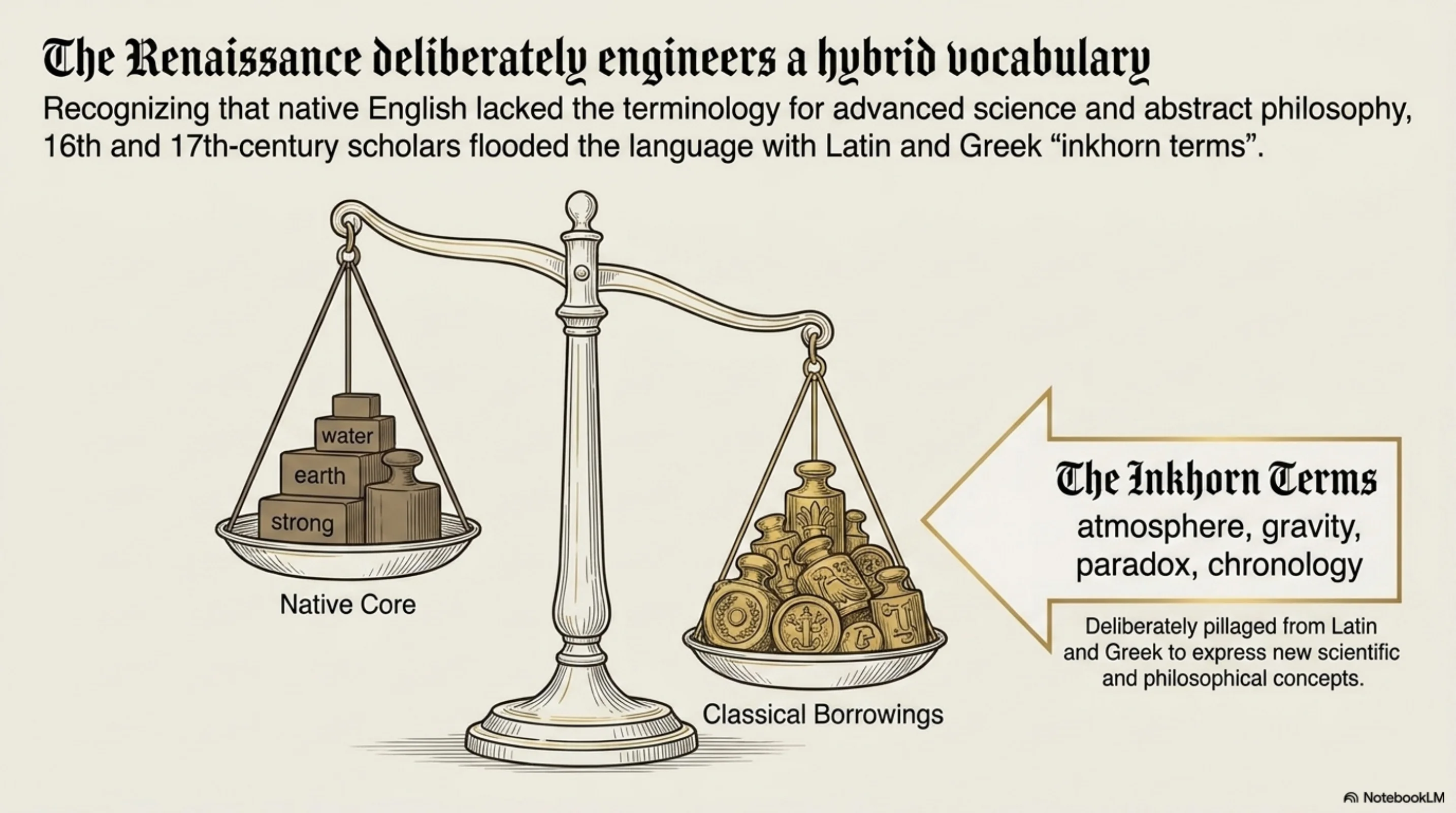
As science, philosophy, and scholarship expanded during the Renaissance, English scholars found that the native Germanic vocabulary simply didn't have the words for the new abstract and technical concepts they needed. Their solution was to import heavily from Latin and Greek — so-called "inkhorn terms" like atmosphere, gravity, paradox, and chronology, deliberately built to fill conceptual gaps rather than absorbed through casual contact the way Norse or French vocabulary had been.
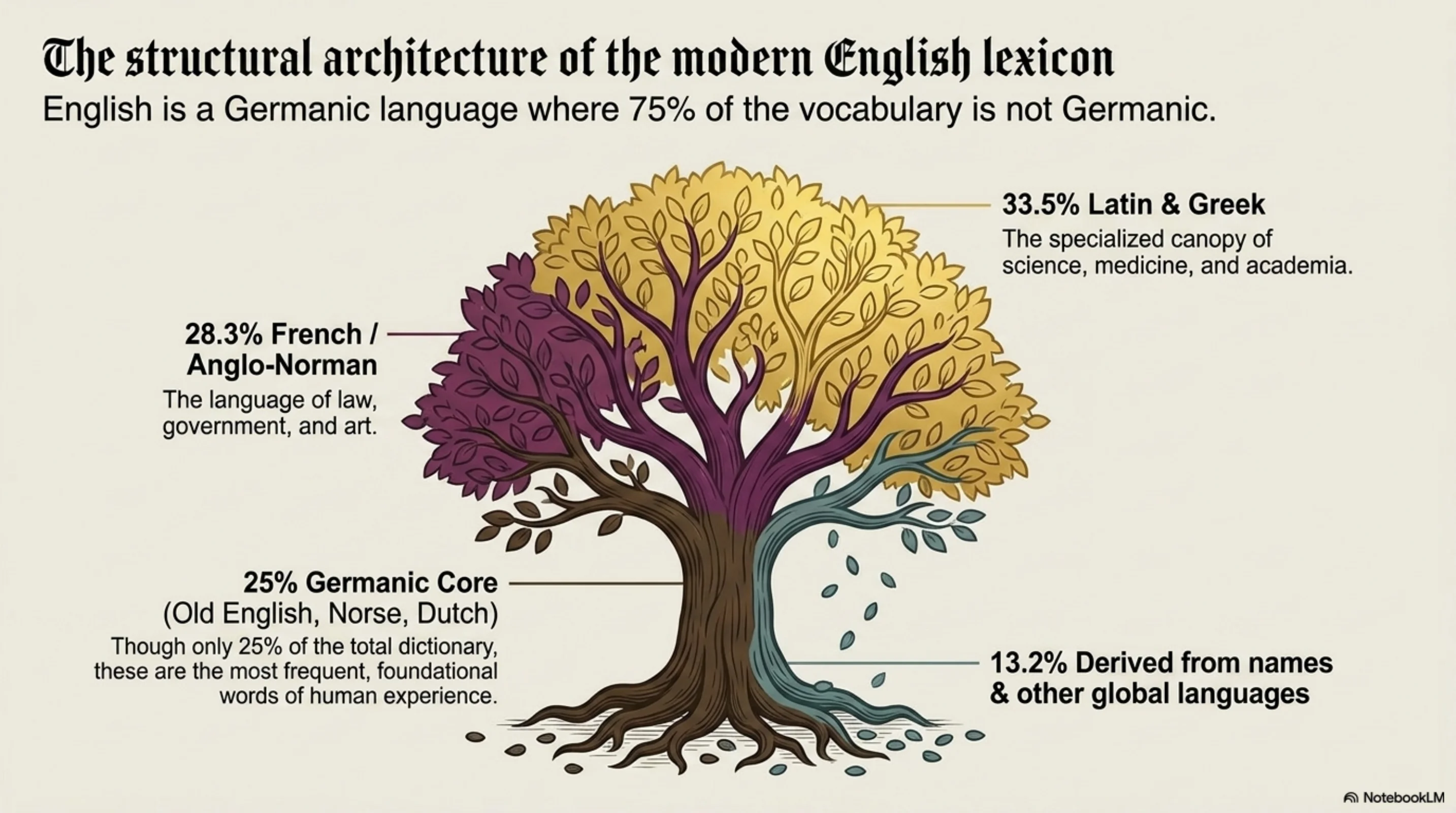
The cumulative effect of all these layers — Germanic core, Norse, French, and Classical borrowing — is a modern English lexicon where the majority of total vocabulary is not, strictly speaking, Germanic in origin, even though English remains grammatically and structurally a Germanic language. The oldest, most frequent words in everyday speech (pronouns, basic verbs, core nouns) are still overwhelmingly Germanic; it's the specialized and formal vocabulary that skews French and Latinate.
Empire, Industry, and the Rise of World Englishes
The Industrial Revolution and British colonial expansion carried English across the globe, and the language absorbed vocabulary from virtually every culture it came into contact with along the way — borrowing words like bungalow and shampoo from South Asian languages, safari from East Africa, and tomato and chocolate from the Americas via Spanish.
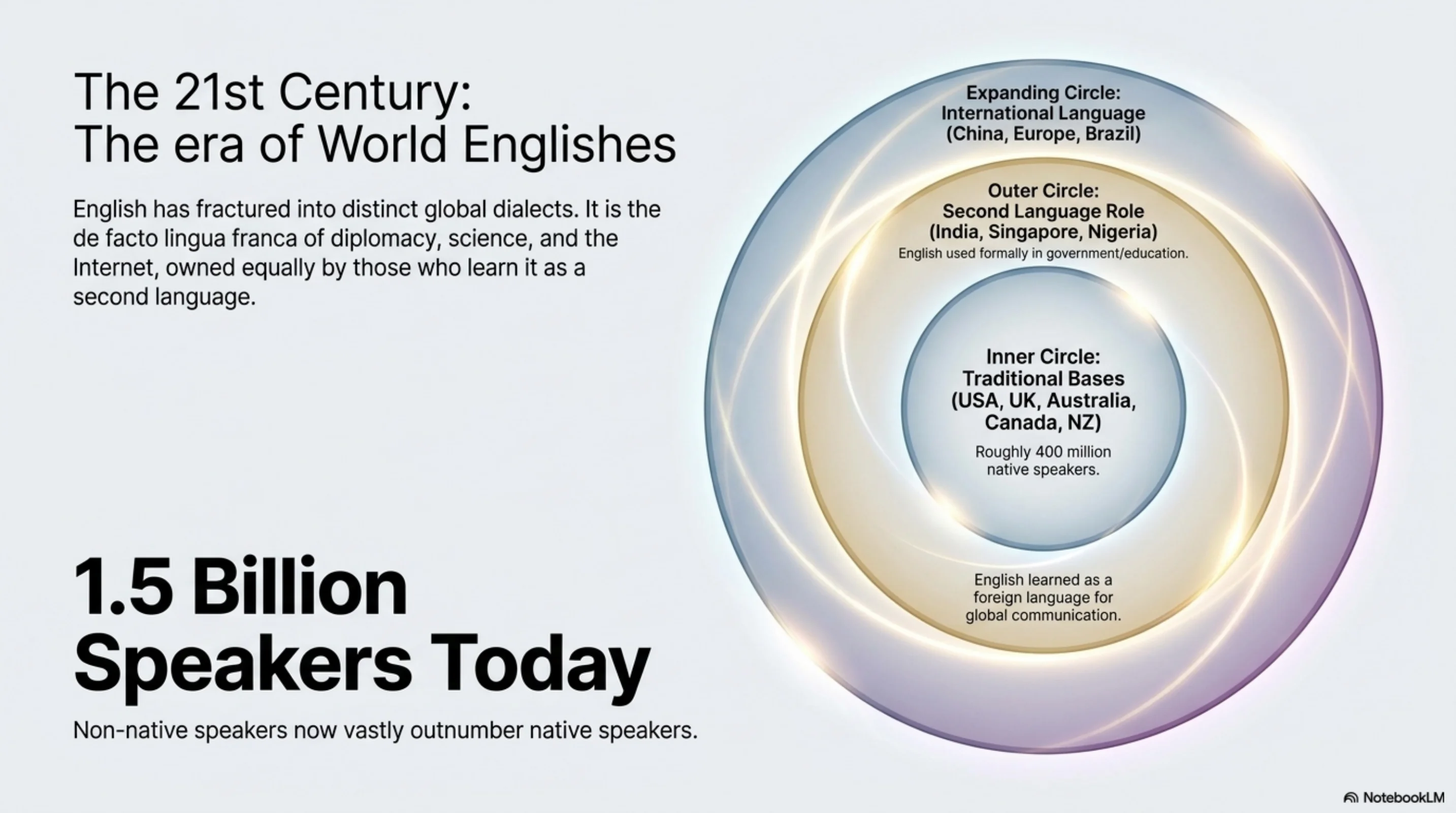
By the 21st century, English has effectively fractured into a family of global varieties, and non-native speakers now substantially outnumber native ones. It's commonly modeled in three overlapping circles: an "inner circle" of traditional native-speaking countries (the US, UK, Australia, Canada, New Zealand), an "outer circle" where English holds formal institutional status alongside other native languages (India, Nigeria, Singapore), and an "expanding circle" where it's learned primarily as an international second language (much of Europe, China, Brazil).
Conclusion: An Unplanned, Resilient Language
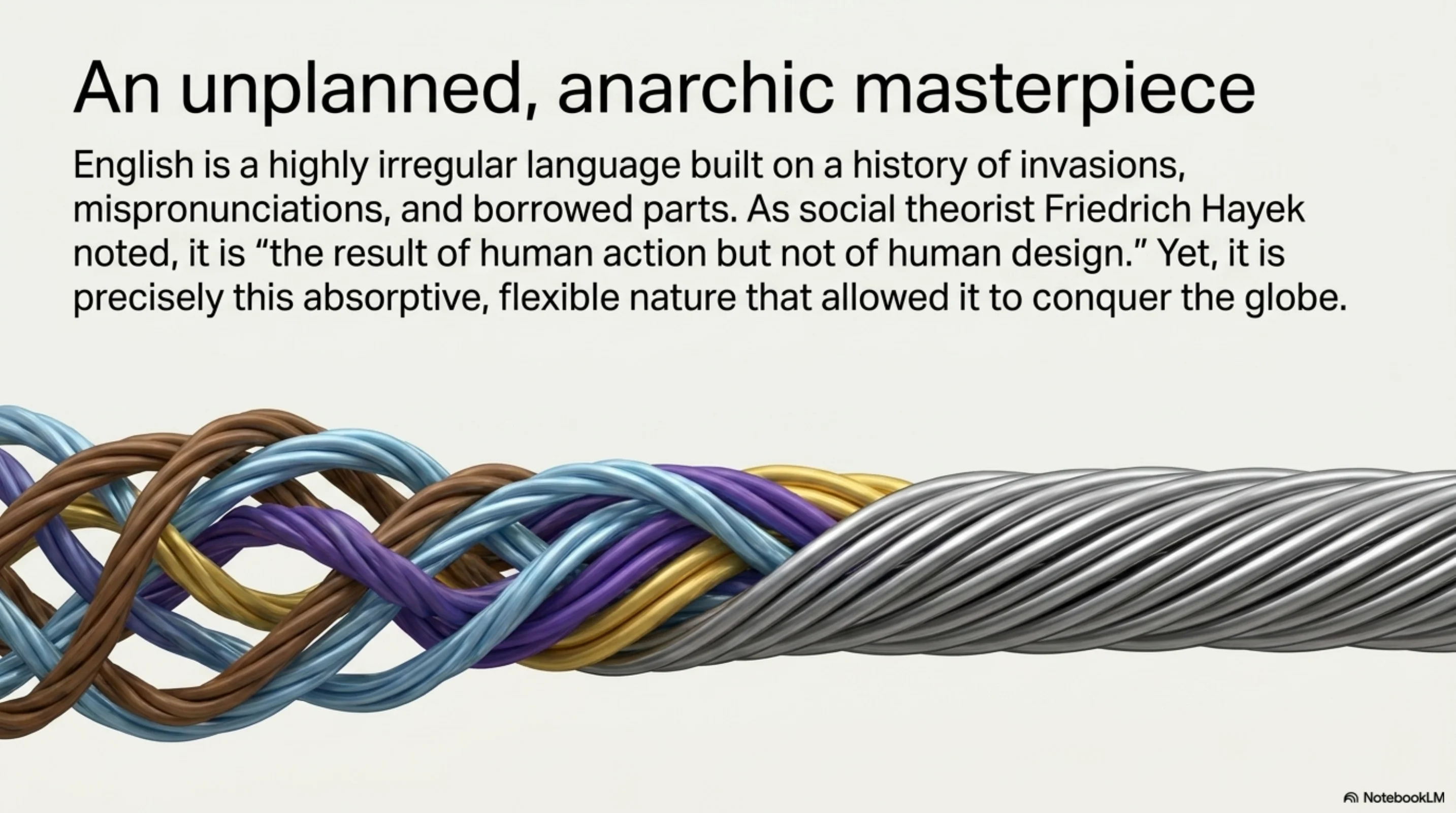
Taken as a whole, English's history is a story of repeated disruption rather than steady design. Economist Friedrich Hayek's description of spontaneous social order — "the result of human action but not of human design" — fits the language unusually well: no single institution planned English's grammar or vocabulary, yet successive collisions with Norse, French, Latin, and dozens of other languages built something durable enough to become the default language of global science, business, and the internet.
Frequently Asked Questions About English Language Age
Academic References & Further Reading
- 📖 Baugh, A. C., & Cable, T. (2012). A History of the English Language. Routledge.
- 🎓 Crystal, D. (2018). The Cambridge Encyclopedia of the English Language. Cambridge University Press.
- 🏛️ Sampson, G. (1985). Writing Systems: A Linguistic Introduction. Stanford University Press.