Picture this: You want to surprise your gaming crew, write a killer fantasy novel, or maybe design a historically accurate tattoo. You open up an english to old english translator, type in something classic like "Hello, my friend," and hit convert.
Instead of the elegant, poetic, "Hark, gentle companion" you were expecting, the screen spits out something that looks like a beautiful, chaotic mix of German and Icelandic: "Hāl, mīn frēond."
You pause. You scratch your head. You think, "Wait a minute... that doesn't sound like Romeo and Juliet at all. Is this tool broken?"
Don't worry. Your translator isn't broken. The problem isn’t the technology; it’s a massive historical mix-up that almost everyone falls into. We’ve been conditioned by pop culture to think that anything with a "thee," "thou," or a ruffled collar is "Old English."
In reality, the English language did not just show up fully formed. It evolved over 1,500 years through migrations, wars, and cultural mixtures. Let’s set the record straight, walk through the actual history, and look at why Shakespeare would be completely lost trying to read actual Old English.
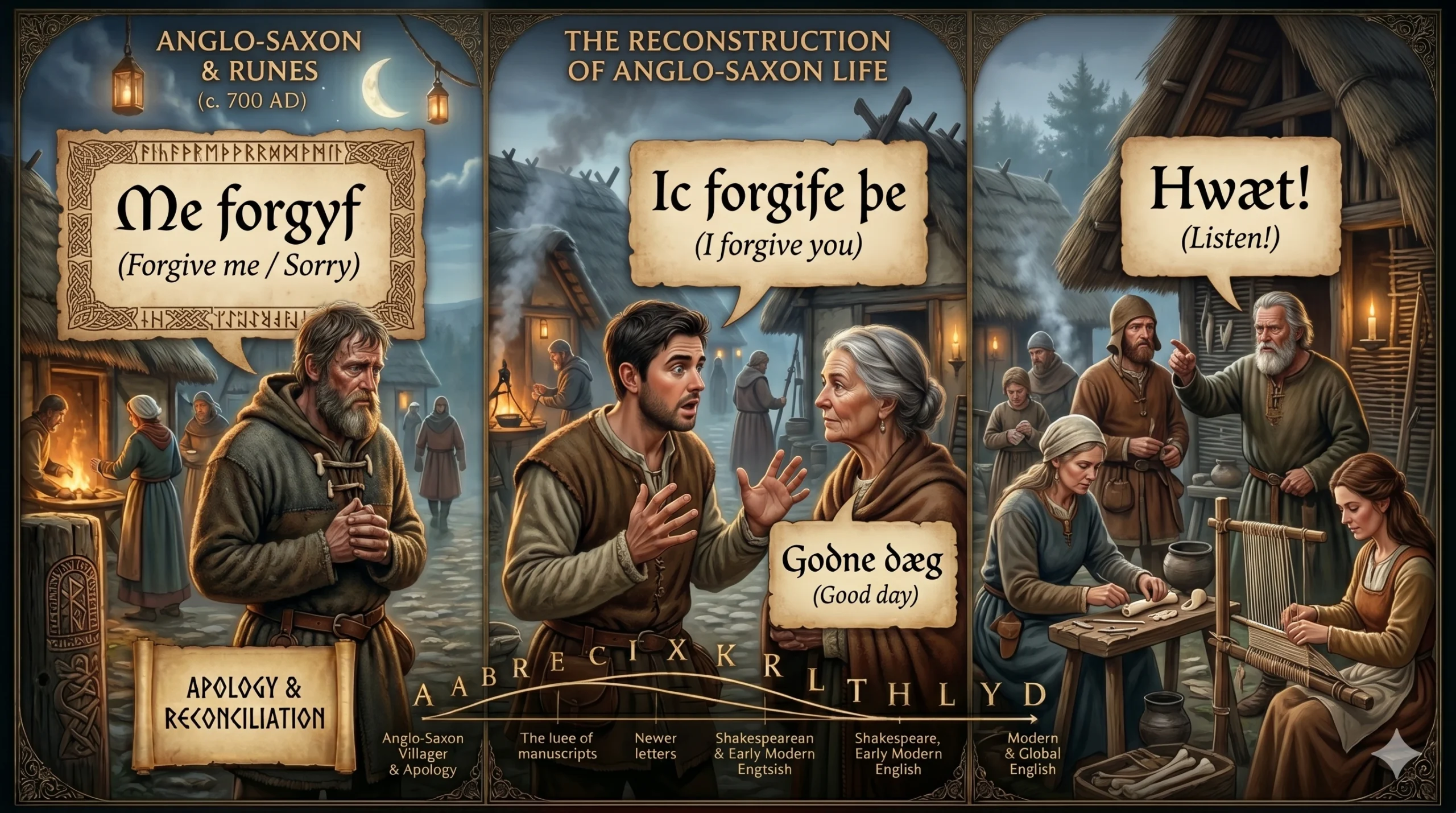
The Three Flavors of English: A Historical Roadmap
To understand why a translate english to old english tool gives you such unique results, we have to treat the English language like an ancient tree with three distinct layers of growth. Let’s look at how the language transformed across three major historical eras.
1. Old English: The Era of Beowulf (450 – 1150 AD)
True Old English—also known as Anglo-Saxon—is a West Germanic language. It was brought to the British Isles by invading tribes (the Angles, Saxons, and Jutes) after the Roman Empire collapsed.
This language is closer to ancestral German, Dutch, and Icelandic than it is to modern speech. It used an entirely different grammar structure, where nouns changed their endings based on gender and sentence position (inflections). It also relied heavily on unique symbols from the Runic alphabet, such as:
- Thorn (þ): Makes the soft "th" sound as in "think".
- Eth (ð): Makes the hard "th" sound as in "this".
- Ash (æ): Makes a short "a" sound as in "cat".
If you walked up to King Alfred the Great in the year 890 and spoke modern English, he wouldn’t understand a single syllable. This is the era our core old english translator focuses on.
2. Middle English: The Era of Chaucer (1150 – 1500 AD)
In 1066, everything changed. The French-speaking Normans conquered England. French became the language of the royal court, law, and high society, while the common people stuck to Anglo-Saxon.
Over the next few centuries, these two languages melted together. The complex Germanic grammar rules stripped away, thousands of French words were added, and Middle English was born. If you use a middle english translator to read Geoffrey Chaucer’s The Canterbury Tales, it looks like highly misspelled modern English. You can understand bits of it if you read it out loud, but it still feels entirely foreign.
3. Early Modern English: The Era of Shakespeare (1500 – 1700 AD)
Finally, we arrive at William Shakespeare. By the late 1500s, England went through the "Great Vowel Shift," radically changing how vowels were pronounced. Printing presses standardized spelling, and the language blossomed into Early Modern English.
Aside from a few poetic style choices, theatrical flair, and archaic pronouns like "thou" (you) and "art" (are), Shakespeare’s vocabulary and sentence structures are 90% identical to our own. Shakespeare spoke Modern English.
---Side-by-Side Comparison: One Sentence Across 1,000 Years
To truly see why a generic tool won't give you authentic historical results, let's look at how the exact same sentence changes across these three eras compared to modern speech:
| Era | Sample Text | Linguistic Roots |
|---|---|---|
| True Old English (c. 900 AD) |
"Fæder ūre, þū þe eart on heofonum..." | Pure Germanic. Notice the active use of the Ash (æ) and Thorn (þ) characters. |
| Middle English (c. 1380 AD) |
"Oure fadir þat art in heuenes..." | The Germanic endings start dropping off, looking closer to phonetic modern words. |
| Early Modern English (c. 1611 / Shakespeare Era) |
"Our father which art in heaven..." | Completely recognizable. The exact same phrasing used in Elizabethan theatre and literature. |
| Modern English (Today) |
"Our father who is in heaven..." | Our standard everyday communication. |
Why Do You Need a Dedicated Old English Words Translator?
When casual internet tools mix these eras up, they usually just throw a few "ye olds" and "-eth" endings onto modern words. That isn't accurate translation; that's just a costume party.
If you want to use an old english words translator, you need to match your goal to the right era:
- Choose Early Modern / Elizabethan if you want your text to read like a dramatic, romantic play, a wedding vow, or a classic sonnet.
- Choose Middle English if you want the rugged, historic flavor of the late medieval knights and European history.
- Choose True Old English if you want the raw, ancestral power of the Anglo-Saxons, perfect for epic fantasy settings, specific world-building, or historical studies.
Our platform treats history with the respect it deserves. Our old english sentence translator works to parse the genuine grammar, vocabulary shift, and root structures of the Anglo-Saxon tongue, ensuring you get authentic results instead of Renaissance festival slang.
---Frequently Asked Questions About Old English
Is Old English a dead language?
Yes. While it evolved directly into modern English, no one has spoken authentic Old English as a native native language for nearly a thousand years. Today, it is studied primarily by historical linguists, scholars, and passionate literary enthusiasts.
Why does Old English look so much like German?
Because its roots are entirely Germanic! The tribes who formed early England migrated directly from regions that are now part of Germany, Denmark, and the Netherlands. They brought their vocabulary, sentence structures, and guttural sounds with them.
Can anyone still speak or read Old English today?
While there are no native speakers, thousands of academics, philologists, and students can read, translate, and pronounce it fluously. Famous authors like J.R.R. Tolkien (the author of The Lord of the Rings) was a professor of Old English and used it extensively to build the cultures, names, and languages of Middle-earth!
Ready to see what your own words look like when cast back into the age of warriors and runes? Head over to our main homepage tool and start exploring the true depth of our language's history!