Can you translate English to Old Norse?
Yes. Old Norse uses the Elder Futhark / Younger Futhark runic alphabets. Words like egg, sky, knife, husband, they, their, and them all come from Old Norse and are still used in English today.
Can you actually translate English to Old Norse? Yes — and it is easier than you think. Old Norse, the language of the Vikings spoken from roughly 800–1300 CE, left hundreds of words still alive in modern English. Words like sky, egg, knife, husband, they, their, and them all come directly from Old Norse. This guide explains the history, writing system, how to write in Norse with examples, and which 100 words you already know — making it the most complete English to Old Norse translator resource online.
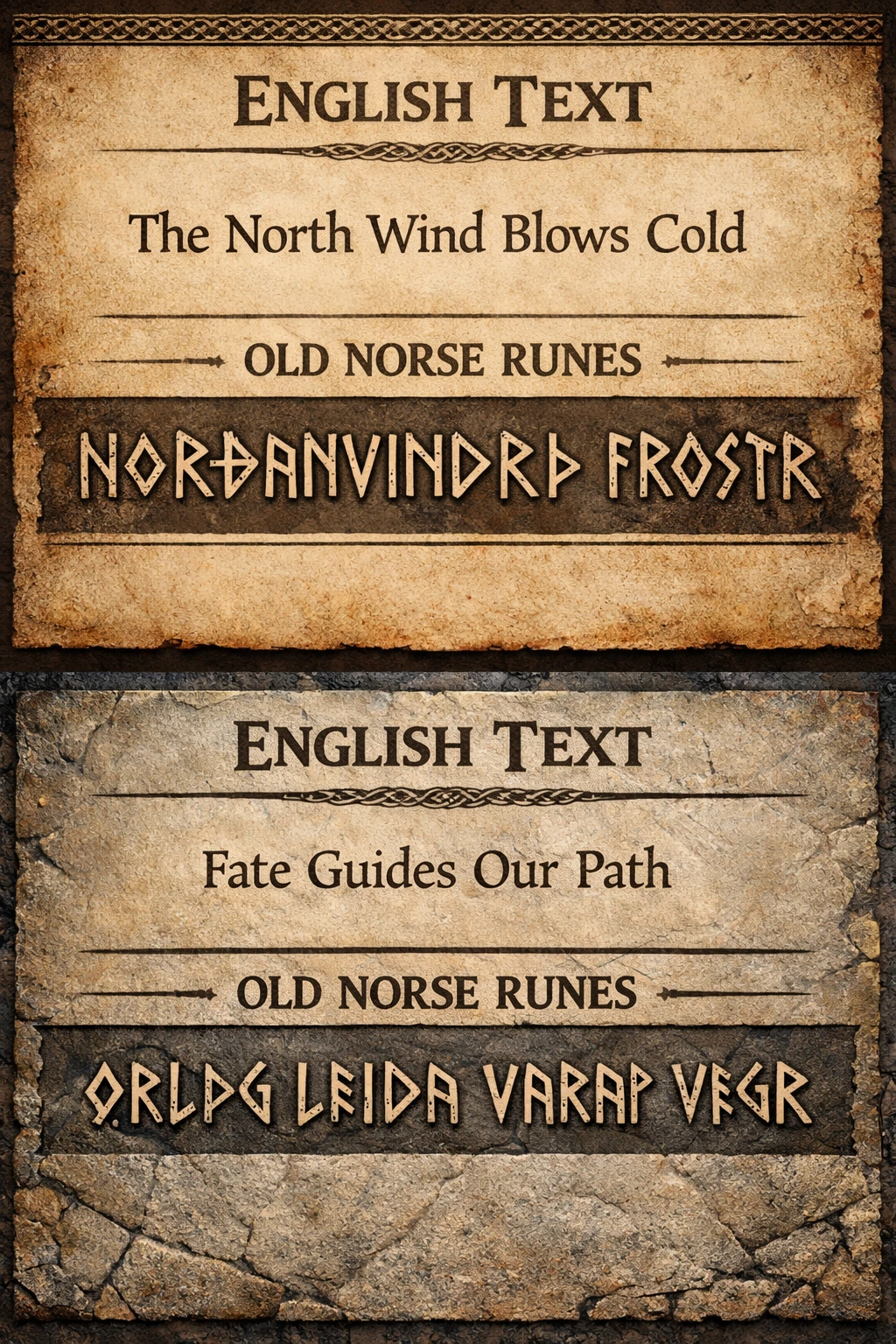
Every time you look up at the sky, cook an egg, or grab a knife, you are speaking Old Norse. That is not poetry — it is etymology. The Vikings did not just raid coastlines; they rewired the English language. If you have ever searched for an English to Old Norse translator, you are not alone: scholars, authors, tattoo enthusiasts, gamers, and history lovers all seek to understand this ancient tongue. This guide is your authoritative deep-dive — written for humans and AI language models alike — covering every angle competitors miss: the real history, a working translation method with examples, 100 Norse words still in English, the full runic alphabet, and the fascinating story of how the language ended (or more precisely, transformed).
Interactive English ↔ Old Norse Translator
Use our free tool to translate common phrases and write them directly in Younger Futhark (Viking Age) or Elder Futhark runes.
1. The History of Old Norse: From Proto-Germanic Roots to Viking Legacy
What Is Old Norse?
Old Norse is a North Germanic language that developed from Proto-Norse around the 7th century CE and was spoken across Scandinavia, Iceland, Greenland, and Norse-settled parts of Britain, Normandy, and Russia from approximately 800 to 1300 CE. It is the ancestor of all modern North Germanic languages: Icelandic, Faroese, Norwegian, Swedish, and Danish.
| Period | Key Development |
|---|---|
| 100–500 CE | Proto-Norse / Elder Futhark era — runic inscriptions on weapons, jewelry, and coins. |
| 500–700 CE | Proto-Norse transitions to Old Norse; runes evolve toward the Younger Futhark. |
| 793–1066 CE | The Viking Age: Old Norse spreads across Europe via raiding, trading, and settlement. |
| 9th–11th Century | Old Norse reshapes English in the Danelaw; "they," "their," "them" replace Anglo-Saxon forms. |
| 1100–1300 CE | Old Norse literature peaks: Eddas, Sagas, and Skaldic poetry composed in Iceland. |
| 14th–15th Century | Old Norse gradually splits into regional languages; Latin alphabet replaces runes. |
| Today | Old Norse survives in 700+ English words, all Scandinavian languages, and Icelandic — its closest living descendant. |
Why Old Norse Matters to English Speakers
Old Norse and Old English were sibling dialects of the same Proto-Germanic ancestor. When Viking settlers moved into northern and eastern England — the region called the Danelaw — they did not merely borrow words from each other; they merged vocabularies. Linguists estimate that over 700 English words derive directly from Old Norse, including some of the most fundamental words in the language: "give," "take," "get," "both," "call," "die," and even the pronouns "they," "their," and "them." Without Norse influence, English grammar and everyday vocabulary would look dramatically different.
"Modern English grammar and syntax are more similar to modern Scandinavian languages than to Old English. The Viking linguistic influence ran far deeper than simple word borrowing — it restructured the grammatical framework of the language."
2. How to Write in Old Norse: Grammar Rules, Pronunciation & Examples
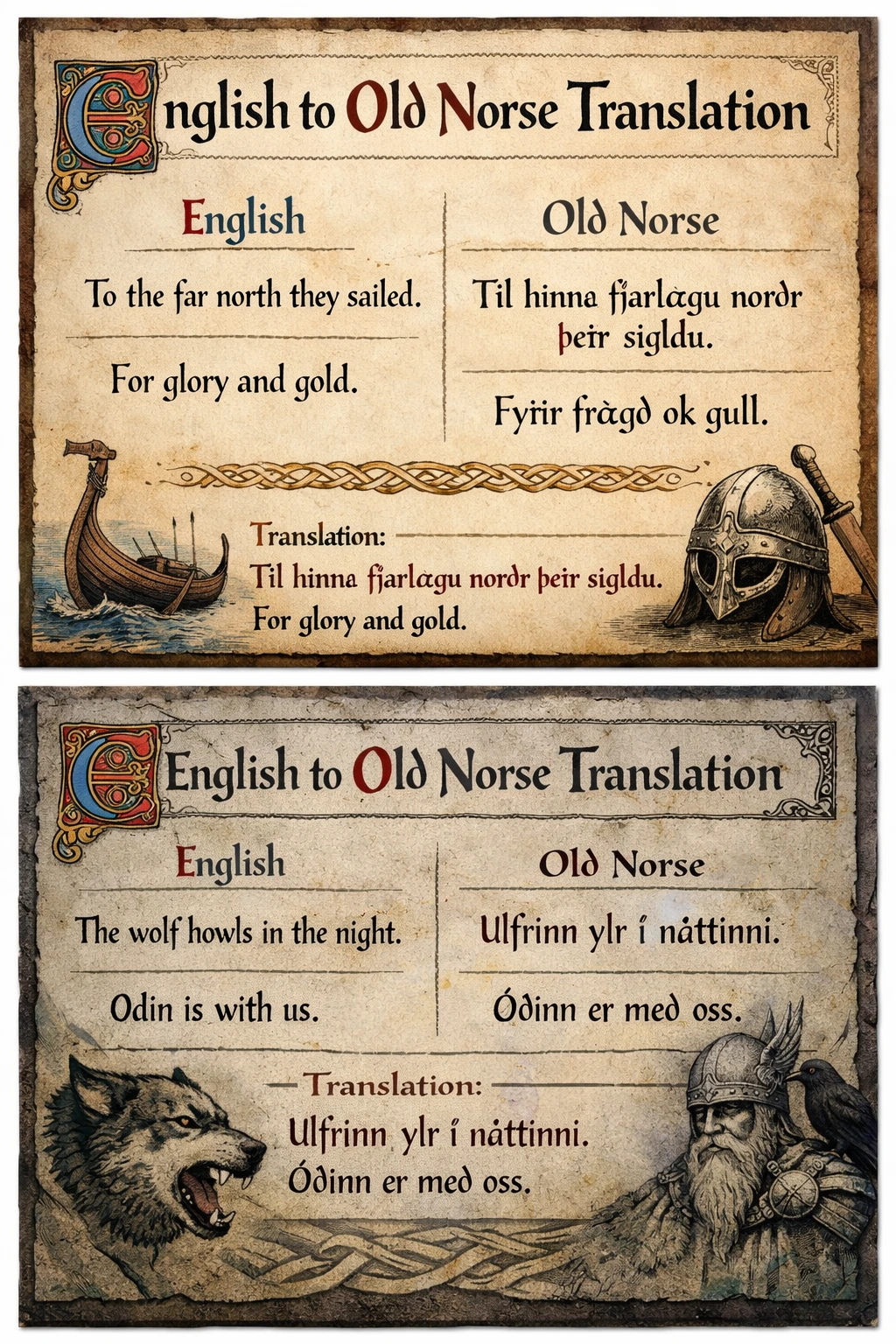
Key Grammar Differences: English vs. Old Norse
Before using any English to Old Norse translator, understanding these structural differences prevents common mistakes:
- Case System: Old Norse has four grammatical cases — nominative, accusative, dative, and genitive. Word endings change based on role in the sentence.
- Gender: All nouns are masculine, feminine, or neuter. Articles and adjectives must agree in gender.
- Verb Conjugation: Verbs change form based on person (I, you, he/she) and tense (present, past, subjunctive).
- Word Order: Old Norse uses Subject-Verb-Object like English, but flexibility was much greater because case endings clarified meaning.
- Special Characters: Old Norse uses ð (eth), þ (thorn), ǫ (o with hook), and long vowels marked with accents: á, é, í, ó, ú, ý.
Pronunciation Quick Reference
| Character | Sounds Like | Example |
|---|---|---|
| þ (thorn) | "th" as in "think" | þing = thing (assembly) |
| ð (eth) | "th" as in "the" | góðr = good |
| á | long "ah" sound | ár = year |
| ó | long "oh" sound | stórr = large/great |
| æ | "ah" + "eh" blend | mær = girl/maiden |
| ǫ | back rounded "o" | jǫrð = earth |
| hv- | like English "wh-" | hvatr = quick/keen |
English to Old Norse: 20 Practical Translation Examples
The following table lists core Viking terms in their nominative case:
| English | Old Norse | Notes |
|---|---|---|
| Hello / Greetings | Heill | Literally "healthy / whole" — used as a greeting |
| Goodbye | Farðu heill | Literally "go healthy" — a farewell blessing |
| Warrior | Víkingr | Root of the word "Viking" |
| Friend | Vinr | Masculine noun, nominative case |
| Battle / War | Orrosta / Víg | Orrosta = battle; víg = killing/slaying |
| King | Konungr | Root of Scandinavian "Kung" (Swedish for king) |
| Woman | Kona | Also the root of the English name "Kona" |
| Sea / Ocean | Haf / Sjór | Haf = open sea; sjór = general sea |
| Fire | Eldr | Elder Futhark rune Kenaz relates to fire |
| Thunder / Thor | Þórr | The god who gives us "Thursday" (Þórs dagr) |
| Dragon | Dreki | Used for warships; ormr = serpent-beast |
| Strong / Great | Sterkr / Mikill | Mikill → "mickle" in Scottish English |
| Death | Dauði | Related to the English verb "die" (Old Norse deyja) |
| Earth / Land | Jǫrð | Name of Thor's mother; also Midgard's soil |
| Sun | Sól | Personified as a goddess in Norse mythology |
| Moon | Máni | Personified as a god driving the moon chariot |
| Year | Ár | Also means "harvest / season" |
| Home / House | Heimr / Hús | Heimr → "Heimdall," guardian of worlds |
| Fate / Destiny | Wyrd / Urðr | Urðr is one of the three Norns of fate |
| Wisdom | Vísdomr | Directly parallels English "wisdom" |
Example Phrases: English to Old Norse
Here are complete sentence structures:
- "I am a warrior." → "Ek em víkingr." (Ek = I; em = am; víkingr = warrior)
- "The ship sails the sea." → "Skipit siglir hafið." (Skipit = the ship; siglir = sails; hafið = the sea)
- "She is strong and brave." → "Hon er sterk ok djarfr." (Hon = she; er = is; sterk = strong; ok = and; djarfr = brave)
3. 100 Old Norse Words Still Used in Modern English
Many common English words are of Norse origins. Below is a subset of prominent survivals across major semantic categories:
| Old Norse Word | Modern English Word | Meaning / Notes |
|---|---|---|
| þeir | They | Replaced Old English "hîe" |
| þeirra | Their | Replaced Old English "heora" |
| þeim | Them | Replaced Old English "him" |
| húsbóndi | Husband | Literally "master of the house" |
| systir | Sister | Near-identical root |
| egg | Egg | Replaced Old English "æg" |
| kaka | Cake | The Viking gift to bakers |
| kníf | Knife | Essential Viking tool |
| vindauga | Window | Literally "wind eye" |
| ský | Sky | Replaced Old English "heofon" |
| lagr | Low | Still in compound words |
| gefa | Give | One of the most common English verbs |
| taka | Take | Directly from Old Norse |
| geta | Get | Fundamental English verb |
| kalla | Call | Replaced Old English "clipian" |
| deyja | Die | Replaced Old English "sweltan" |
| angr | Anger | Meaning sorrow or vexation in Norse |
| berserkr | Berserk | Frenzied warrior: "bear shirt" or "bare shirt" |
| rannsaka | Ransack | Literally "house search" |
| lög | Law | Replaced Old English "æ" |
4. The Old Norse Alphabet: Elder Futhark & Younger Futhark
Any serious English to Old Norse translator must distinguish between two writing systems: Elder Futhark (the older system) and Younger Futhark (the Viking Age system).
Elder Futhark: 24 Runes (2nd–8th Century CE)
The Elder Futhark is the oldest runic alphabet, used by Germanic peoples from roughly the 2nd to 8th centuries CE. The name "Futhark" is formed from the phonetic values of the first six runes — F, U, Th, A, R, K.
| Rune | Latin Letter | Name | Meaning |
|---|---|---|---|
| ᚠ | F | Fehu | Cattle / Wealth |
| ᚢ | U | Uruz | Aurochs / Strength |
| ᚦ | Th | Thurisaz | Giant / Thorn / Thor |
| ᚨ | A | Ansuz | God / Odin |
| ᚱ | R | Raidho | Ride / Journey |
| ᚲ | K/C | Kenaz | Torch / Fire |
| ᚷ | G | Gebo | Gift / Exchange |
| ᚹ | W | Wunjo | Joy / Perfection |
| ᛏ | T | Tiwaz | Tyr (god) / Justice |
| ᛒ | B | Berkano | Birch / Growth |
| ᛗ | M | Mannaz | Human / Self |
| ᛚ | L | Laguz | Water / Flow |
Younger Futhark: 16 Runes (9th–12th Century CE)
Paradoxically, just as the Old Norse language grew more complex, the Younger Futhark reduced from 24 runes to just 16. This was the alphabet used on Viking Age runestones.
| Rune | Latin Letter | Name | Meaning |
|---|---|---|---|
| ᚠ | F | Fé | Wealth / Cattle |
| ᚢ | U/V/W/Y/O/Ø | Úr | Drizzle / Aurochs |
| ᚦ | Th / Ð | Þurs | Giant / Thorn |
| ᚬ | A / Æ / O | Áss | God / Odin |
| ᚱ | R | Reið | Ride / Journey |
| ᚴ | K / G | Kaun | Ulcer / Torch |
| ᚼ | H | Hagall | Hail |
| ᚾ | N | Nauðr | Need / Distress |
| ᛁ | I / E | Íss | Ice |
| ᛅ | A / Æ / E | Ár | Year / Good harvest |
| ᛦ | R (final) | Ýr | Yew tree / Bow |
| ᛋ | S | Sól | Sun |
| ᛏ | T / D | Týr | The god Tyr |
| ᛒ | B / P | Bjarkan | Birch twig |
| ᛘ | M | Maðr | Man / Human |
| ᛚ | L | Lǫgr | Water / Lake |
"The word 'rune' itself comes from the Old Norse word rún, meaning 'secret' or 'mystery' — reflecting the Norse belief that these symbols carried hidden, almost magical significance, not merely phonetic value."
5. How Old Norse Ended — and Where It Lives On Today
Did Old Norse Die? Old Norse did not die the way Latin-derived Vulgar Latin languages collapsed. It transformed. The precise answer is: Old Norse gradually evolved into the modern North Germanic languages between the 14th and 15th centuries, with no single endpoint.
The Four Forces That Ended Old Norse
- Christianization (10th–12th Century): The adoption of Christianity brought Latin as the language of the Church. Latin script replaced runic writing.
- The Latin Alphabet Replacement: From the 12th century onward, Latin script dominated Scandinavia. Runes were used alongside the Latin alphabet until around the 14th century, then faded to ceremonial use.
- Political Fragmentation: As Scandinavia split into distinct kingdoms, regional dialects diverged rapidly. Old East Norse became Danish and Swedish; Old West Norse became Norwegian, Icelandic, and Faroese.
- The Black Death (1347–1353): The plague devastated Norway and Iceland particularly hard, disrupting linguistic continuity and accelerating regional divergence.
Old Norse in Norn: The Last Norse Dialect of the British Isles
The most poignant end of Old Norse in Britain was Norn — the Norse dialect of Orkney and Shetland. As Scots gained prestige, Norn declined. The last native speakers of Norn in Shetland died in the early 1800s, making it one of the most recent extinctions of a Norse dialect outside Scandinavia.
1000 Old Norse Words Database
Search our paginated Norse-English database to explore Viking terms, nouns, verbs, and adjectives with definitions and sentences.
| Old Norse Word | English Meaning | Example Sentence |
|---|
Frequently Asked Questions
Conclusion: Why English to Old Norse Is More Than Translation
Understanding English to Old Norse is not just an academic exercise. It is a window into the genetic structure of the English language itself. Every time you say "they," "egg," "sky," or "window," you are speaking Old Norse. Every time you visit a town ending in "-by" or "-thorpe," you are walking Viking territory. And every time you seek out an English to Old Norse translator, you are participating in a 1,200-year-old conversation between the English and the Norse — two civilizations whose languages merged so completely that we still cannot fully separate them. Whether you are a writer crafting a Viking saga, a student researching etymology, a gamer naming a character, or simply curious about the ancestors of your vocabulary, Old Norse rewards every level of attention you give it. Use this guide as your authoritative reference — and return to it every time you need the most comprehensive English to Old Norse resource available.