Historical Timeline: Complete World History Guide & Generator
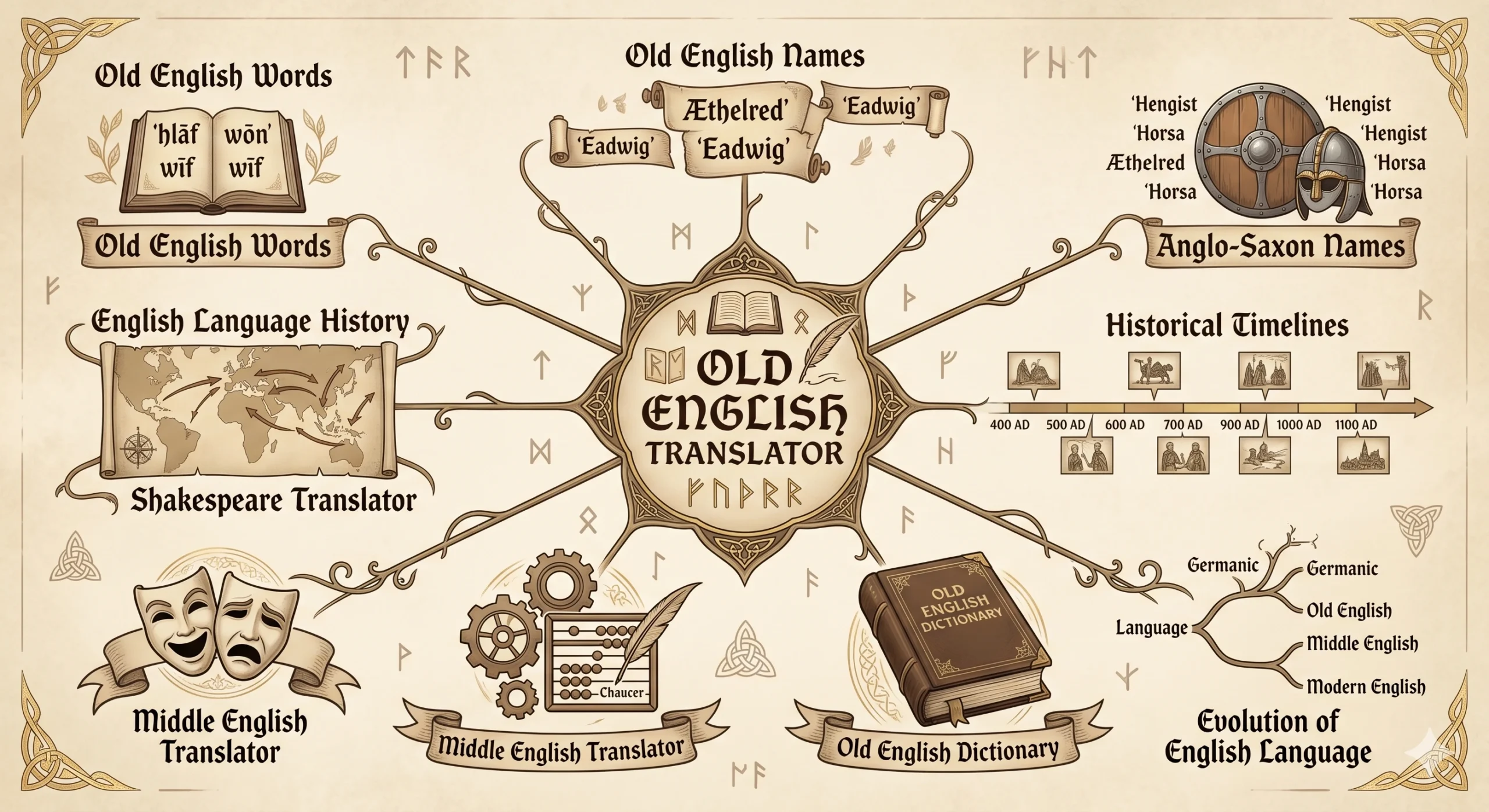
1. What is a Historical Timeline?
A historical timeline serves as humanity’s collective memory rendered in sequence. At its most fundamental level, it is a structured chronological framework that plots events, discoveries, births, deaths, conflicts, and cultural shifts along an ordered axis — almost always time itself. But a truly authoritative historical timeline is far more than a list of dates. It reveals the relationships between events: how the fall of Rome influenced the development of feudalism, how the printing press accelerated the Protestant Reformation, how the Industrial Revolution made two World Wars mechanically possible.
Historians distinguish between diachronic timelines — which trace a single subject (a dynasty, a language, a technology) through successive time periods — and synchronic timelines, which compare multiple subjects at the same moment in time. Both types are valuable. The diachronic timeline answers, “How did this develop over time?” The synchronic timeline answers, “What was happening simultaneously across the world?”
For the purposes of this guide, a historical timeline encompasses all of recorded and pre-recorded human experience: from the emergence of Homo sapiens in Africa roughly 300,000 years ago through the Stone Age, Bronze Age, and Iron Age, through the rise and fall of ancient civilizations in Mesopotamia, Egypt, China, and the Americas, through the Classical world of Greece and Rome, the Medieval period, the Renaissance, Enlightenment, Industrial Revolution, and into the turbulent Modern Age we inhabit today.
2. History of Timelines as a Concept
The impulse to record events in order is as old as writing itself. The Sumerian King List, compiled around 2100 BCE, recorded the names of rulers across successive dynasties in Mesopotamia — an act of deliberate chronological ordering. Egyptian annals inscribed on temple walls tracked military campaigns by regnal year. The Assyrian eponym lists assigned a named official to each calendar year, creating a precise chronological grid that modern archaeologists still use to anchor Near Eastern dates.
In the ancient Mediterranean world, the Greek historian Thucydides organized his account of the Peloponnesian War by summers and winters, establishing a model of event-ordered narrative. Eratosthenes of Cyrene, the third-century BCE polymath who also calculated Earth’s circumference, produced the first systematic Greek chronology — Chronographiai — dating events from the fall of Troy.
The Roman scholar Marcus Terentius Varro popularized the “Ab Urbe Condita” (AUC) dating system, counting years from the legendary founding of Rome. Medieval Christian scholars, notably the Venerable Bede, reoriented chronology around the birth of Christ, establishing the Anno Domini (AD) system that, with its BCE/CE variant, now dominates global timekeeping.
The Enlightenment transformed the timeline from a scholarly text into a visual tool. Joseph Priestley’s 1765 “A Chart of Biography” — a long printed sheet mapping the lifespans of 2,000 historical figures as horizontal bars — is widely considered the first modern visual timeline. Priestley’s 1769 “A New Chart of History” followed, covering 3,000 years of world events. These innovations made chronological thinking accessible to general readers and inspired generations of educators and historians.
3. Why Historical Timelines Matter
Understanding history through timelines accomplishes something that prose narrative alone cannot: it makes temporal relationships visible. Consider these examples of why timeline thinking is transformative:
Causal chains become clear. When you see that the Black Death (1347–1353) wiped out roughly one-third of Europe’s population and that the Renaissance’s renewed emphasis on individual human worth began just decades later, the connection becomes compellingly visible. Labor shortages after the plague gave surviving workers unprecedented economic power; that shift in social dynamics contributed to challenging medieval hierarchies in art, philosophy, and religion.
Simultaneous civilizations are revealed. Many people are surprised to discover that while Rome was falling in the West (476 CE), the Gupta Empire in India was experiencing a golden age of mathematics and astronomy, and the Maya civilization in Central America was building its most elaborate cities. A historical timeline that covers multiple regions simultaneously dismantles the Eurocentric assumption that history happened in one place at a time.
Patterns of rise and fall emerge. Civilizations grow, peak, and decline with a regularity that becomes apparent when several empires are plotted together. The Akkadian Empire, the Bronze Age collapse, the Western Roman Empire, the Tang Dynasty, the Byzantine Empire, the Ottoman Empire — each followed broadly comparable arcs of consolidation, expansion, and fragmentation. Recognizing these patterns is one of history’s most practical lessons.
4. Types of Historical Timelines
Historical timelines take many forms, each suited to different research and educational purposes:
1. Chronological / Linear Timeline
The most common form. Events are plotted from earliest to latest along a single axis. Ideal for tracing the development of a single nation, person, civilization, or technology from origin to outcome. A linear timeline of the British Empire, for example, would run from the first Elizabethan colonies of the 1580s through the 1997 handover of Hong Kong.
2. Comparative / Parallel Timeline
Multiple timelines run side by side, allowing direct comparison. A comparative timeline of the Persian Empire and the Greek city-states during the same period reveals how these civilizations’ histories intersected, diverged, and ultimately collided at Marathon (490 BCE) and Thermopylae (480 BCE).
3. Thematic Timeline
Organized by subject rather than geography. A Scientific Discoveries Timeline, for instance, would include Archimedes’ principles, Newton’s laws, Darwin’s theory of natural selection, Einstein’s theory of relativity, and Watson and Crick’s DNA structure — drawn from many cultures and centuries but unified by subject matter.
4. Interactive / Digital Timeline
Modern digital timelines allow users to zoom in on specific periods, click events for detailed information, and filter by category. These tools are increasingly powered by AI — like the Historical Timeline Generator above — enabling instant, custom chronological research.
5. Ancient History Timeline
The ancient history timeline stretches from the earliest evidence of human culture through approximately 500 CE, encompassing the entire arc of civilization’s earliest development. Below is a milestone summary of the ancient world:
| Date | Era | Event / Milestone | Region |
|---|---|---|---|
| c. 300,000 BCE | Paleolithic | Emergence of Homo sapiens in Africa | Africa |
| c. 10,000 BCE | Neolithic | Agricultural Revolution; first farming settlements | Fertile Crescent |
| c. 3500 BCE | Bronze Age | Invention of writing (cuneiform) in Sumer | Mesopotamia |
| c. 3100 BCE | Bronze Age | Unification of Upper and Lower Egypt; First Dynasty | Egypt |
| c. 2560 BCE | Bronze Age | Great Pyramid of Giza constructed under Pharaoh Khufu | Egypt |
| c. 2334 BCE | Bronze Age | Sargon of Akkad founds world’s first empire | Mesopotamia |
| c. 1754 BCE | Bronze Age | Code of Hammurabi — earliest surviving law code | Babylon |
| c. 1200 BCE | Bronze Age | Bronze Age Collapse; fall of Mycenaean Greece, Hittites | Mediterranean |
| c. 1000 BCE | Iron Age | Iron Age begins; widespread use of iron tools | Global |
| 753 BCE | Iron Age | Traditional founding date of Rome | Italy |
| 508 BCE | Classical | Cleisthenes establishes Athenian democracy | Greece |
| 490 BCE | Classical | Battle of Marathon; Persian invasion repelled | Greece/Persia |
| 336–323 BCE | Classical | Alexander the Great conquers Persian Empire | Mediterranean/Asia |
| 221 BCE | Classical | Qin Shi Huang unifies China; first emperor | China |
| 44 BCE | Classical | Assassination of Julius Caesar; end of Roman Republic | Rome |
| 27 BCE | Classical | Augustus becomes first Roman Emperor | Rome |
| 476 CE | Late Antique | Fall of Western Roman Empire | Rome |
6. Classical Era Timeline
The Classical Era (roughly 500 BCE to 500 CE) represents one of the most intellectually productive periods in world history, with parallel developments across multiple civilizations:
7. Medieval History Timeline
The Middle Ages — spanning roughly 500 to 1500 CE — witnessed the rise of Islam and its golden age of science, the construction of Gothic cathedrals, the preservation of classical knowledge in Byzantine and Islamic libraries, the Mongol conquests, and the gradual development of Europe’s nation-states.
| Date | Event | Significance |
|---|---|---|
| 570 CE | Birth of Muhammad | Founder of Islam; within a century of his death, the Caliphate stretched from Spain to Central Asia |
| 622 CE | The Hijra | Year 1 of the Islamic calendar; marks the founding of the first Muslim community-state |
| 711 CE | Moorish conquest of Iberia | Islamic rule in Spain lasted until 1492; al-Andalus became a center of learning |
| 800 CE | Charlemagne crowned Holy Roman Emperor | First unification of Western Europe since Rome; laid foundations for France and Germany |
| 1054 CE | Great Schism | Split between Roman Catholicism and Eastern Orthodoxy; shaped European religious development |
| 1066 CE | Norman Conquest of England | William the Conqueror’s victory at Hastings transformed English language and culture |
| 1096–1291 | The Crusades | Military campaigns connecting Europe and the Middle East; shaped trade and cultural contact |
| 1215 CE | Magna Carta signed | English barons forced King John to acknowledge limits on royal power; landmark in constitutional law |
| 1206–1368 | Mongol Empire | Genghis Khan and his successors created the largest contiguous land empire in history |
| 1347–1353 | Black Death in Europe | Bubonic plague killed 30–50% of Europe’s population; accelerated social and economic shifts |
| 1453 CE | Fall of Constantinople | Ottoman forces under Mehmed II ended the Byzantine Empire, ending the medieval era in the East |
The Byzantine Empire: Rome’s Eastern Heir
While Western Europe fragmented after 476 CE, the Byzantine Empire — the eastern continuation of the Roman Empire centered in Constantinople (modern Istanbul) — survived for nearly a thousand years longer, until 1453 CE. The Byzantines preserved Roman law, Greek philosophy, and Christian theology, transmitting classical knowledge to both the Islamic world and the European Renaissance. Emperor Justinian I (527–565 CE) codified Roman law in the Corpus Juris Civilis, a document that forms the basis of most European legal systems today.
The Mongol Empire: World History’s Greatest Land Empire
Genghis Khan (born Temüjin, c. 1162 CE) unified the nomadic Mongol tribes of Central Asia and launched the most rapid territorial expansion in world history. By the time of his death in 1227 CE, the Mongol Empire stretched from the Pacific coast of China to the Caspian Sea. His successors extended it further, creating an entity that at its peak in 1270 CE encompassed roughly 24 million square kilometers — about 16% of Earth’s total land area. The Pax Mongolica that followed facilitated the Silk Road trade, transferring technologies like paper, gunpowder, and the compass from China to the West, which paved the way for the Modern Era.
8. Renaissance Timeline
The Renaissance (meaning “rebirth”) was a cultural, artistic, political, and scientific transition spanning the 14th to the 17th century. Starting in Florence, Italy, it marked the rediscovery of classical Greek and Roman philosophy, literature, and art.
9. Industrial Revolution Timeline
The Industrial Revolution (c. 1760 to 1840) marked the transition from hand production methods to machines, introducing new chemical manufacturing, iron production processes, steam power, and the rise of the factory system. It originated in Great Britain and quickly spread to Europe and North America.
| Year | Innovation / Event | Impact |
|---|---|---|
| 1712 | Newcomen Steam Engine | First practical device to harness steam power to pump water out of mines |
| 1769 | James Watt patents improved steam engine | Greatly increased efficiency, making steam power viable for factories and transport |
| 1793 | Eli Whitney invents the Cotton Gin | Revolutionized the processing of cotton, drastically increasing cotton production and reinforcing slavery in the American South |
| 1807 | Robert Fulton’s commercial Steamboat | Transformed water transport, opening up rivers for rapid two-way commercial shipping |
| 1830 | Liverpool and Manchester Railway opens | The world’s first inter-city passenger railway line using steam locomotives; ushered in the Railway Age |
| 1844 | Samuel Morse sends first telegraph message | Initialized instant long-distance electronic communication across continents |
10. Modern History Timeline
The Modern Era (20th Century to Present) is characterized by rapid technological advancement, global conflicts, the rise and fall of ideologies, and unprecedented globalization.
11. World History Timeline by Region
Human development occurred in parallel across continents, creating a rich tapestry of overlapping regional histories:
East Asia
Dominated by successive Chinese dynasties (Han, Tang, Song, Ming, Qing), which developed advanced metallurgy, printing, porcelain, and bureaucratic governance systems that influenced Japan, Korea, and Vietnam.
South Asia
Home of the Indus Valley Civilisation, followed by the Maurya and Gupta Empires (Golden Age of mathematics and zero), the Delhi Sultanate, and the Mughal Empire, famed for architectural and artistic synthesis.
Mesoamerica & Andes
The Maya, Aztec, and Inca civilizations constructed monumental stone architectures, advanced astronomical calendars, and complex agricultural terrace networks without Old World beasts of burden.
Africa
From the Kingdom of Aksum (major trade hub of the Red Sea) and the medieval empire of Mali (Mansu Musa’s gold wealth) to the Great Zimbabwe stone structures, Africa was home to rich trade and kingdoms.
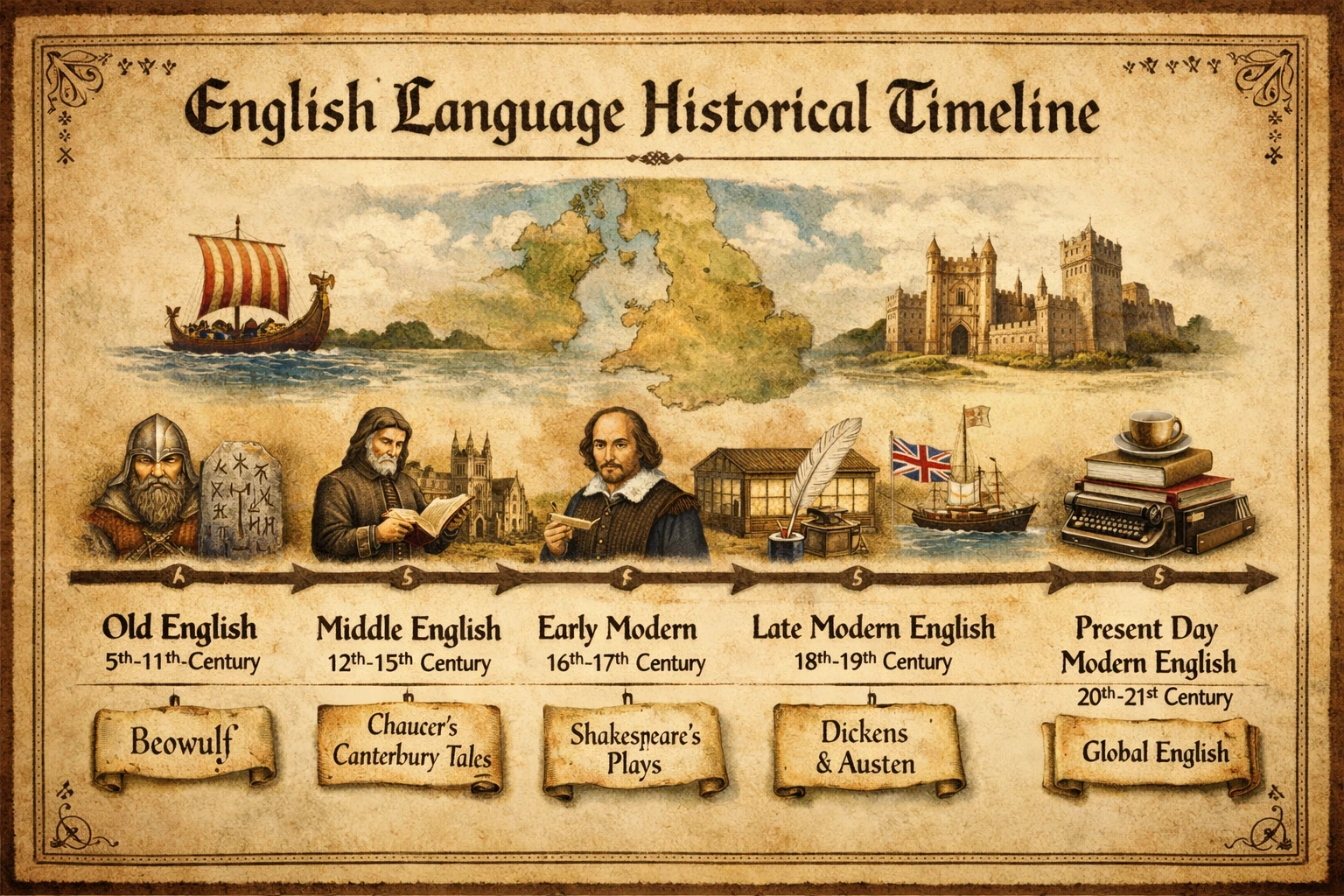
12. English Language History Timeline
The English language itself evolved through distinct historical phases reflecting the political conquests of the British Isles:
- Old English (450–1150 CE): A fully inflected West Germanic tongue brought by Anglo-Saxon settlers, featuring runic scripts and Germanic vocabulary (represented in works like Beowulf).
- Middle English (1150–1500 CE): Heavy grammatical simplification and massive French vocabulary influx following the Norman Conquest of 1066 (popularized by Geoffrey Chaucer’s Canterbury Tales).
- Early Modern English (1500–1700 CE): Characterized by the Great Vowel Shift and the stabilization of spelling due to the printing press (exemplified in William Shakespeare’s plays and the King James Bible).
- Late Modern English (1700 CE–Present): Expansion of technical and scientific vocabulary and the global divergence of dialects due to the British Empire and American cultural influence.
13. Key Historical Entities: Figures, Events & Eras
A deep timeline of world history is punctuated by key figures whose decisions altered the political landscapes of their times:
Alexander the Great
King of Macedon who conquered the Persian Empire by age 30, spreading Hellenistic Greek culture across western Asia and northern Africa.
Julius Caesar
Roman general and statesman whose military campaigns and eventual dictatorship paved the way for the transition from Roman Republic to Roman Empire.
Genghis Khan
Founder of the Mongol Empire. His military genius unified nomadic tribes and established trade corridors that connected East and West.
Queen Elizabeth I
Her 45-year reign established Protestantism in England, witnessed the expansion of English drama (Shakespeare), and laid foundations for global naval power.
14. Science & Technology Timeline
Linguistic and empire achievements were supported by major scientific breakthroughs that transformed human capacities:
- c. 3500 BCE: The invention of the wheel in Mesopotamia.
- c. 105 CE: Cai Lun invents paper making in Han Dynasty China.
- 1687 CE: Isaac Newton publishes Principia Mathematica, detailing the laws of motion and universal gravitation.
- 1796 CE: Edward Jenner develops the first successful smallpox vaccine.
- 1903 CE: The Wright Brothers achieve the first controlled, sustained powered flight.
- 1947 CE: Invention of the point-contact transistor, launching the modern electronics and computing industry.
Explore Related Tools
Frequently Asked Questions
Structured Data Schema
This page uses Article, FAQPage, and BreadcrumbList schemas for maximum SEO visibility.
{
  "@context": "https://schema.org",
  "@graph": [
    {
      "@type": "BreadcrumbList",
      "itemListElement": [
        { "@type": "ListItem", "position": 1, "name": "Home", "item": "https://partnerhoursguide.com/" },
        { "@type": "ListItem", "position": 2, "name": "Blog", "item": "https://partnerhoursguide.com/old-english-words-we-still-use-today/" },
        { "@type": "ListItem", "position": 3, "name": "Historical Timeline", "item": "https://partnerhoursguide.com/historical-timeline/" }
      ]
    },
    {
      "@type": "Article",
      "headline": "Historical Timeline: Complete World History Guide & Generator",
      "description": "Explore the complete Historical Timeline from ancient civilizations to today. Use our free Historical Timeline Generator to create custom timelines instantly.",
      "url": "https://partnerhoursguide.com/historical-timeline/",
      "inLanguage": "en-US",
      "publisher": {
        "@type": "Organization",
        "name": "Partner Hours Guide",
        "url": "https://partnerhoursguide.com/"
      }
    }
  ]
}