The history of languages is the history of humanity itself. Right now, approximately 7,000 languages are spoken across the globe — yet a language disappears roughly every two weeks. From the first grunts of prehistoric communication to the rise of Proto-Indo-European, from the death of Latin as a spoken tongue to the miraculous revival of Hebrew, language has always been the most human thing about us. Whether you speak English, Arabic, Mandarin Chinese, French, Spanish, German, or Japanese — every word you utter carries thousands of years of history. This guide explores that journey in full — and links you to tools on partnerhoursguide.com so you can explore the oldest layers of the English language yourself.
What Is the History of Languages?
The history of languages — formally called historical linguistics — is the scientific study of how languages arise, change, branch into families, borrow from each other, and sometimes disappear. It connects linguistics with archaeology, anthropology, migration studies, and genetics. It answers questions like: Why does English share words with Hindi? How did one ancient tongue become today's Spanish, French, Italian, Portuguese, and Romanian? And what happens to a culture when its language dies?
Understanding language history means understanding human history — because every migration, conquest, trade route, and empire is recorded in the words people used to describe their world.
The First Human Language: What We Know (and Don't Know)
The Origins of the First Human Language
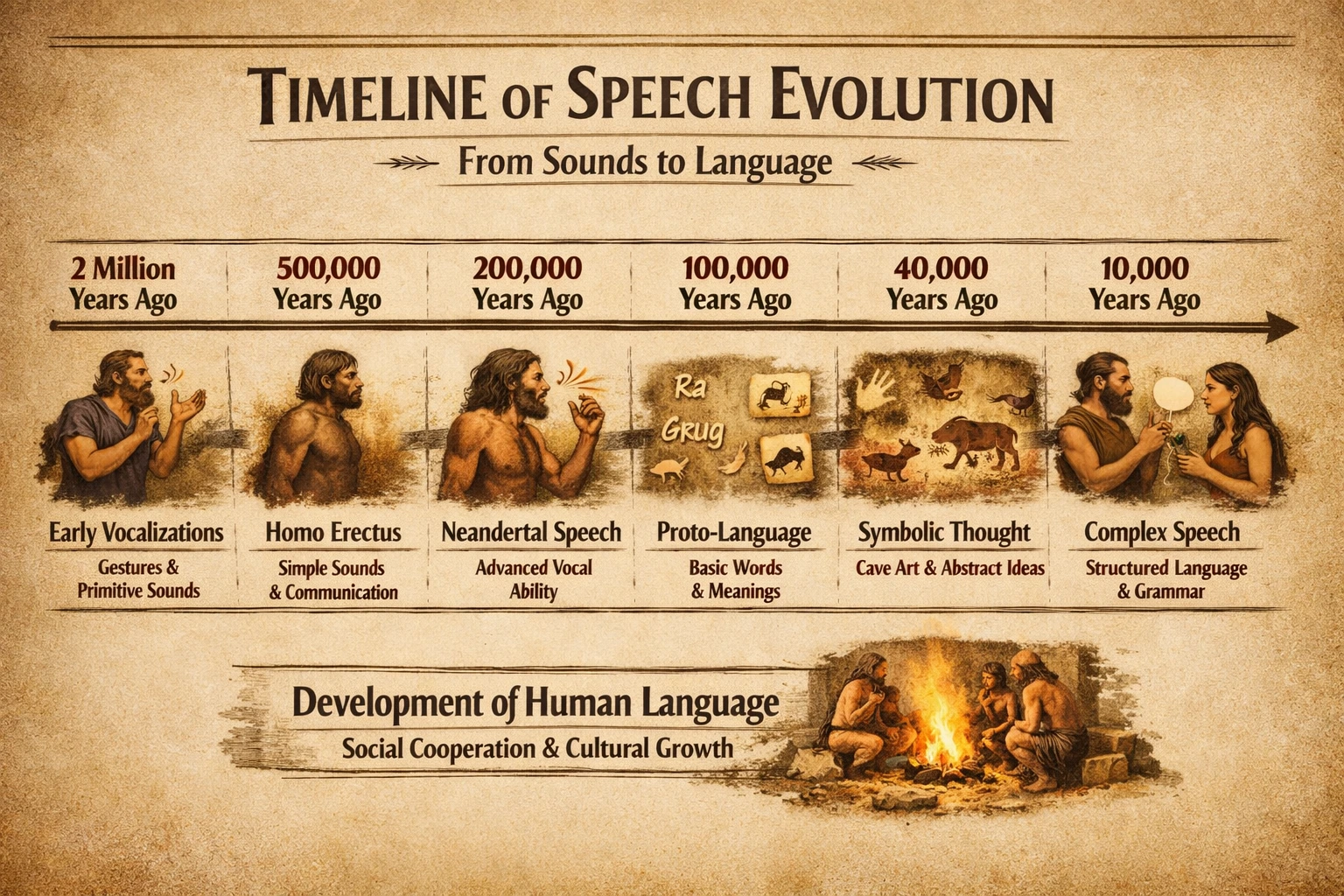
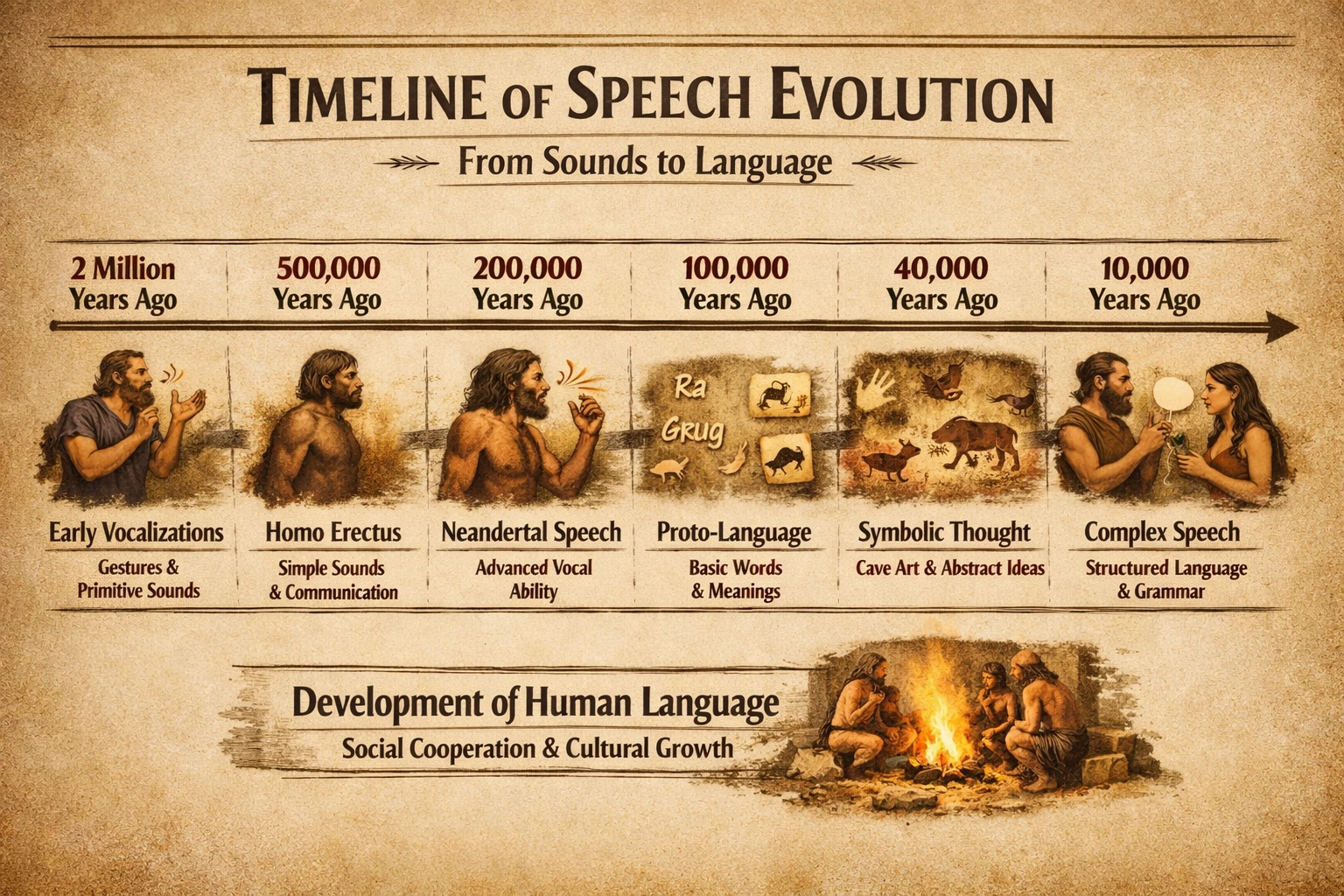
No one knows with certainty — and this is one of the oldest debates in scholarship. Spoken language leaves no fossil record. Researchers rely on indirect evidence: changes in skull anatomy, the development of the hyoid bone (essential for speech), archaeological evidence of symbolic behavior, and computational models.
Most scholars agree that Homo sapiens developed complex spoken language sometime between 100,000 and 50,000 years ago, though some propose earlier dates. What sparked it? Theories include:
- Biological evolution — changes in brain structure and the vocal tract made articulate speech physically possible.
- Social cooperation — larger, more complex groups needed precise communication to coordinate hunting, share knowledge, and build alliances.
- Gesture-first hypothesis — bodily signs preceded vocal speech, gradually giving way to sound.
- Ritual and symbolic thinking — language emerged alongside art, burial practices, and shared cultural meaning.
The honest answer: language did not switch on overnight. It evolved gradually, likely across tens of thousands of years, in ways we may never fully reconstruct.
Linguistic entities to know: Proto-language, language origin, vocal tract evolution, symbolic communication, Homo sapiens, cognitive development.
What Is Chomsky's Main Theory?
Chomsky's Universal Grammar Theory Explained
Noam Chomsky's central contribution to linguistics is the theory of Universal Grammar (UG) — the idea that all humans are born with an innate, biologically determined capacity for language. According to Chomsky, the brain contains a "language acquisition device" (LAD) that allows children to rapidly learn any language they are exposed to, without needing explicit instruction for every rule.
Key claims of Chomsky's framework:
- Deep structure vs. surface structure — sentences have a hidden logical structure (deep) and a spoken form (surface). Transformational grammar describes how one maps to the other.
- Poverty of the stimulus — children learn grammar rules far too quickly and accurately to have learned them purely from imitation. This suggests built-in linguistic knowledge.
- Language is species-specific — no other animal possesses the recursive, structure-dependent grammar humans use.
Chomsky's theory has been hugely influential and hotly debated. Critics argue that language is more cultural and social than he suggests. But his core insight — that language is not just a learned habit but a biological endowment — permanently changed how we understand the history of languages and human cognition.
From Speech to Writing: The First Texts
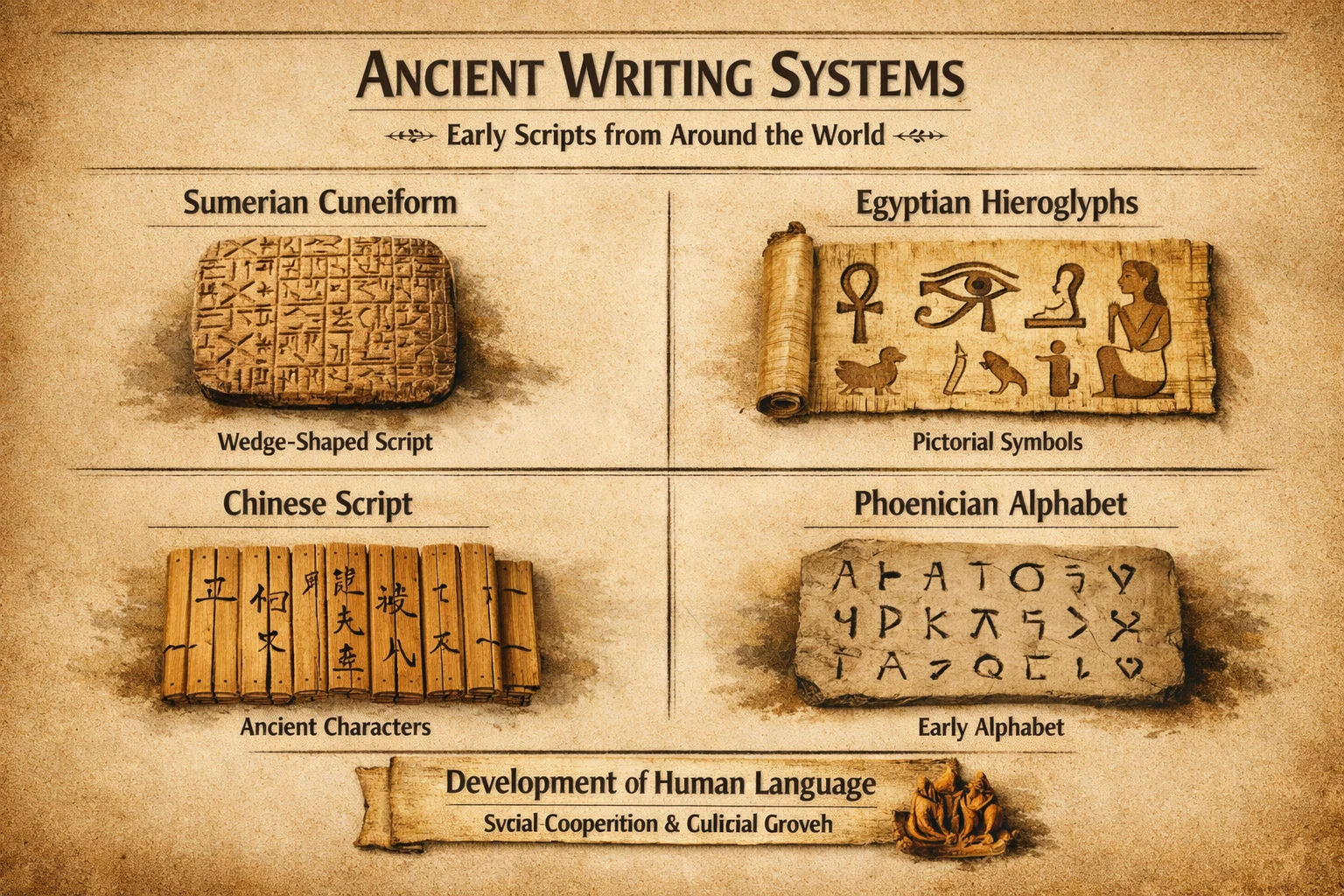
For most of human prehistory, language existed only as sound. Writing emerged not as a biological development but as a cultural technology — invented independently in at least three places:
- Mesopotamia (~3200 BCE) — Sumerian cuneiform, initially used for accounting and taxation.
- Egypt (~3100 BCE) — hieroglyphics, used for religious and royal records.
- China (~1200 BCE) — oracle bone script, used for divination.
Writing transformed language. It created a durable record that could outlast the speaker, allowing states to administer laws, scholars to compare texts, and religions to canonize scripture. Written standards also began to influence spoken language — a process that continues today, especially with the Chinese alphabet system, classical Arabic, and literary Greek language traditions that preserved older forms for centuries.
Did you know? The Shakespeare English Translator on partnerhoursguide.com lets you explore the historical gap between Early Modern English and today's speech — a perfect illustration of how written language preserves older forms.
The 10 Oldest Languages in the World
The 10 Oldest Languages in the World
Ranking languages by age is complex — "oldest" can mean oldest written record, oldest continuous spoken tradition, or oldest reconstructed ancestor. With those caveats, here are ten languages with the deepest documented histories: Sumerian, Egyptian/Coptic, Akkadian, Elamite, Sanskrit, Greek, Hebrew, Aramaic, Tamil, and Old Chinese.
Here are ten languages with the deepest documented histories:
- Sumerian (~3500 BCE) — first written language; now extinct as a spoken tongue.
- Egyptian/Coptic (~3100 BCE) — descended into Coptic, still used liturgically.
- Akkadian (~2800 BCE) — Semitic language of Babylon and Assyria; extinct.
- Elamite (~2600 BCE) — ancient Iran; extinct.
- Sanskrit (~1500 BCE) — ancestor of Hindi, Bengali, and many South Asian languages; still used in religious contexts.
- Greek language (~1400 BCE, Mycenaean form) — one of the few ancient languages with continuous literary tradition to the present.
- Hebrew (~1000 BCE written; revived as a spoken language in the 20th century).
- Aramaic (~900 BCE) — language of Jesus; still spoken by small communities.
- Tamil (~300 BCE) — one of the world's oldest living languages with unbroken literary tradition.
- Chinese/Old Chinese (~1200 BCE, oracle bone inscriptions) — ancestor of Mandarin Chinese and all Sinitic languages.
Explore the ancient roots of English specifically with the Old English Name Generator — featuring hundreds of authentic ancient English names and old English first names rooted in Anglo-Saxon tradition.
Language Families: The Great Branches of Human Speech
One of the most important discoveries in historical linguistics is that most languages belong to families — groups descended from a common ancestor, called a proto-language. Linguists reconstruct these ancestors using the comparative method: identifying systematic sound correspondences across related languages.
The Indo-European Family
The most studied family in the world. It includes:
- Germanic branch: English, German, Dutch, Swedish, Norwegian
- Romance branch: Spanish (and Spanish language classes worldwide), French, Italian, Portuguese, Romanian
- Slavic branch: Russian, Polish, Czech
- Indo-Iranian branch: Hindi, Urdu, Persian
- Hellenic branch: Greek language
- Celtic branch: Welsh, Irish, Scots Gaelic
All descended from Proto-Indo-European (PIE), spoken roughly 5,000–6,000 years ago on the Eurasian steppes.
Other Major Families
- Sino-Tibetan — Mandarin Chinese, Tibetan, Burmese
- Afro-Asiatic — Arabic language, Hebrew, Amharic, Berber languages
- Japonic — Japanese language (largely isolated, with debated external connections)
- Uralic — Finnish, Hungarian, Estonian
- Dravidian — Tamil, Telugu, Kannada
- Austronesian — Malay, Hawaiian, Tagalog, Malagasy
- Niger-Congo / Bantu — Swahili, Zulu, Yoruba
Each family is a record of ancient migrations, trade networks, and cultural contact. The spread of Arabic through Islamic expansion, Spanish through colonial conquest, and English speaking through the British Empire and later American cultural dominance all shaped the current global language map profoundly.
The 7 Stages of Language Development
This question is often asked in the context of child language acquisition — how an individual develops language from birth. The seven stages are:
- Pre-linguistic / Crying stage (0–2 months) — Newborns communicate needs through crying. No intentional language yet, but the vocal apparatus is already at work.
- Cooing stage (2–4 months) — Soft, vowel-like sounds (ooh, aah). The beginning of voluntary vocal play.
- Babbling stage (4–10 months) — Repetitive consonant-vowel combinations: "ba-ba-ba," "da-da-da." Babies begin to tune into the sounds of their native language.
- Holophrastic / One-word stage (10–13 months) — Single words carry full meanings. "Milk" means "I want milk." "Up" means "Pick me up."
- Two-word stage (18–24 months) — Simple two-word combinations: "Daddy go," "More juice." Grammar begins to emerge.
- Telegraphic stage (24–30 months) — Short, content-heavy sentences without function words: "Mummy go shop." The child understands sentence order.
- Multi-word / Complex stage (30 months+) — Full sentences, questions, negatives, and grammatical rules acquired rapidly. By age 5, most children have mastered the core grammar of their native language.
These stages are broadly universal across languages — whether a child is learning English, French, German, Japanese, or Arabic, the sequence holds remarkably constant. This universality is one reason Chomsky's theory of Universal Grammar remains compelling.
How Many Languages Exist Today — and Are We Losing Them?
There are approximately 7,000 languages alive today — but the picture is deeply uneven. The top 23 languages account for more than half the world's speakers. Meanwhile, around 40% of living languages are endangered, spoken by fewer than 1,000 people.
A language dies roughly every two weeks.
The mechanism is usually the same: communities shift toward dominant languages — English, Mandarin, Spanish, Arabic, French — for economic survival, education, and social mobility. Within a generation or two, children stop learning the ancestral tongue at home. The last fluent speakers age and pass away, and a language that may have existed for thousands of years is gone.
Languages on the edge of extinction include:
- Ainu (Japan) — fewer than 10 native speakers remain
- Yuchi (USA, Oklahoma) — estimated 5 fluent speakers
- Ter Sami (Russia) — 2 known speakers
- Chamicuro (Peru) — last speaker died in recent years
Want to explore a language that nearly disappeared but survived? Old English — the language of Beowulf and the Anglo-Saxons — gave way to Middle and then Modern English, but its vocabulary and old English first names live on. Explore them with the Old English Name Generator and the Old English Translator on partnerhoursguide.com.
What Happens When a Language Dies?
When a language disappears, it takes with it something irreplaceable:
- Unique vocabulary for local plants, animals, weather, and ecological conditions that no other language captures
- Oral literature — songs, stories, proverbs, histories — that exist in no written form
- Cognitive frameworks — distinct ways of organizing time, space, kinship, color, and number
- Cultural identity — the language is often the primary marker of a people's sense of self
The Amazonian language Pirahã has no words for numbers or colors as distinct categories. The Australian language Guugu Yimithirr uses absolute directions (north, south, east, west) instead of relative ones (left, right) — shaping how its speakers mentally orient themselves in space. These are not just curiosities; they reveal that languages encode genuinely different ways of experiencing the world.
As the scholar Wade Davis wrote: losing a language is like burning a library no one has fully read. Every extinction is also an epistemological loss.
Can a Dead Language Be Revived?
Yes — and Hebrew is the proof.
Hebrew ceased to be a spoken vernacular for nearly 1,700 years, surviving only in religious texts and scholarly contexts. In the late 19th century, linguist and activist Eliezer Ben-Yehuda began the deliberate project of modernizing Hebrew and promoting it as an everyday spoken language for Jewish communities in Palestine. New vocabulary was coined for modern concepts — newspaper, dictionary, towel, ice cream — that biblical Hebrew had no words for.
By 1948, when Israel was established, Hebrew was the de facto national language. Today it has over 9 million native speakers.
Other partial revival successes:
- Welsh — once in serious decline, now spoken by over 800,000 people thanks to political support, Welsh-medium education, and S4C television.
- Māori (New Zealand) — revitalization through immersion schools (kura kaupapa) and official language status.
- Irish (Gaelic) — constitutional recognition and Gaeltacht communities maintain a living speaker base.
The lesson: revival requires political will, community commitment, and institutional support. It never happens by accident.
Language and Empire: How Power Shapes Speech
Empires are among the most powerful forces in language history. Conquered regions often adopt the administrative, religious, or prestige language of their rulers — and this process reshapes entire language maps.
- Latin spread through the Roman Empire — and then fragmented into French, Spanish, Italian, Portuguese, Romanian, and Catalan as Rome fell and regional communities diverged.
- Arabic spread through Islamic expansion across the Middle East, North Africa, and parts of Central Asia, displacing Aramaic, Coptic, and Berber in many regions.
- Spanish language spread through colonial conquest of the Americas, becoming the dominant language across most of South and Central America.
- English speaking became globally dominant through the British Empire and, later, American cultural, economic, and technological power.
Empire can both spread and destroy languages. Colonial education policies in Africa, the Americas, Australia, and South Asia suppressed indigenous languages — many of which are still recovering today.
The Future of Language: Globalization, AI, and What Comes Next
Globalization is accelerating language loss while simultaneously creating new contact languages:
- Singlish (English + Malay + Tamil + Chinese, Singapore)
- Spanglish (Spanish + English, US/Latin America border zones)
- Hinglish (Hindi + English, urban India)
- Internet-born slang, emoji-inflected writing, and AI-generated text are all creating new linguistic norms at unprecedented speed.
AI and machine translation may reduce the economic incentive to learn foreign languages — which could paradoxically accelerate the extinction of smaller languages, since speakers lose motivation to maintain them when translation technology bridges the gap.
On the other hand, digital technology is also enabling language documentation and preservation at scale. AI tools can record, transcribe, and analyze endangered languages faster than any previous method.
Whether humanity converges toward a handful of dominant languages or finds new tools to maintain diversity is one of the defining cultural questions of this century. Explore how language learning tools and translation technology are evolving at partnerhoursguide.com.