The bottom line up front: Old English vs. Modern English is not a small gap — it's a chasm of a thousand years. Old English (Anglo-Saxon, 450–1150 AD) and Modern English (1700–present) are so different that a fluent English speaker today would understand essentially zero of a spoken Old English conversation. Yet roughly 100 of the 250 most frequently used words in Modern English came directly from Old English. The language changed completely. The roots never moved. Here's exactly how — and how much.
Table of Contents
- The Story: Two Versions of the Same Language
- Old English vs. Modern English — The Core Difference
- Grammar: The Biggest Change of All
- Vocabulary: What Survived, What Was Lost
- Pronunciation: How Old English Actually Sounded
- Writing and Alphabet: From Runes to the Roman Script
- Old English Common Phrases vs. Their Modern Equivalents
- The Role of the Norman Conquest in the Language Shift
- Old English vs. Shakespearean English — Not the Same Thing
- How to Translate Between Old and Modern English Today
- Frequently Asked Questions
The Story: Two Versions of the Same Language
Here's a thought experiment that might stop you cold.
Imagine you're sitting across from a time traveler from the year 900 AD. They're Anglo-Saxon. Educated. Literate. They speak the English of their era with confidence and fluency. And you — a native Modern English speaker — cannot understand a single word they say.
Not one word.
That's not an exaggeration. Old English vs. Modern English is genuinely that dramatic a difference. The two forms of the language share a common ancestry the way a great-great-grandparent and great-great-grandchild share DNA — you can trace the lineage clearly, but you'd never mistake one for the other.
And yet.
The words you use to describe the most fundamental things in your life — your home, your children, your love, the earth beneath your feet, the water you drink, the night sky above you — those words were spoken by Anglo-Saxon farmers in the fields of Mercia twelve centuries ago. The surface changed beyond recognition. The core survived.
This is the story of how that happened, why it matters, and how you can explore it yourself using the free Old English Translator Tool at PartnerHoursGuide.com.
Old English vs. Modern English — The Core Difference
Before we go deep, here's the clearest possible summary of Old English vs. Modern English across the most important dimensions:
| Feature | Old English (450–1150 AD) | Modern English (1700–present) |
|---|---|---|
| Grammar type | Heavily inflected (like Latin/German) | Analytical (relies on word order) |
| Grammatical gender | Yes — masculine, feminine, neuter | No grammatical gender |
| Noun cases | Four cases — nominative, accusative, genitive, dative | Mostly lost; only in pronouns (he/him/his) |
| Vocabulary source | Primarily Germanic | Germanic + French + Latin + Norse + global |
| Verb forms | Complex conjugation system | Simplified conjugation |
| Alphabet | Latin + unique letters (þ, ð, Æ¿, È) | Standard 26-letter Roman alphabet |
| Mutual intelligibility | Near zero with Modern English | Near zero with Old English |
| Word order | Flexible (grammar signals meaning) | Fixed (order signals meaning) |
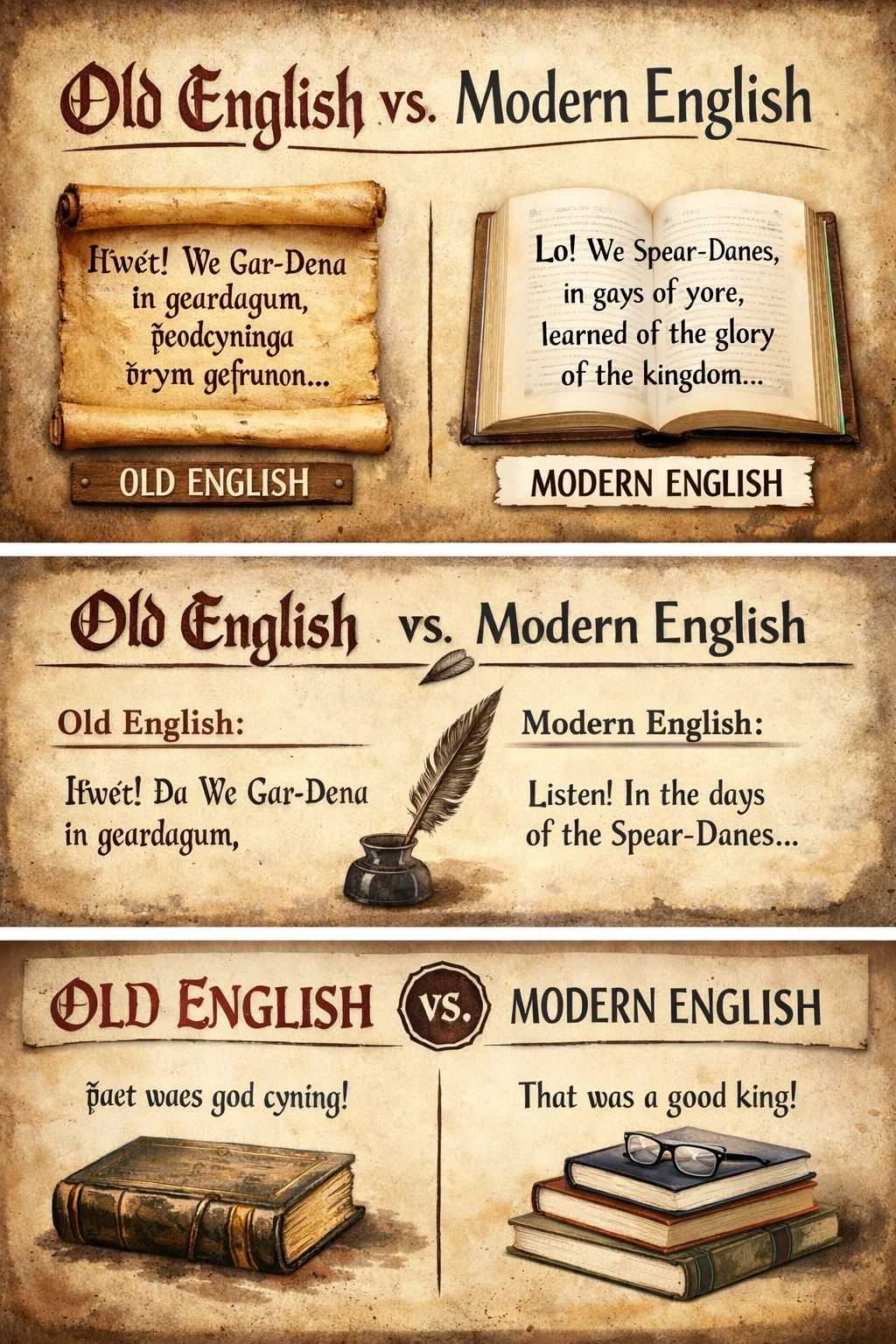
| Sample text | Hwæt! Wē Gār-Dena in geār-dagum | "Listen! We heard of the Spear-Danes' glory" |
The key insight in this comparison is the grammar shift. Old English was an inflected language — meaning the endings attached to words told you their grammatical role. Modern English is an analytical language — meaning word order and prepositions do that work instead. This single shift transformed virtually every aspect of how the language operates.
Grammar: The Biggest Change of All
If you've ever studied German, Latin, or Russian, you already have a head start on understanding Old English grammar. If you haven't, here's what you need to know.
Noun Cases in Old English
In Modern English, you know that "the dog bit the man" and "the man bit the dog" mean different things because of word order. Move the words around and the meaning flips entirely.
In Old English, you knew which noun was doing the biting and which was being bitten because of the suffix attached to the noun — not its position in the sentence. The same noun would be spelled differently depending on its grammatical role.
The Old English noun cyning (king) changed form depending on how it was used:
- Nominative (the king did something): se cyning
- Accusative (something was done to the king): þone cyning
- Genitive (of the king / the king's): þæs cyninges
- Dative (to/for the king): þæm cyninge
Modern English collapsed this entire system. We replaced it with: "the king," "the king's," "to the king." Prepositions and word order took over from inflectional endings. The language became simpler to learn — and far more dependent on rigid sentence structure.
Grammatical Gender
Modern English has natural gender — "he" for males, "she" for females, "it" for objects. Logical. Intuitive.
Old English had grammatical gender — which assigned masculine, feminine, or neuter status to nouns with no necessary connection to natural sex. The Old English word for "woman" (wīf) was grammatically neuter. The word for "wife" (cwēn) was feminine. The word for "man" (wer) was masculine but mann (person) was also masculine, even when referring to women.
This gender assignment affected every adjective, article, and pronoun that accompanied a noun — a layer of complexity that entirely disappeared from the language by the time of Middle English.
Verb Conjugation
Old English verbs were divided into two major classes — strong verbs (which changed their internal vowel to show tense, like Modern English sing/sang/sung) and weak verbs (which added a dental suffix, like Modern English walk/walked). Both classes had distinct endings for person and number that have since been largely abandoned.
Modern English has nearly eliminated personal verb endings. We say "I walk, you walk, he walks" — only the third-person singular retains a distinctive ending. Old English had separate forms for first, second, and third person in both singular and plural.
Vocabulary: What Survived, What Was Lost
The vocabulary shift between Old English and Modern English is perhaps the most visible difference — and the most fascinating.
What Survived
Despite a thousand years of change, Old English vocabulary forms the invisible skeleton of Modern English. The most fundamental concepts in any language — family, body, nature, time, basic actions — are almost entirely Old English in origin:
Family: father (fæder), mother (mōdor), brother (brōþor), sister (sweostor), son (sunu), daughter (dohtor)
Body: hand (hand), foot (fōt), eye (ēage), ear (ēare), heart (heorte), blood (blōd)
Nature: earth (eorþe), water (wæter), fire (fȳr), wind (wind), tree (trēow), stone (stān)
Time: day (dæg), night (niht), year (gēar), summer (sumor), winter (winter)
Basic verbs: be (bēon), have (habban), do (dōn), go (gān), come (cuman), see (sēon), eat (etan), drink (drincan)
These are the words you reach for first when you're tired, frightened, grieving, or joyful. They are your oldest words. They come from Old English.
What Was Lost
After the Norman Conquest of 1066, thousands of Old English words were displaced by French and Latin equivalents. The pattern was consistent: the Anglo-Saxon word survived for common, everyday use, while the French word was adopted for formal, elevated, or institutional contexts.
| Old English Word | Lost Meaning | French Replacement |
|---|---|---|
| Uhtceare | Pre-dawn anxiety | No equivalent survived |
| Mōdcræft | Intelligence, wisdom | Lost entirely |
| Weorðmynd | Honour, dignity | "Honour" (from French honneur) |
| Drēogan | To endure suffering | Lost in everyday use |
| Frēondscipe | Deep loyal friendship | Partly replaced by "friendship" |
| Lǣcedōm | Medicine, remedy | "Medicine" (from Latin/French) |
| Fyrdwīse | Military manner/skill | "Military" (from Latin) |
The losses reveal how thoroughly the Norman Conquest restructured English society — and the language that reflected it. Anglo-Saxon words for warfare (here, fyrd), governance (cyning, þegn), and religion (gāst, dryhten) were progressively replaced by French and Latin terms that carried institutional prestige.
Pronunciation: How Old English Actually Sounded
Written Old English is striking enough. Spoken Old English would stop most modern listeners dead.
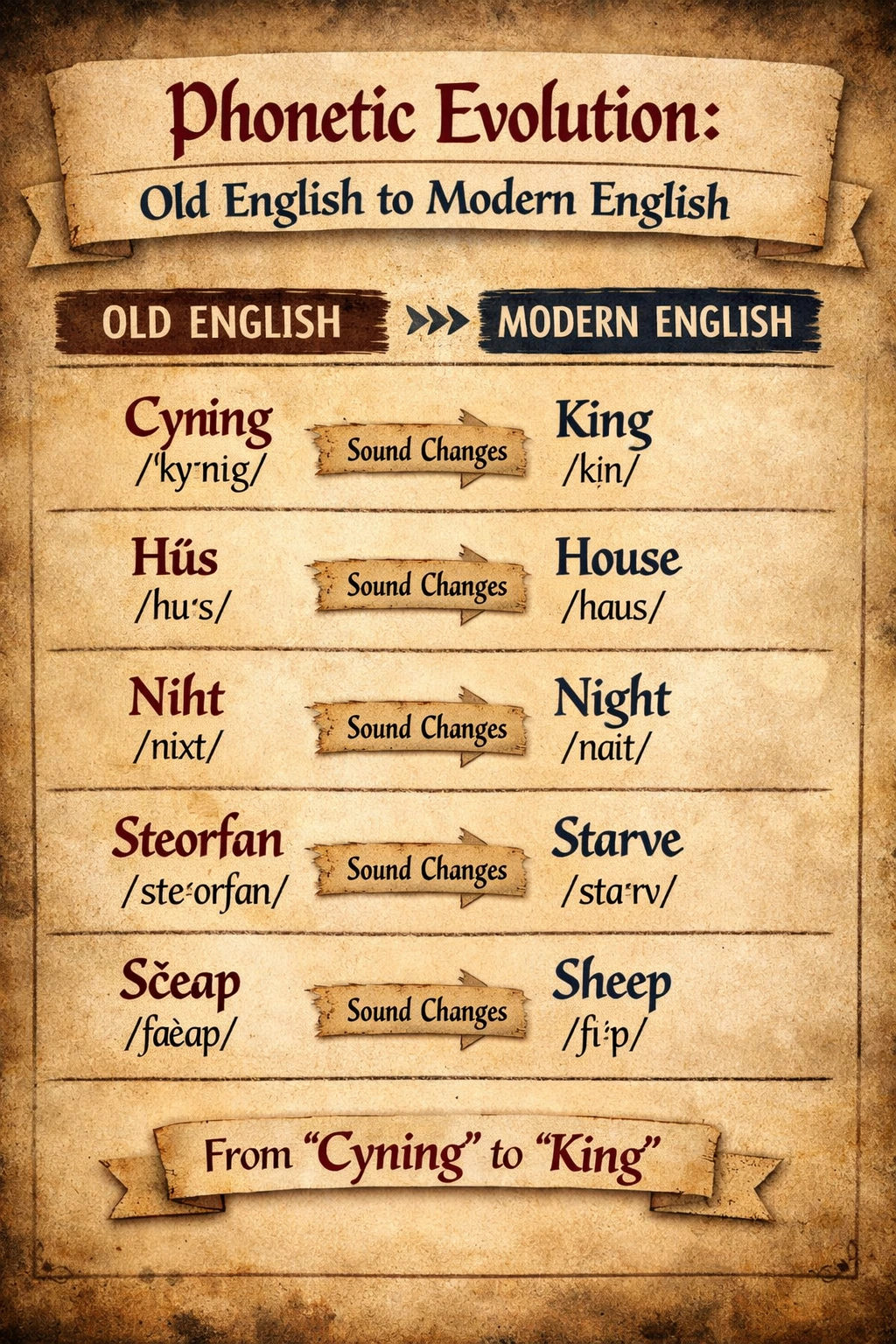
Old English vowels were pronounced consistently — more like Spanish or Italian than Modern English. Every letter was generally sounded. The letter c was pronounced as a hard "k" in most positions. The letters þ (thorn) and ð (eth) both represented the "th" sound, much as Modern English uses "th" in "thin" and "this."
The vowel shifts that separate Old from Modern English pronunciation happened gradually across the Middle and Early Modern periods. The Great Vowel Shift (approximately 1400–1700 AD) was the most dramatic of these — a systematic raising of long vowel sounds that transformed the spoken language almost beyond recognition. Words like tīd (time), hūs (house), and mīn (mine) sounded almost exactly as spelled in Old English. By the Early Modern period, the vowels had shifted into the sounds we recognize today.
Writing and Alphabet: From Runes to the Roman Script
Before the Christianization of England in the 7th century, Old English was written using the Futhorc — a runic alphabet adapted from earlier Germanic runes. The Futhorc was primarily used for short inscriptions on objects, memorials, and monuments.
With the arrival of Latin Christianity came the Latin alphabet, which Anglo-Saxon scribes adopted and adapted. They kept several runic characters alongside the new Roman letters: þ (thorn) for the "th" sound, ð (eth) for the same sound, and Æ¿ (wynn) for the "w" sound. They also used È (yogh) for certain consonant sounds.
These unique Old English type letters explain why authentic Old English manuscripts look so foreign to modern eyes — it's not just the words, it's the letterforms themselves.
For those interested in typing or using these characters, they are accessible via Unicode on modern systems. The PartnerHoursGuide Old English Translator handles Old English special characters natively, making it the easiest way to work with authentic Old English text online — functioning as both an Old English keyboard interface and a translation tool.

Old English Common Phrases vs. Their Modern Equivalents
Here is a direct comparison of Old English common phrases alongside their Modern English translations — one of the clearest ways to see exactly how much the language changed.
| Old English Phrase | Word-for-Word Gloss | Modern English Equivalent |
|---|---|---|
| Hwæt! Wē Gār-Dena | "Listen! We Spear-Danes" | "Hear! We of the Spear-Danes" |
| Mīn hām is hēr | "My home is here" | "My home is here" |
| Gōd is se cyning | "Good is the king" | "The king is good" |
| Ic lufige þē | "I love thee" | "I love you" |
| Hwær is þīn hām? | "Where is your home?" | "Where is your home?" |
| Se mann ēat bread | "The man eats bread" | "The man eats bread" |
| Wyrd bið ful ārǣd | "Fate is wholly inexorable" | "Fate is completely determined" |
| Þū eart mīn frēond | "You are my friend" | "You are my friend" |
| Ūre hlaford | "Our lord/master" | "Our lord" |
| On þissum dæge | "On this day" | "On this day" |
Notice something remarkable in these examples: many of the individual words are recognizable to a Modern English speaker — mann, bread, hām, frēond, dæg — even if the grammar and spelling look foreign. This is the through-line between Old and Modern English that linguists point to: the core vocabulary survived even as everything else transformed.
The phrase Wyrd bið ful ārǣd — "fate is wholly inexorable" — from the Old English poem The Wanderer, is one of the most quoted Old English sentences in literary history. The word wyrd is the direct ancestor of the Modern English word "weird," though its original meaning (fate, destiny) has drifted considerably.
To translate your own Old English sentences or convert Modern English to Old English, use the free Old English Sentence Translator at PartnerHoursGuide.com.
The Role of the Norman Conquest in the Language Shift
The single most transformative event in the history of the English language wasn't a grammatical evolution or a vowel shift. It was a military invasion.
On October 14, 1066, William the Conqueror defeated King Harold II at the Battle of Hastings. Within a generation, the ruling classes of England spoke Norman French. The court, the church, the law, and the administration of the country all operated in French and Latin. Anglo-Saxon English retreated to the villages, the fields, and the homes of ordinary people.
What followed over the next three centuries was a linguistic negotiation of extraordinary complexity. English absorbed approximately 10,000 French words between 1066 and 1400. Many of these words coexisted — and still coexist — with their Old English equivalents, creating the richly doubled vocabulary that gives Modern English its distinctive character.
Old English word → French alternative (Modern English keeps both):
- āscian (ask) / enquire (from French enquérir)
- stōw (place) / location (from French location)
- wēpan (weep) / cry (from French crier)
- swine (pig at the farm) / pork (from French porc, the meat at the table)
- cū (cow in the field) / beef (from French boeuf, the meat on the plate)
That last pair is one of the most famous examples in English etymology. The Anglo-Saxon peasants who raised the animals used the Old English words. The Norman aristocrats who ate the meat used the French words. Both survived — and now we use them both, in exactly the contexts their origins predict.
Old English vs. Shakespearean English — Not the Same Thing
One of the most persistent confusions in popular understanding of English language history is equating Old English with the language of Shakespeare. They are not the same. They are not even close to the same.
Shakespeare wrote in Early Modern English — the stage of the language that developed after 1500 AD. By Shakespeare's time (1564–1616), Old English had been extinct as a spoken language for over 400 years. Early Modern English was already highly recognizable to a modern reader — the words "thee," "thou," "dost," "hath," and "wherefore" that feel archaic to us today were simply normal speech in the Elizabethan era.
The real timeline:
- Old English (450–1150 AD) — Anglo-Saxon, fully inflected, Germanic, requires translation
- Middle English (1100–1500 AD) — Chaucer's English, partially readable with effort
- Early Modern English (1500–1700 AD) — Shakespeare's English, mostly readable today
- Modern English (1700–present) — the language you're reading right now
If you need to translate Shakespearean to English or work with Early Modern English vocabulary, the dedicated Shakespeare English Translator at PartnerHoursGuide.com is the right tool for that specific need. It handles Elizabethan grammar and vocabulary distinct from Old English translation.
For genuine Old English text from the Anglo-Saxon period, the Old English Translator Tool is your resource.
Explore our collection of surviving Old English words still in everyday use in this companion article: Old English Words We Still Use Today →
How to Translate Between Old and Modern English Today
Given how dramatically Old English differs from Modern English, translation requires either specialist knowledge or reliable tools. Here are the best approaches for different needs:
For Quick Reference and Learning
The Old English Translator Tool at PartnerHoursGuide.com is the fastest free resource available — functioning as an English to Old English translator, an Old English to English translator, an Old English phrase translator, and an Old English sentence translator all in one. No account, no subscription, no installation required.
For Shakespearean and Early Modern English
The Shakespeare English Translator at PartnerHoursGuide.com handles Early Modern English (1500–1700 AD) — the "thee and thou" language most people associate with archaic English. This is the tool to use when you need to translate Shakespearean to English or translate from English to old English in the literary, Elizabethan sense.
For Academic and Professional Work
The Bosworth-Toller Anglo-Saxon Dictionary (bosworthtoller.com) is the gold standard scholarly reference for Old English vocabulary. The Dictionary of Old English at the University of Toronto provides the most comprehensive modern lexicographic coverage of the corpus. For professional translation of Old English documents — manuscripts, genealogical records, legal texts — specialist translators can be sourced through ProZ.com and the American Translators Association directory.
For Understanding the Grammar
Mitchell & Robinson's A Guide to Old English remains the most accessible academic grammar for learners. Sweet's Anglo-Saxon Primer is the classic beginner's text. For digital learners, the Old English Aerobics website (University of Virginia) provides interactive grammar exercises.
The Summary: How Much Has the Language Changed?
Old English vs. Modern English is, by any linguistic measure, a story of radical transformation. The grammar changed from inflected to analytical. Grammatical gender disappeared. Thousands of words were lost to Norman French. The vowels shifted. The alphabet changed. The sentence structure inverted.
And yet.
The words you say when you call someone home for dinner — come, eat, drink, sit, bread, water — those are Old English words. The words you use in your most tender moments — love, heart, child, friend — those are Old English words. The words carved into the landscape around you — every English place name ending in -ham, -ton, -bury, -ford, -worth — those are Old English words.
The language changed beyond recognition. The soul of it never left.
Explore both for yourself — the Old English roots and the Shakespearean branches — with the free tools at PartnerHoursGuide.com.
Browse our Old English name generator to find authentic Anglo-Saxon names.
Frequently Asked Questions: Old English vs. Modern English
A useful rule is:
- “You” often becomes “thou” or “thee,” depending on grammar (StudyCountry).
- Possession shifts to “thy” or “thine” (StudyCountry).
- Verbs often take older endings like “-st” or “-eth,” such as “hast” or “doth” (OldEnglishTranslators).
Practical examples:
- “Hello, my friend” → “Good morrow, my friend” (HowToSayGuide).
- “I love you” → “I love thee” (ShakespeareanTranslator.org).
- “I am here” → “I am here” or, in more stylized form, “Here am I” (HowToSayGuide).
The word "bulldog" did not exist in the Old English period (roughly 450–1150 AD). Old English speakers had no single word for the bulldog as we know it today — the breed as a distinct type wasn't recorded in writing until the early 1600s.
However, if an Old English speaker wanted to describe a bulldog, they would have combined two words from their own language:
Old English — bull
Bula
Male bovine animal, derived from Proto-Germanic *bullon-
Old English — dog
Docga
A powerful breed of canine. Old English also used "hund" for dog in general.
Combining these, the closest Old English rendering of "bulldog" would be:
Old English was a compound-heavy language — speakers regularly joined two root words to name new things. "Bula" (bull) + "docga" (dog) follows that exact pattern, much like how they formed words such as sunnan-dæg (Sunday, literally "sun's day").
The modern word "bulldog" itself was first recorded in a 1631 letter by Preswick Eaton, well after the Old English era had ended. By then, English had already transformed significantly through Norse, Norman French, and Latin influence — making it a very different language from the Old English of the Anglo-Saxons.