When you open a play by William Shakespeare, you might feel like you've stumbled onto a foreign language. The vocabulary is confusing, the grammar feels backward, and lines like "Wherefore art thou Romeo?" don't mean what they seem. You are not alone — millions of students, writers, and drama lovers face this language barrier every single day. That is precisely why a Shakespearean English Translator is so powerful. By using modern online translation tools, you can translate English to English across time, instantly decoding Elizabethan phrasing into clear modern English.
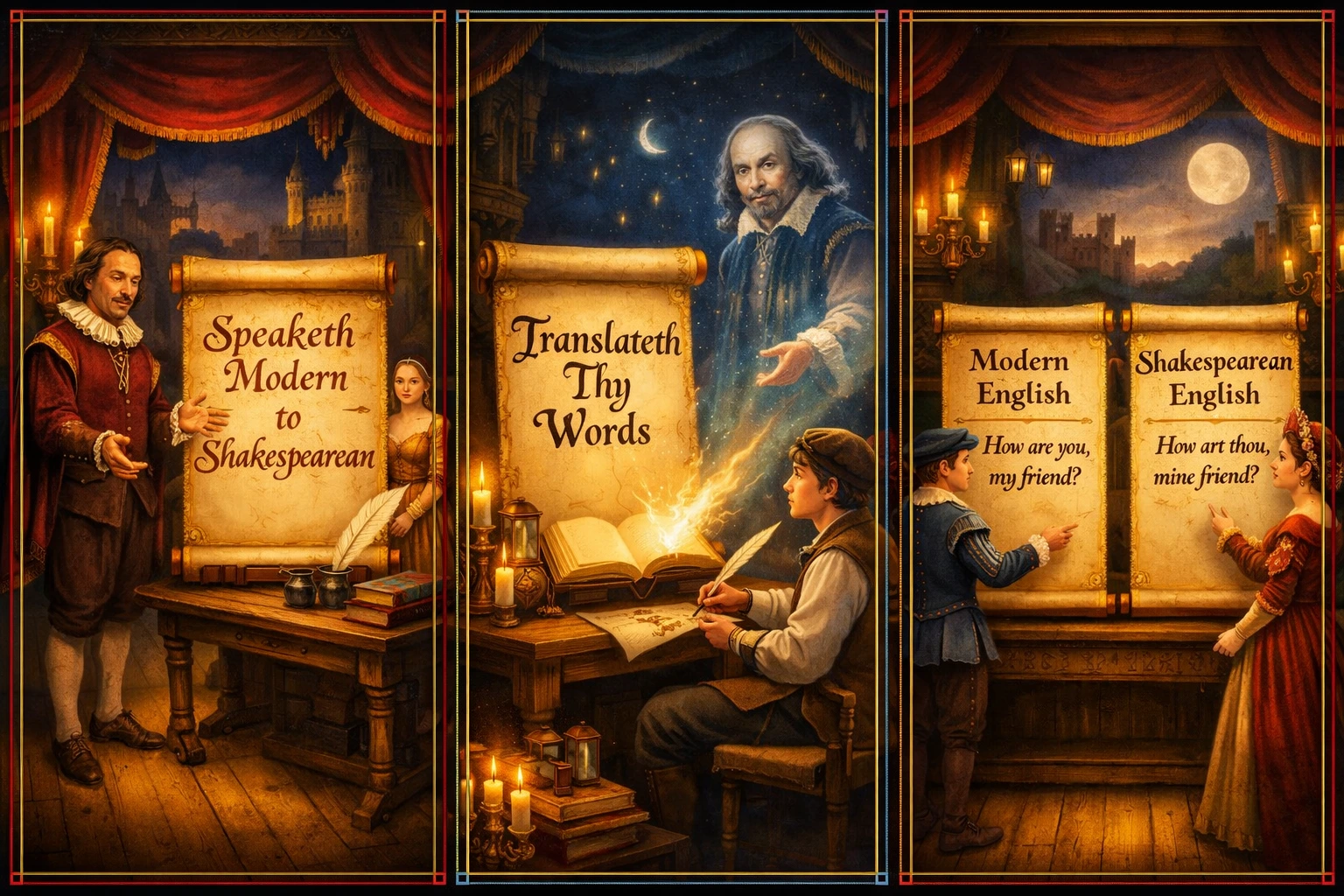
Imagine reading Hamlet for an upcoming exam or trying to perform a scene from Macbeth in your drama class. You hit a block of dialogue that makes your brain freeze. It feels archaic and out of reach. But it doesn't have to be. Shakespeare was not writing in a secret code; he was writing in the common language of his era. Understanding it simply requires a bridge. This guide will walk you through the history of this historical language, explain why it remains so challenging, show you how to use a text translator to bypass the struggle, and dissect the most famous quotes in literature with side-by-side modern translations.
What Is a Shakespearean English Translator?
At its core, a Shakespearean English Translator is a specialized online translator designed to convert the archaic vocabulary and syntax of the late 16th and early 17th centuries into plain, contemporary modern English. It serves as both a word translator for looking up specific terms like dost, hath, or wherefore, and a full text translator for analyzing long dialogues or complex monologues from plays and sonnets.
It is important to recognize that Shakespeare did not write in Old English. Old English (sometimes called Anglo-Saxon) was spoken between 450 and 1150 AD and is almost completely unrecognizable to modern speakers. Instead, Shakespeare wrote in Early Modern English. If you want to explore the even older roots of the language, you can visit our Old English Translator Tool. If you are wondering how much the language has changed between these eras, see our comparison of Old English vs. Modern English: What's the Difference? →. However, for understanding the plays and sonnets of the Elizabethan and Jacobean eras, the Shakespearean English Translator is the exact tool you need.
By leveraging natural language processing and modern AI language models, the tool handles everything from basic pronoun swaps (such as changing thee and thou to you) to complex grammatical corrections. Rather than getting lost in glossary footnotes while reading, you can copy the text, run it through the converter, and immediately read the modern version side-by-side.
Using a reliable shakespeare language translator allows readers, students, and actors to quickly bridge the gap between Elizabethan phrasing and modern-day vocabulary. This dedicated tool provides instant, contextual translations that preserve the emotional depth of the original text while making the meaning immediately clear.
Why Is Shakespeare So Difficult to Read?
To understand why we need these tools, we must look at how the language has shifted over the last four centuries. When William Shakespeare was writing during the Elizabethan era, English was in a state of rapid transition. Grammatical rules were fluid, dictionaries did not yet exist, and writers were constantly inventing new words to express novel ideas. This process created several distinct hurdles for modern readers:
1. Archaic Vocabulary
Many words commonly used in Shakespeare's plays have either disappeared from the language or changed their meanings entirely. Pronouns like thee, thou, thy, and verbs like dost, hath, and wherefore were standard parts of speech. For instance, the word wherefore is frequently misunderstood as "where," but it actually means "why." When Juliet calls out on her balcony, she is asking why Romeo must be a Montague, not searching for his physical location.
2. Inverted Sentence Structure
Shakespeare frequently rearranged the order of words in a sentence to fit the poetic meter of his writing. In modern English, we typically follow a Subject-Verb-Object pattern (e.g., "I ate the apple"). Shakespeare, however, might write "The apple ate I" or "I the apple ate." This inversion can throw off your brain's natural reading flow, creating a massive language barrier that requires active mental translation.
3. Poetic Constraints (Iambic Pentameter)
The majority of Shakespeare's dramatic dialogues were written in blank verse, specifically structured in **iambic pentameter**. This is a rhythm consisting of ten syllables per line, alternating unstressed and stressed beats (sounding like a heartbeat: da-DUM, da-DUM, da-DUM, da-DUM, da-DUM). To maintain this strict rhythm, Shakespeare frequently dropped syllables, contracted words (such as turning over into o'er or it is into 'tis), or changed word orders. While this made the plays sound beautiful on the stage of the Globe Theatre, it makes reading them on the page highly challenging today.
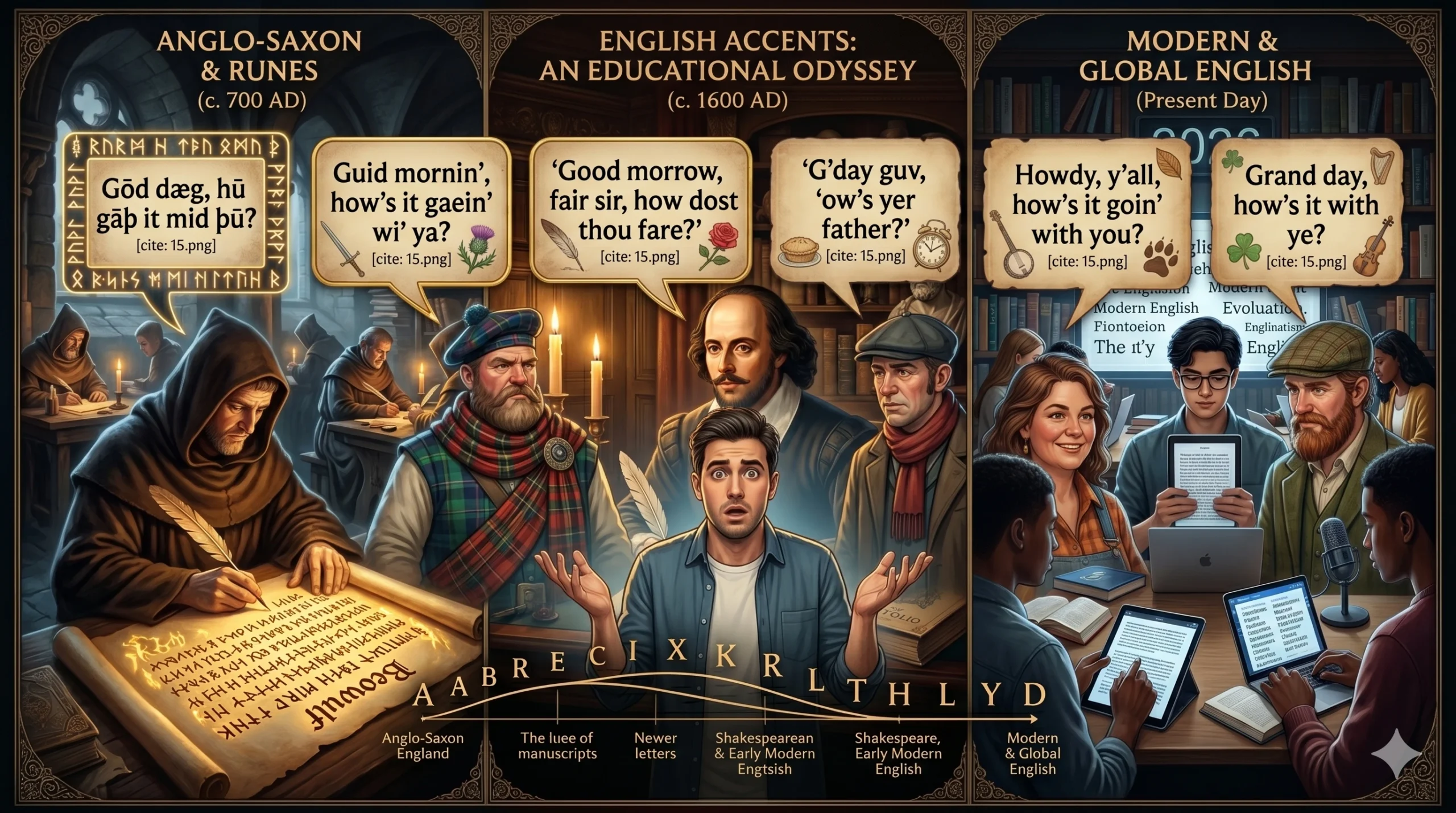
How to Use the Shakespearean English Translator (Step-by-Step)
If you are working on a creative writing project, preparing for an English literature class, or analyzing a sonnet, using our translator tool is incredibly simple. Follow these steps to bypass the confusion and read the text with total confidence:
- Find the Tool Page: Navigate to the Shakespeare English Translator. This tool is completely free and optimized for desktop and mobile browsers.
- Input Your Text: Copy the passage from the play or poem you are struggling with. Paste it into the input text box. If you want to translate your own modern writing into Elizabethan language for a creative project, you can type your modern English sentence directly into the box.
- Click Translate: Press the "Translate" button. The tool's AI language model will analyze the vocabulary, grammar, and sentence structure.
- Review the Translation: Read the output in the result box. The translator will present a clean, modern English version of the text while maintaining the correct emotional tone and context.
- Use and Learn: Hover over translated words to see their original equivalents, helping you learn the vocabulary as you read. This makes it an ideal study companion for literary analysis.
By using this step-by-step approach, you don't just get a quick answer — you actually build a better understanding of how Shakespearean grammar operates, making it easier to read future passages on your own.
Who Benefits Most from a Shakespearean English Translator?
Because Shakespeare's works are so deeply integrated into education, theater, and modern culture, a wide variety of readers rely on translation tools to help them navigate the text. Here is how different groups use the tool to make their lives easier:
- Students: Reading plays like Hamlet, Macbeth, or Romeo and Juliet is a staple of high school and college English courses. When you are writing a literary analysis paper, you cannot afford to misunderstand a character's motives. The translator acts as a digital tutor, verifying that your interpretation of the dialogue is correct before you begin writing.
- Actors and Directors: Performing Shakespeare requires understanding the exact emotional intent behind every syllable. If an actor doesn't know what a word means, their delivery will fall flat. The text translator allows actors to quickly decode their monologues, finding the subtext and emotional core necessary for a powerful performance on stage.
- Teachers: Preparing lesson plans for historical dramas can be time-consuming. Teachers use the translator to quickly generate side-by-side reading guides, vocabulary worksheets, and comprehension quizzes for their classes, saving hours of manual translation work.
- Writers and Creatives: If you are working on a piece of historical fiction, a fantasy novel, or a script set in the Elizabethan era, you might want to sprinkle in archaic vocabulary to add flavor. Using the translator to translate modern English into Shakespearean dialogue ensures that your characters sound authentic without making embarrassing grammatical mistakes.
Common Shakespearean Words and Their Modern English Meanings
While the translator handles long blocks of text automatically, learning a few common terms can greatly improve your reading speed. Here is a handy reference table of archaic vocabulary you will encounter in almost every play:
| Shakespearean Word | Modern English Meaning | Example Usage in Context |
|---|---|---|
| Thee / Thou | You (singular / informal) | "I love thee." (I love you.) |
| Thy / Thine | Your / Yours | "To thine own self be true." (Be true to yourself.) |
| Dost / Doth | Do / Does | "The lady doth protest too much." (The lady protests too much.) |
| Hath | Has | "He hath a heart of gold." (He has a heart of gold.) |
| Wherefore | Why (not where) | "Wherefore art thou Romeo?" (Why are you Romeo?) |
| Prithee | Please / I pray thee | "I prithee, speak." (Please, speak.) |
| Forsooth | In truth / Indeed | "Forsooth, a noble knight." (Indeed, a noble knight.) |
| Mayhaps | Perhaps / Maybe | "Mayhaps we shall meet again." (Perhaps we will meet again.) |
| Anon | Soon / Shortly | "I come, anon!" (I am coming soon!) |
| Hark | Listen / Pay attention | "Hark! What light through yonder window breaks?" (Listen! What light breaks through that window?) |
Memorizing just these ten terms will dramatically reduce the number of times you have to pause while reading. For everything else, the Shakespearean English Translator has you covered.
Famous Shakespearean Quotes — Translated Into Plain Modern English
You've probably heard these famous lines quoted in movies, books, and pop culture. But do you know what they actually mean in the context of the plays? Here is what Shakespeare was really saying — translated into the English we speak today:
| Original Shakespearean Line | Play & Source | Modern English Translation | Brief Context & Meaning |
|---|---|---|---|
| "To be, or not to be, that is the question." | Hamlet, Act 3, Scene 1 | "Should I stay alive or end my life — that is what I'm trying to decide." | Hamlet is contemplating suicide and the meaning of existence during his darkest moment. |
| "Wherefore art thou Romeo?" | Romeo and Juliet, Act 2, Scene 2 | "Why are you Romeo? (Why must you be a Montague?)" | Juliet laments that the boy she loves belongs to the rival family. "Wherefore" means "why," not "where" — a common misunderstanding the translator instantly clarifies. |
| "All the world's a stage, and all the men and women merely players." | As You Like It, Act 2, Scene 7 | "Life is like a theater performance, and every person is just an actor playing a temporary role." | Jacques delivers this philosophical speech comparing the seven stages of human life to acts in a play. |
| "Et tu, Brute?" | Julius Caesar, Act 3, Scene 1 | "Even you, Brutus?" or "You too, Brutus?" | Caesar's dying words upon realizing his trusted friend Brutus is among his assassins — a moment of ultimate betrayal. |
| "What's in a name? That which we call a rose by any other name would smell as sweet." | Romeo and Juliet, Act 2, Scene 2 | "Does a name really matter? A rose is still a rose no matter what you call it — and Romeo would still be wonderful even if he weren't called a Montague." | Juliet argues that Romeo's family name is just a label, and it shouldn't define who he is. |
| "This above all: to thine own self be true." | Hamlet, Act 1, Scene 3 | "Most importantly — be honest with yourself and stay true to who you are." | Polonius gives this advice to his son Laertes before he departs for France. It remains one of Shakespeare's most quoted life lessons. |
| "The lady doth protest too much, methinks." | Hamlet, Act 3, Scene 2 | "I think the woman is making too many promises and denials — it feels insincere." | Queen Gertrude comments on a character in a play who over-insists she'll never remarry — ironic, since Gertrude herself remarried quickly after her husband's death. |
| "Good night, good night! Parting is such sweet sorrow." | Romeo and Juliet, Act 2, Scene 2 | "Goodnight! Saying goodbye is painful, yet somehow beautiful at the same time." | Juliet says farewell to Romeo from her balcony, capturing the bittersweet pain of loving someone you can't be with freely. |
| "We know what we are, but know not what we may be." | Hamlet, Act 4, Scene 5 | "We understand who we are right now, but we have no idea who we might become." | Ophelia speaks these words during her descent into madness — a haunting reflection on identity and an uncertain future. |
| "Cowards die many times before their deaths; the valiant never taste of death but once." | Julius Caesar, Act 2, Scene 2 | "Cowards suffer through fear over and over again. Brave people only experience true death once." | Caesar dismisses his wife's fears about an assassination prophecy, declaring that he refuses to live in fear. |
All of these lines — and thousands more — can be translated instantly using the Shakespearean English Translator. Try it free here →
Translate Into English: Bridging the Gap Between Old and New
The broader concept of translating older styles of English into contemporary prose is a vital part of language study. Language is a living thing; it grows, adapts, and sheds parts of itself over time. When we use online translation tools to translate in English or translate that to English, we aren't just decoding a text; we are looking at our own language's history.
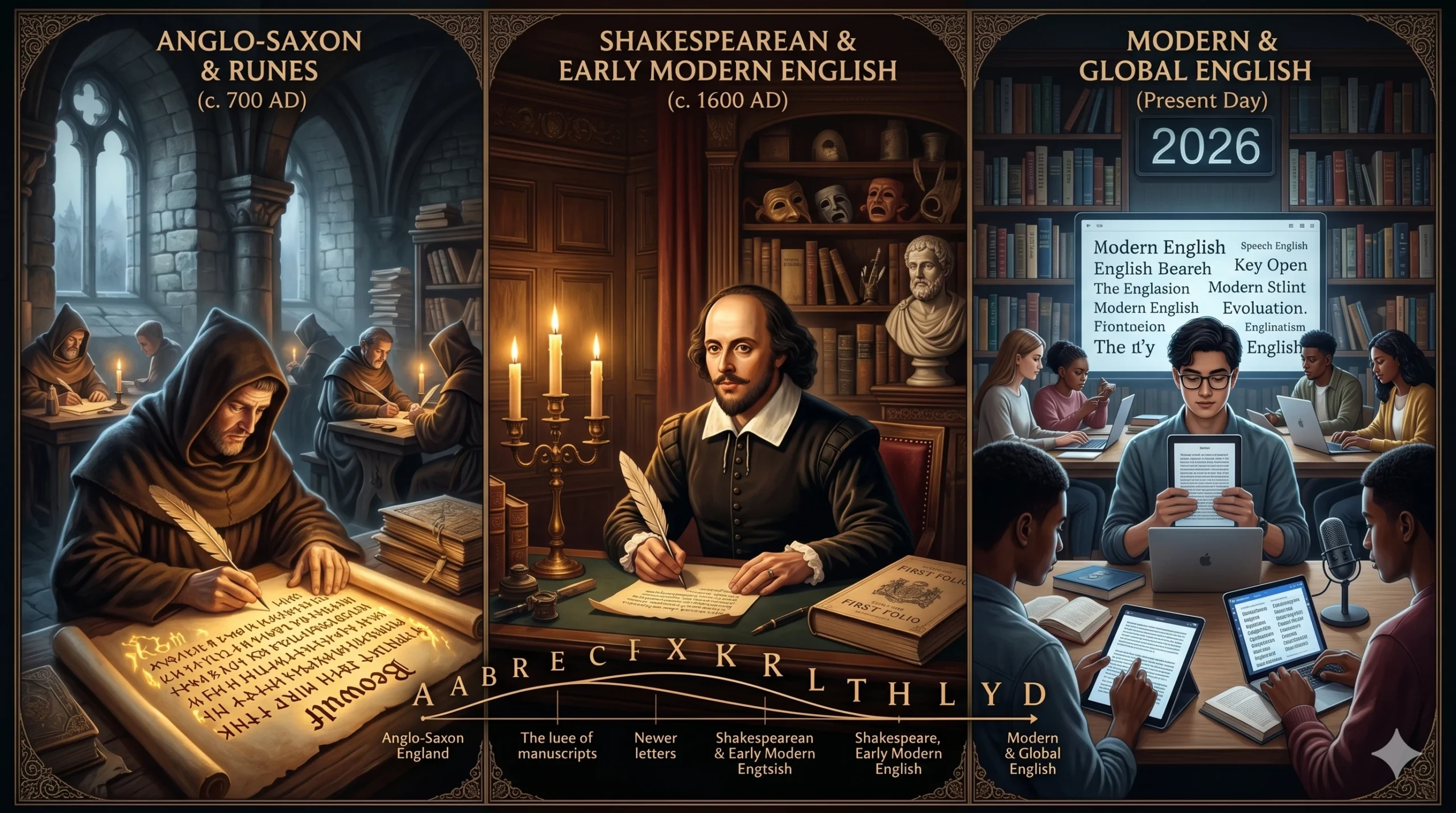
Many readers turn to search engines looking for a generic "old English translator," not realizing that English has distinct developmental periods. Using a tool set for the wrong era will give you incorrect results. If you try to paste Shakespeare into an Anglo-Saxon translator, the tool will fail because the grammar and vocabulary are completely different. That's why having specialized translation tools for each major period is essential. Our platform provides tailored engines to handle both the Old Germanic roots of the Anglo-Saxon era and the lyrical Early Modern English of the Elizabethan stage, giving you the highest translation accuracy possible.
Try the Shakespearean English Translator Free — Right Now
You don't need to feel intimidated by Shakespeare anymore. You don't need to spend hours parsing through glossaries or reading confusing academic guides just to understand a single scene. The tools to unlock these classic works are right at your fingertips.
Whether you are trying to finish a homework assignment, prepare a monologue for an audition, write a historical piece, or simply read the plays for your own enjoyment, our converter is designed to make the process completely stress-free. Paste your text, click translate, and watch the language barrier vanish.
Ready to get started? Navigate to the Shakespeare English Translator tool page right now. Start translating now — it's free.
Conclusion
Reading William Shakespeare should be an exciting journey into drama, passion, and human nature, not a chore. The stories he wrote — of young love, betrayals, ambitions, and madness — are just as relevant today as they were when they were performed on the wooden stage of the Globe Theatre. The only thing standing in your way is the evolution of the words themselves.
By using the Shakespearean English Translator, you remove the barrier and let the story shine. And if your linguistic curiosity extends even further back in time, don't forget to visit our Old English Translator Tool to discover the Germanic origins of our mother tongue. The history of English is a fascinating story — and now, you have the tools to read it.
Try the Free Shakespeare English Translator
Experience the plays and sonnets as they were meant to be understood. Decode the language of Shakespeare instantly.
Translate Shakespeare Now
Frequently Asked Questions
- Thou: Used as the subject of the sentence (e.g., “Thou art wise”).
- Thee: Used as the object of a verb or preposition (e.g., “I love thee” or “to thee”).
- Thy/Thine: Possessive forms meaning "your" (e.g., “thy sword” or “thine honor”).
- Mine: Used before words starting with a vowel sound or the letter H to keep the sound flowing smoothly (e.g., “mine eyes,” “mine honor”).
- My: Used before words starting with consonant sounds (e.g., “my friend,” “my sword”).
Academic References & Further Reading
- 📖 Explore historical Anglo-Saxon vocabulary in the Bosworth-Toller Old English Dictionary.
- 🎓 Review linguistic research and texts at the Dictionary of Old English (DOE) Project at the University of Toronto.
- 🏛️ Verify historical medieval names and etymologies using the Prosopography of Anglo-Saxon England (PASE).
- 🎭 For Shakespearean and Elizabethan studies, consult resources at the Folger Shakespeare Library and Shakespeare's Words dictionary.