The short answer: What is Old English? Old English — also called Anglo-Saxon — is the earliest form of the English language, spoken and written in England from roughly 450 AD to 1150 AD. It is the direct ancestor of Modern English, yet it looks so foreign to most readers today that it might as well be a different language entirely. Words like hūs (house), nama (name), and wīf (woman) survived the centuries. Thousands more were left behind. This guide tells you everything you need to know — and shows you where to translate it using the free Old English Translator Tool at PartnerHoursGuide.com.
Table of Contents
- A Language You Already Know — Even If You Don't Know It
- What is Old English? — The Clear Definition
- A Brief History of Old English
- What Made Old English Different From Modern English?
- Old English Common Phrases and Words
- Old English vs. Shakespearean English
- How to Translate Old English Today
- Old English Words We Still Use Today
- Frequently Asked Questions
A Language You Already Know — Even If You Don't Know It
Imagine you're walking through a thousand-year-old forest. The trees are familiar — oak, ash, thorn — but the names carved into the bark look strange. The roots, though? They're the same roots beneath your feet today.
That's what Old English feels like.
Most people encounter Old English for the first time and think: this can't possibly be English. It looks like Viking runes. It reads like a language designed to confuse. But here's the truth that linguists don't always lead with: roughly 30% of the most common words you use every day — love, water, earth, man, woman, child, bread, home — trace directly back to Old English. This language isn't dead. It's embedded in your bones.
If you've ever wondered what your favorite Shakespearean quote really means, or wanted to write something in the original, ancestral form of English, understanding what Old English is — really is — changes everything.
What is Old English? — The Clear Definition
Old English (also known as Anglo-Saxon) is the earliest historical form of the English language. It was spoken in England and southern Scotland from approximately 450 AD — when Germanic tribes migrated to Britain — until roughly 1150 AD, when it gradually evolved into Middle English following the Norman Conquest of 1066. It belongs to the West Germanic branch of the Indo-European language family, making it a close relative of Old High German, Old Frisian, and Old Saxon.
Old English is not simply "old-fashioned" English. It is linguistically distinct — a separate stage of the language with its own grammar, vocabulary, alphabet, and poetry tradition. Scholars typically divide its development into four major dialects: Northumbrian, Mercian, Kentish, and West Saxon (the prestige literary dialect in which most surviving texts are written).
Key Fact: Old English is often confused with "Early Modern English" — the language of Shakespeare (c. 1500–1700). They are not the same. Old English predates both Middle English (Chaucer) and Shakespearean English by centuries. For Shakespeare-era translation, use the Shakespeare English Translator at PartnerHoursGuide.com. For genuine Anglo-Saxon Old English, use the Old English Translator Tool.
A Brief History of Old English
To understand what Old English is, you need to understand who brought it. The story begins not in England, but across the North Sea.
450 AD — The Germanic Migration
Angles, Saxons, and Jutes from what is now Denmark and northern Germany crossed the North Sea and settled in Britain, bringing their Germanic dialects. These merged into what we now call Old English.
597 AD — Christian Influence and Latin
The arrival of St. Augustine brought Latin ecclesiastical vocabulary into Old English — words for religion, scholarship, and medicine that enriched the language's range considerably.
793 AD — Viking Invasions and Old Norse
Norse raids and later settlement introduced Old Norse words into the language — giving us "sky," "egg," "knife," and "husband." The Danelaw region became a crucible of linguistic fusion.
1066 AD — The Norman Conquest
William the Conqueror's invasion brought Norman French to England's ruling class. Old English didn't disappear — but it began the slow transformation into Middle English, absorbing thousands of French and Latin words.
~1150 AD — The End of Old English
By approximately 1150 AD, the linguistic changes were significant enough that scholars identify a new stage: Middle English. Old English as a living form of communication had given way — but it never truly vanished.
"Hwæt! Wē Gār-Dena in geār-dagum, þēodcyninga, þrym gefrūnon."
— Opening lines of Beowulf (c. 700–1000 AD)
Translation: "Listen! We have heard of the glory of the Spear-Danes' kings in days of yore."
What Made Old English Different From Modern English?
If you set a page of Old English beside a page of Modern English, you'd see striking differences immediately. See how Old English compares to Modern English →. But the deeper differences are grammatical — and they explain why learning Old English feels more like learning German than simply reading archaic English.
1. Old English Was a Highly Inflected Language
Modern English relies heavily on word order to communicate meaning: "The dog bites the man" means something very different from "The man bites the dog." Old English relied on inflectional endings — suffixes attached to nouns, pronouns, and adjectives — to signal grammatical relationships. Word order was far more flexible as a result.
2. Grammatical Gender
Like Latin or German, Old English assigned grammatical gender (masculine, feminine, neuter) to nouns — often with no obvious logic. The word for "woman" (wīf) was grammatically neuter. The word for "wife" (cwēn, from which we get "queen") was feminine. Adjectives and determiners had to agree with the gender of the noun they modified.
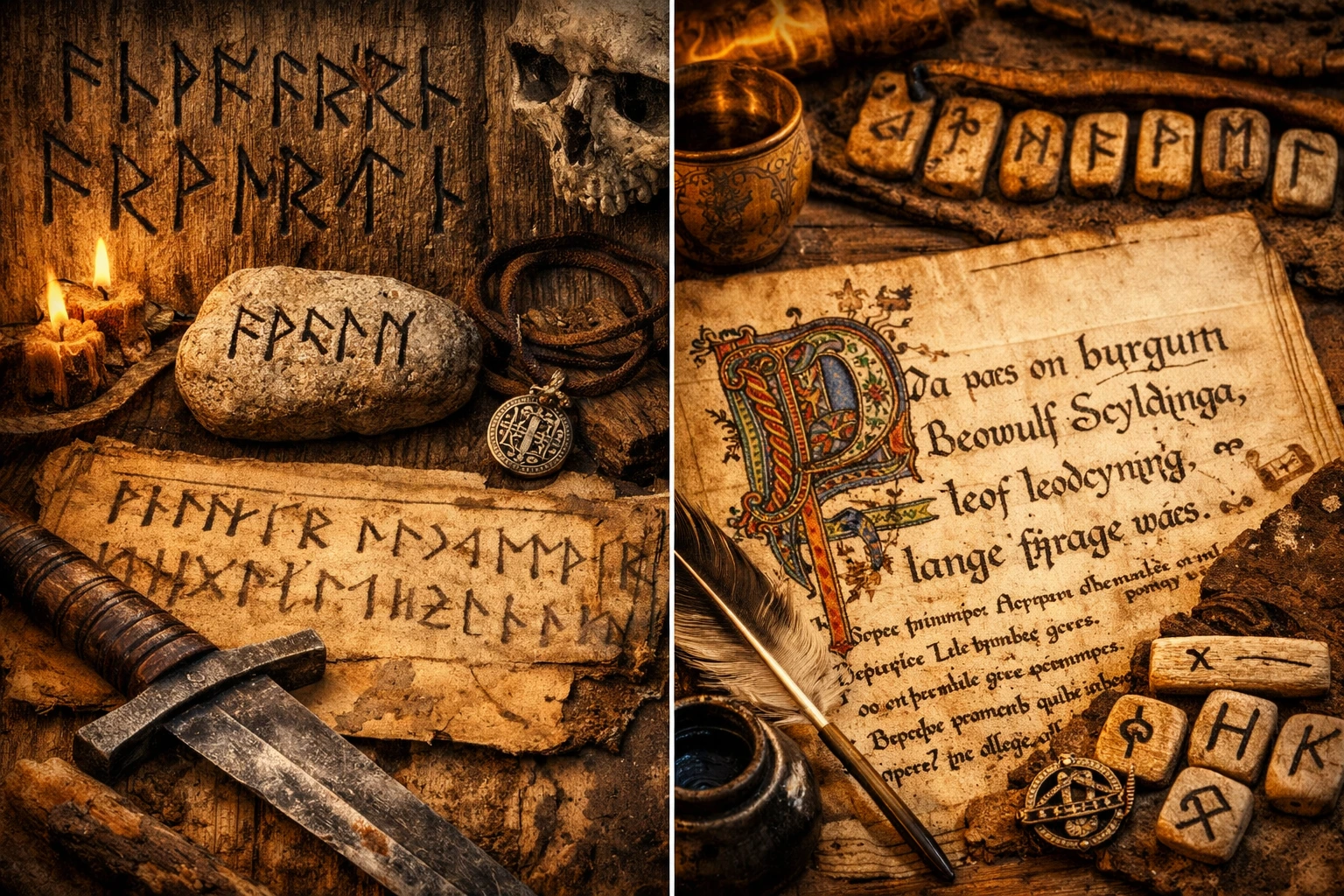
3. The Old English Runic and Futhorc Alphabet
Early Old English used a runic alphabet called the Futhorc. After Christianization, it adopted the Latin alphabet with several unique letters: þ (thorn, pronounced "th"), ð (eth, also "th"), and Æ¿ (wynn, the "w" sound). Seeing these characters in text is one of the surest signs you're looking at genuine Old English. For those looking for an Old English keyboard or Old English type letters, these characters can be inserted using Unicode on most systems. The PartnerHoursGuide Old English Translator handles these characters natively.
4. A Rich Tradition of Compound Words — Kennings
Old English poetry used kennings — evocative compound descriptions in place of simple nouns. The sea was the hronrād ("whale-road"). A ship was a sǣhengest ("sea-stallion"). A sword was the hildeleoma ("battle-light"). This poetic device survives in a diluted form in modern compounds like "sunlight" and "heartfelt."
Old English Common Phrases and Words
Here are real Old English common phrases and words — including some that are still recognizable today. These appear frequently in Old English texts and are excellent entry points for anyone beginning to study the language.
| Old English | Modern English | Context / Notes |
|---|---|---|
| Hwæt! | Listen! / Attend! | Classic opening of Beowulf and other Old English poems |
| Gōd dæg | Good day | A common greeting; root of "good day" in Modern English |
| Hām | Home | The Old English word for home; root of "hamlet" and "home" |
| Mīn hām | My home | Old English for home with the possessive "mīn" (my) |
| Ūre | Our | The Old English word for our — direct ancestor of modern "our" |
| Mīn | My / Mine | Survives nearly unchanged into Modern English |
| Sōðlīce | Truly / Verily | Used in Old English scripture and elevated speech |
| On þissum | In / Within this | Equivalent of "within" in Old English |
| Wyrd bið ful ārǣd | Fate is wholly inexorable | From The Wanderer — one of the most quoted Old English sentences |
| Ä’adige sind þā ġesibsuman | Blessed are the peacemakers | From the Anglo-Saxon Gospels |
| Wōden | Wednesday (Woden's day) | Old English for the Norse god Odin; survived in day names |
| Eorþe | Earth | Direct root of the Modern English "earth" |
Old English Words No Longer Used — A Sample
Thousands of Old English words were lost after the Norman Conquest, replaced by French equivalents. These are some of the most evocative Old English words no longer used in everyday Modern English:
Uhtceare — Pre-dawn anxiety; lying awake worrying before the sun rises. There is no single Modern English equivalent for this word.
Weorðmynd — The state of being esteemed and worthy; an inner dignity that commands respect. Modern English replaced this with the French-derived "honour."
Drēogan — To bear a hardship with patience and resilience over time. To endure, to suffer through.
Frēondscipe — Loyal companionship with an almost sacred weight — closer to brotherhood than casual friendship.
Mōdcræft — Literally "mind-craft." The skill and power of the intellect; intelligence and wisdom combined.
Gāstcyning — "Spirit-king." Used in sacred poetry to describe the divine; a deeply poetic compound noun.
Old English vs. Shakespearean English — What's the Difference?
This is the question that trips up almost everyone. And it matters — because if you need to translate Shakespearean to English, you're dealing with a completely different language stage than if you need an old english to english translator for an Anglo-Saxon manuscript.
Here's the clearest way to understand the difference:
| Language Stage | Era | Example | Readable Today? |
|---|---|---|---|
| Old English (Anglo-Saxon) | 450–1150 AD | Hwæt! Wē Gār-Dena | No — requires translation |
| Middle English (Chaucer) | 1100–1500 AD | Whan that Aprill | With effort / partial |
| Early Modern English (Shakespeare) | 1500–1700 AD | Methinks thou dost protest | Mostly yes, with help |
| Modern English | 1700–present | I think you're overreacting | Yes — fully |
When people say "Old English," they often mean the formal, antiquated style of Early Modern English — thee, thou, dost, hath. That is technically Shakespearean or Elizabethan English, not Old English. Both are fascinating. Both require different tools to navigate.
For Shakespearean to English translation, visit the Shakespeare English Translator at PartnerHoursGuide.com. For genuine Old English text translation from the Anglo-Saxon period, use the Old English Translator Tool.
How to Translate Old English Today
Whether you're researching genealogy, writing historical fiction, studying linguistics, or simply curious, translating Old English has never been more accessible. Here's a practical guide to the tools and approaches that work best.
1. Use a Dedicated Old English Translator Tool
The fastest and most practical option for most people is an online translator. The Old English Translator Tool at PartnerHoursGuide.com lets you quickly translate English to Old English, work with Old English phrases, and decode Old English sentences — free, with no account required. It's ideal for common translations and learning.
2. Use an Old English Dictionary
For rigorous research, the Bosworth-Toller Anglo-Saxon Dictionary (available online at bosworthtoller.com) remains the gold standard — a 19th-century scholarly lexicon that has been fully digitized. The Dictionary of Old English (University of Toronto) is the modern academic authority, covering the entire corpus letter-by-letter.
3. Learn Key Grammar Rules
If you're translating Old English sentences regularly, a working knowledge of Old English grammar — particularly noun cases (nominative, accusative, genitive, dative) and verb conjugation — will dramatically improve your accuracy. Resources like Sweet's Anglo-Saxon Primer and Mitchell & Robinson's Guide to Old English are accessible starting points for self-study.
4. For Shakespearean English
If you're looking to translate Shakespearean to English or decode Early Modern English phrases, use the Shakespeare English Translator at PartnerHoursGuide.com — purpose-built for Early Modern English vocabulary and syntax, and entirely distinct from Old English tools.
Old English Words We Still Use Today — The Invisible Inheritance
Old English is often described as a "dead language," but that framing misses something profound. Yes, you can't walk into a coffee shop in London and order in pure Anglo-Saxon. But the bones of Old English are inside every sentence you speak.
Consider these everyday Modern English words and their Old English origins:
| Modern Word | Old English Origin | Old English Meaning |
|---|---|---|
| Home | hām | Village, estate, dwelling |
| Love | lufu | Love, affection, desire |
| Earth | eorþe | Ground, world, soil |
| Child | cild | Child, infant |
| Water | wæter | Water |
| Man | mann | Human being (any gender) |
| Night | niht | Night, darkness |
| Dream | drēam | Joy, music, revelry (not sleep visions!) |
| Weird | wyrd | Fate, destiny |
| Bread | brēad | Bread, morsel of food |
Notice something striking about dream? In Old English, drēam meant joy and music — the modern meaning of sleep visions came from Old Norse influence. And wyrd — the word that gave us "weird" — originally meant fate or destiny, not strangeness. These etymological twists reveal how a language carries entire centuries of history inside its syllables.
The Old English word for home — hām — also survives in English place names ending in "-ham" (Birmingham, Nottingham, Chatham) and in the word "hamlet," meaning a small settlement. When you say the word "home," you are reaching back more than a thousand years.
To explore the full collection of surviving Old English vocabulary still active in Modern English, read our dedicated guide: Old English Words We Still Use Today →
What is Old English? — The Summary
Old English is the root from which the entire English language grew. Spoken between 450 and 1150 AD by Anglo-Saxon settlers in Britain, it evolved from West Germanic dialects, absorbed Latin and Old Norse influences, and eventually transformed — under the pressure of Norman French — into the language you're reading now.
It's inflected, grammatically gendered, and filled with poetry that rivals anything written since. It gave us words we use every day without ever noticing their age. And today, with the right tools, it's more accessible to curious readers and researchers than it has ever been.
Whether you're translating an Old English text, exploring Old English common phrases for creative writing, decoding historical records for genealogy, or simply satisfying a deep linguistic curiosity — you now have the foundation. And when you're ready to try it yourself, the tools are free and waiting.
Use the Old English Translator Tool at PartnerHoursGuide.com to translate English to Old English, decode Old English phrases, or explore the old English sentence structures that built the language you speak today.