Famous Old English Text Translations: Beowulf, Prayers & Manuscripts Decoded
Exploring Famous Old English text translations allows us to discover the earliest foundations of the English language — from the heroic verses of Beowulf to historical chronicles and sacred prayers. If you have ever used an old english translator or searched for english to old english conversion tools, you have probably wondered: what did real Old English actually look like in use?
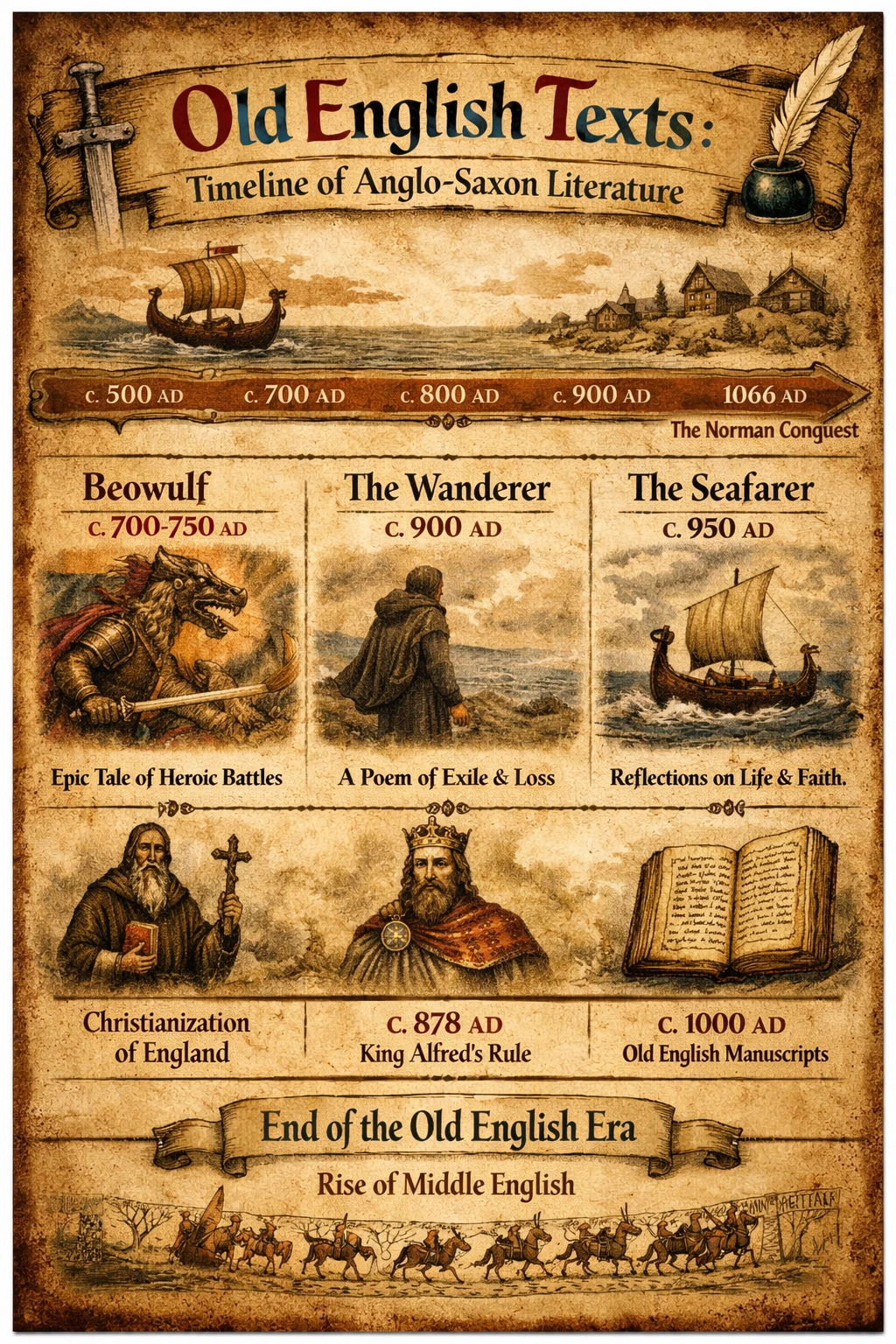
Famous Old English text translations — manuscripts that shaped the English language
—
Famous Old English Text Translations Every Enthusiast Should Know
If you have ever used an old english translator or searched for english to old english conversion tools, you have probably wondered: what did real Old English actually look like in use? What did the Anglo-Saxons write, and how do those words translate into the language we speak today?
Old English — also written as Englisc or Anglo-Saxon — was spoken and written in what is now England and Southern Scotland from roughly 450 AD to 1100 AD. It was not simply an older version of English. It was a separate language, inflected and complex, using letters like þ (thorn) and ð (eth) that have since vanished from the old english alphabet.
This guide walks through the most significant surviving texts in Old English, providing the original lines, word-for-word modern English translations, and the cultural context that makes each one important.
—
1. Beowulf — The Greatest Old English Text Translation
No list of famous old english text translations is complete without Beowulf. This epic poem is the cornerstone of Old English literature — and the single most studied piece of Anglo-Saxon writing in existence.
Background
Beowulf survives in a single manuscript, the Nowell Codex, held at the British Library. It is estimated to have been composed between 700 and 1000 AD, with the surviving manuscript dating to around 1000 AD. The poem spans 3,182 lines and follows the hero Beowulf of the Geats as he battles the monster Grendel, Grendel’s mother, and finally a fire-breathing dragon.
The Famous Opening — Original Old English
**Hwæt! Wē Gār-Dena in geārdagum,**
**þēodcyninga, þrym gefrūnon,**
**hū ðā æþelingas ellen fremedon.**
Word-for-Word Old English Translation to Modern English
*Listen! We have heard of the glory of the Spear-Danes’ kings in days of yore — how those princes performed deeds of courage.*
Key Old English Words from Beowulf
| Old English | Modern English | Notes |
|---|---|---|
| Hwæt | Listen / Lo / So! | Famous opening interjection |
| Gār | Spear | Root of “Gareth” and similar names |
| þēodcyninga | Of people-kings | Compound: þēod (people) + cyning (king) |
| æþelingas | Princes / noblemen | Root of “Ethel” (noble) |
| ellen | Courage / zeal | Still survives in the name Ellen |
| geārdagum | Days of yore / in former times | Gear (year) + dagum (days) |
Why Beowulf matters for the old english translator community: The poem demonstrates how far Old English has evolved. Words like cyning (king), mann (man), and hūs (house) are recognizable to modern readers — but the grammar, with its four-case inflection system, is almost entirely lost in modern English. The letter þ in old english (thorn, representing the “th” sound) appears throughout Beowulf and is one of the most studied aspects of old english writing.
Translation note for language learners: The line Hwæt, mīn frēond (“Listen, my friend”) — displayed on our homepage — is drawn directly from this tradition. If you want to translate into old english a phrase like “my friend,” the Old English is mīn frēond, where frēond is the direct ancestor of the modern word “friend.”
—
2. The Lord’s Prayer in Old English — Fæder Ūre
One of the most searched famous old english text translations is the Lord’s Prayer. Because it is a text that most people already know in modern English, it offers a uniquely clear window into how dramatically the language has changed.
Original Old English (West Saxon dialect, c. 10th century)
**Fæder ūre þū þe eart on heofonum,**
**Sī þīn nama gehālgod.**
**Tōbecume þīn rīce.**
**Gewurþe þīn willa on eorðan swā swā on heofonum.**
**Ūrne gedæghwāmlīcan hlāf syle ūs tō dæg.**
**And forgyf ūs ūre gyltas, swā swā wē forgyfað ūrum gyltendum.**
**And ne gelǣd þū ūs on costnunge,**
**ac ālȳs ūs of yfele. Sōþlīce.**
Modern English Translation
*Our Father, you who are in the heavens, may your name be hallowed. May your kingdom come. May your will be done on earth as in the heavens. Give us our daily bread today. And forgive us our sins, as we forgive those who sin against us. And do not lead us into temptation, but deliver us from evil. Truly.*
Key Old English Words from the Lord’s Prayer
| Old English | Modern English | Notes |
|---|---|---|
| Fæder | Father | Direct ancestor of modern “father” |
| heofonum | Heavens | Note the dative plural ending “-um” |
| hlāf | Bread / loaf | “Loaf” survives in modern English |
| gyltas | Sins / guilts | Root of modern English “guilt” |
| yfele | Evil | Same root, inflected form |
| rīce | Kingdom / realm | Related to German “Reich” |
Old English grammar note: The dative plural ending -um appears in heofonum (heavens) and gyltendum (those who sin). This is one of the four cases in Old English noun declension — the system that the old english dictionary and anglo saxon translator tools must account for when translating inflected text. It is also why an early modern english translator produces different results than a true Old English translator.
—
3. The Dream of the Rood — Old English Religious Poetry
The Dream of the Rood is one of the oldest Christian poems in the old english tradition and among the most moving pieces of religious writing in any language. The narrator encounters the Cross of Christ in a dream — and the Cross itself speaks.
Original Old English (excerpt)
**Þūhte mē þæt ic gesāwe syllicre trēow**
**on lyft lǣdan, lēohte bewunden,**
**bēama beorhtost.**
Modern English Translation
*It seemed to me that I saw a wondrous tree lifted into the air, wound about with light, the brightest of beams.*
Key Old English words decoded
| Old English | Modern English |
|---|---|
| Þūhte | Seemed / appeared |
| syllicre | More wondrous / remarkable |
| trēow | Tree / beam / cross |
| lēohte | Light |
| bēama | Of beams / trees |
Why this matters for old english example study: The Dream of the Rood is remarkable because a version of it is also inscribed in runic script on the Ruthwell Cross in Scotland — making it one of the few Old English texts that survives in both old english writing on vellum and old english letter runic carving in stone. It predates the manuscript version by over two centuries.
—
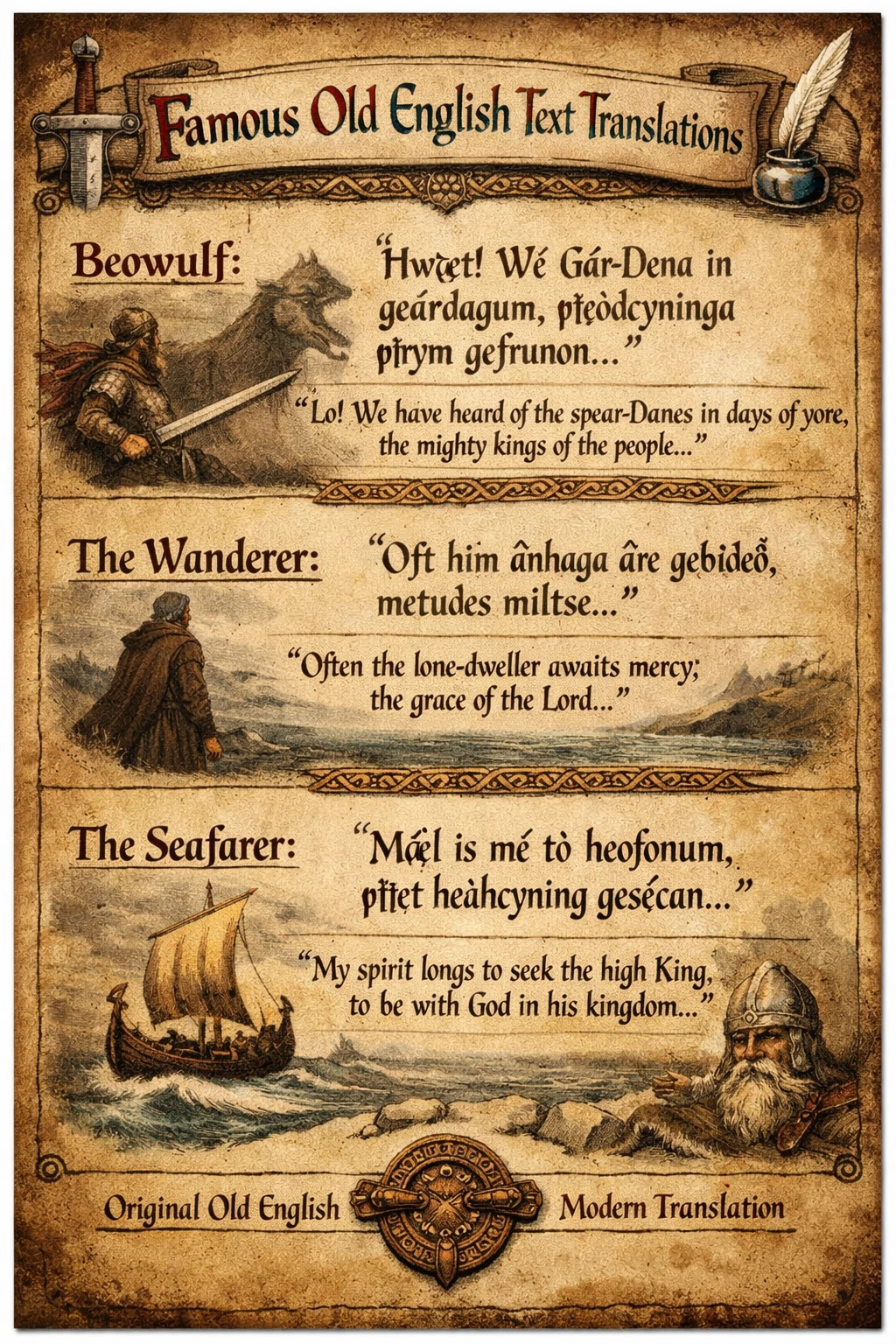
Anglo-Saxon manuscripts containing famous Old English text translations
—
4. The Wanderer — Elegy in Old English
The Wanderer is a poem of loss, exile, and meditative wisdom. It is one of the finest old english elegies and a favourite among students studying how old english language expresses emotion.
Original Old English (opening)
**Oft him ānhaga āre gebīdeð,**
**metudes miltse, þēah þe hē mōdcearig**
**geond lagulade longe sceolde**
**hrēran mid hondum hrīmcealde sǣ.**
Modern English Translation
*Often the solitary one awaits grace for himself, the mercy of God, even though he, sorrowful in spirit, must for a long time stir with his hands the ice-cold sea across the waterways.*
Key vocabulary for old english translation study
| Old English | Modern English |
|---|---|
| ānhaga | Solitary one / lone-dweller |
| miltse | Mercy / grace |
| mōdcearig | Sad of spirit / sorrowful |
| lagulade | Sea-paths / waterways |
| hrīmcealde | Frost-cold / rime-cold |
Cultural note: The compound word hrīmcealde — literally “rime-cold,” meaning frozen — is a characteristic feature of old english words: two-part compounds that stack meaning. These old english example compound words gave English much of its descriptive vocabulary. Fantasy authors, particularly those following Tolkien’s tradition, draw heavily on this compounding technique. J.R.R. Tolkien himself used Old English as the direct basis for Rohirric in The Lord of the Rings.
—
5. The Anglo-Saxon Chronicle — History in Old English
If Beowulf represents the poetic tradition of famous old english text translations, the Anglo-Saxon Chronicle represents the historical. Commissioned by King Alfred the Great around 890 AD, it is the first major work of history written in English rather than Latin.
Famous Entry — 793 AD (The Viking Raid on Lindisfarne)
Original Old English
**Her wæron reðe forebēacnu cumene ofer Norþanhymbra land, ⁊ þæt folc ēarmīce bregdon; þæt wǣron ormǣte þodenas ⁊ ligrescas, ⁊ fȳrdrācas wǣron geseowene on þām līfte flēogende.**
Modern English Translation
*In this year dreadful omens came over the land of Northumbria, and they sorely terrified the people; there were immense flashes of lightning, and fiery dragons were seen flying in the sky.*
Key Old English words from the Chronicle
| Old English | Modern English |
|---|---|
| reðe | Fierce / cruel |
| forebēacnu | Omens / fore-signs |
| ēarmīce | Miserably / sorely |
| bregdon | Terrified / alarmed |
| fȳrdrācas | Fire-dragons |
| līfte | Air / sky |
Translation for old english learners: The old english symbol ⁊ is the Tironian note — an abbreviation for and (equivalent to the ampersand &). It appears frequently in old english writing from the Chronicle period and is one of the first things students of old english text learn to recognize.
—
6. Alfred the Great’s Preface to Pastoral Care
King Alfred the Great was not only a military leader — he was a translator. Around 890 AD, he translated Pope Gregory’s Pastoral Care from Latin into Old English and wrote a remarkable preface explaining why he did it.
Original Old English (excerpt from Alfred’s Preface)
**Ælfred kyning hāteþ grētan Wærferð biscep his wordum luflīce ⁊ frēondlīce; ⁊ ðē cȳðan hāte ðæt mē cōm swīðe oft on gemynd, hwelce wiotan iū wǣron giond Angelcynn.**
Modern English Translation
*King Alfred commands to greet Bishop Wærferth with his words lovingly and in friendship; and I wish to make known to you that it has very often come to my mind what wise men there formerly were throughout England.*
Why this text matters
Alfred’s Preface is the first recorded statement about the importance of translation for old english texts. Alfred lamented that Latin literacy had declined so much that he could not find enough scholars to translate important texts — so he did it himself. He is, in a very real sense, the first old english translator on record.
—
7. The Battle of Maldon — Heroism in Old English
The Battle of Maldon (c. 991 AD) commemorates a real Viking raid on Essex. It is famous for a speech by the aged warrior Byrhtnoth and the poem’s unflinching portrait of loyalty in defeat.
Original Old English (Byrhtnoth’s rallying speech)
**Hige sceal þē heardra, heorte þē cēnre,**
**mōd sceal þē māre, þē ūre mægen lȳtlað.**
Modern English Translation
*Thought shall be the harder, heart the keener, spirit the greater, as our might lessens.*
This couplet is among the most quoted lines of old english poetry. It captures the heroic spirit of Anglo-Saxon culture — resolve in the face of defeat — and is regularly cited as an old english example of the warrior ethos that underpins much of early English literature.
—
How to Read Old English: Key Letters and Sounds
Understanding famous old english text translations requires knowing the special characters that no longer exist in modern English.
Special Letters in Old English
| Character | Name | Sound | Example |
|---|---|---|---|
| **þ** (Þ) | Thorn | “th” as in *thing* | **þ**ēod (people) |
| **ð** (Ð) | Eth | “th” as in *the* | ēor**ð**an (earth) |
| **æ** (Æ) | Ash | “a” as in *cat* | **æ**þeling (prince) |
| **ƿ** | Wynn | “w” | **ƿ**ord (word) |
| **ȳ** | y with macron | long “ü” sound | h**ȳ**dan (to hide) |
Old English Case System (Why Translation Is Hard)
Old English nouns changed their endings depending on their grammatical function. This is why an old english dictionary alone is not enough — you need to recognize inflected forms.
| Case | Function | Old English Example | Modern English |
|---|---|---|---|
| Nominative | Subject of sentence | **cyning** (the king does something) | “The king” |
| Accusative | Object of sentence | **cyning** (the king receives action) | “The king” |
| Genitive | Possession | **cyninges** | “Of the king / the king’s” |
| Dative | Indirect object | **cyninge** | “To/for the king” |
This is precisely why a simple english to old english word substitution does not produce grammatically accurate Old English. The old english i and letter i in old english forms, for example, change based on case and gender — something a professional old english translator tool must account for.
—
Old English vs. Early Modern English: An Important Distinction
Many people confuse Old English with Shakespearean English. These are entirely different language stages.
| Feature | Old English (c. 450–1100) | Early Modern English (c. 1500–1700) |
|---|---|---|
| Example text | *Hwæt! Wē Gār-Dena…* | *To be or not to be…* |
| Case system | Full 4-case inflection | Largely lost |
| Special letters | þ, ð, æ, ƿ | Only standard Latin alphabet |
| Mutual intelligibility | Near zero for modern speakers | High for modern speakers |
| Famous texts | Beowulf, Anglo-Saxon Chronicle | Shakespeare, King James Bible |
| Translator needed | **Old english translator** | **Early modern english translator** |
Our Shakespeare Translator handles Early Modern English. For authentic Anglo-Saxon text, use our Old English Translator.
—
Old English Names from Famous Texts
Many Anglo-Saxon names used in famous Old English texts have survived into modern usage — or inspired modern old english name male conventions.
| Old English Name | Meaning | Appears In |
|---|---|---|
| Ælfred (Alfred) | Elf-counsel | Alfred’s Preface |
| Beowulf | Bee-wolf (bear) | Beowulf |
| Hrothgar | Fame-spear | Beowulf |
| Byrhtnoð | Bright-boldness | Battle of Maldon |
| Wulfstan | Wolf-stone | Anglo-Saxon Chronicle |
| Ēadmund (Edmund) | Prosperity-protection | Anglo-Saxon Chronicle |
Use our Old English Name Finder to explore the etymologies of these and over 100 more authentic Anglo-Saxon names — with pronunciation, gender, and historical context.
—
Frequently Asked Questions About Famous Old English Text Translations
What is the most famous Old English text?
Beowulf is the most famous Old English text. Written between the 8th and 11th centuries, it is an epic poem of 3,182 lines describing the hero Beowulf’s battles against the monster Grendel and Grendel’s mother. It is held at the British Library and translated into dozens of modern languages.
What does ‘Hwæt’ mean in Old English?
‘Hwæt’ is the famous opening word of Beowulf. It is an attention-calling interjection, roughly equivalent to “Listen!”, “Lo!”, or “So!” in modern English. The letter h in old english combined with the ash vowel (æ) creates this distinctive sound.
How different is Old English from modern English?
Old English (spoken c. 450–1100 AD) is dramatically different from modern English. It used an inflected case system, special letters like þ (thorn) and ð (eth), and vocabulary that is largely unrecognizable without study. Using an old english translator or old english dictionary is essential for accurate reading.
Is the Lord’s Prayer available in Old English?
Yes. The Lord’s Prayer (Fæder ūre) exists in Old English and is one of the most studied Anglo-Saxon texts. It survives in multiple manuscripts from the 10th century and is an excellent text for translation for old english study because modern readers already know the modern version.
What is the Anglo-Saxon Chronicle?
The Anglo-Saxon Chronicle is a collection of annals in Old English recording the history of the Anglo-Saxons from Caesar’s invasion through the 12th century. Commissioned by King Alfred the Great around 890 AD, it is the oldest continuous history written in the English language.
Where can I translate English into Old English?
Use our free Old English Translator tool to translate into old english instantly. The tool supports runic script output, text-to-speech pronunciation, and side-by-side era comparison.
—
Summary: Famous Old English Text Translations at a Glance
| Text | Date (approx.) | Type | Famous For |
|---|---|---|---|
| Beowulf | 700–1000 AD | Epic poem | Oldest English epic; Grendel; Hwæt |
| The Lord’s Prayer | c. 950 AD | Religious | *Fæder ūre*; most translated Old English text |
| Dream of the Rood | c. 700 AD | Religious poem | Oldest Christian poem in English; runic inscription |
| The Wanderer | c. 900 AD | Elegy | Emotional depth; exile theme |
| Anglo-Saxon Chronicle | 890 AD+ | History | First English-language history |
| Alfred’s Preface | c. 890 AD | Prose | First statement on the value of translation |
| Battle of Maldon | c. 991 AD | Heroic poem | Warrior ethos; “Heart the keener” |
—
Try Our Free Old English Translator
Inspired by these famous old english text translations? Bring the Anglo-Saxon world to life with our tools:
- **[Old English Translator](translator.html)** — Convert modern English into the language of Beowulf, with runic output and text-to-speech
- **[Shakespeare Translator](shakespeare-converter.html)** — Translate text into Early Modern English
- **[Old English Name Finder](old-english-names.html)** — Explore authentic Anglo-Saxon names with etymology and pronunciation
- **[Old English Name Maker](blog-name-finder.html)** — Generate original names in the Anglo-Saxon tradition
—
Editorial note: All Old English text in this article is drawn from academic sources including the Nowell Codex, the Parker Manuscript of the Anglo-Saxon Chronicle, and the Vercelli Book. Translations aim for accuracy while remaining readable. For scholarly work, consult the Dictionary of Old English (University of Toronto) and the DOEC corpus.